Court Holds 50% Reservation Ceiling a Firm Constitutional Limit; Karnataka Act Raising Total Reservation to 56% Violates Articles 14, 15, and 16
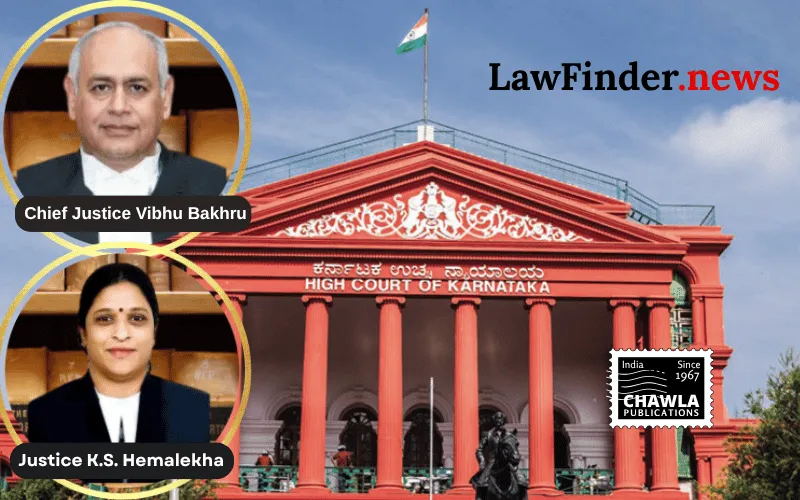
In a landmark judgment delivered on October 12, 2026, a Division Bench of the Karnataka High Court, comprising Chief Justice Mr. Vibhu Bakhru and Justice K.S. Hemalekha, declared unconstitutional the Karnataka Scheduled Castes and Scheduled Tribes (Reservation of Seats in Educational Institutions and of Appointments or Posts in the Services under the State) Act, 2022. The Act had increased the reservation for Scheduled Castes (SCs) from 15% to 17% and for Scheduled Tribes (STs) from 3% to 7%, resulting in a total reservation of 56% when combined with the existing 32% reservation for Other Backward Classes (OBCs).
The Court held that the 50% ceiling on reservation under Articles 15(4) and 16(4) of the Constitution of India is a firm constitutional rule, not a mere guideline, founded on the principles of equality and balance among all citizens. The judgment reaffirmed the binding precedents laid down by the Supreme Court, including the authoritative nine-judge bench decision in Indra Sawhney v. Union of India (1992), which established that reservation beyond 50% violates the equality clauses of the Constitution, except in extraordinary circumstances that must be clearly established.
The petitioners, including a public interest litigant and candidates who had applied for government posts under the Karnataka Public Service Commission (KPSC), challenged the Act on the grounds that it breached the constitutional limits on reservation, thereby infringing upon the fundamental rights guaranteed under Articles 14 (Right to Equality), 15 (Prohibition of Discrimination), and 16 (Equality of Opportunity in Public Employment).
The High Court extensively analyzed the constitutional provisions, historical context, and judicial precedents, including M.R. Balaji v. State of Mysore (1963), State of Kerala v. N.M. Thomas (1976), and the more recent Dr. Jaishri Laxmanrao Patil v. Chief Minister (2021). It underscored the principle articulated by Dr. B.R. Ambedkar during the Constituent Assembly debates that reservation must be confined to a minority of seats to preserve equality of opportunity for all citizens.
The Court rejected the State's argument that the 103rd Constitutional Amendment enabling 10% reservation for Economically Weaker Sections (EWS) nullified the 50% ceiling for reservations for backward classes. It clarified that the EWS reservation is a distinct category carved out in addition to existing reservations and does not justify exceeding the 50% limit for SC/ST and OBC reservations.
Moreover, the Court examined the empirical data and reports relied upon by the State, including the Nagamohan Das Commission Report and the Ratnaprabha Committee Report, which sought to justify the increase in reservation based on population growth and inadequacy of representation. It held that mere population increase, or quantifiable data showing backwardness or underrepresentation, does not by itself constitute an extraordinary circumstance to breach the 50% ceiling. Adequate representation under Articles 15 and 16 is not synonymous with proportionate representation, and reservation is not intended to secure representation strictly in proportion to population.
The Court also addressed procedural lapses, noting the State's failure to consult the National Commission for Scheduled Castes and the National Commission for Scheduled Tribes prior to enacting the Act, as mandated under clauses (9) of Articles 338 and 338A of the Constitution. It held such consultation mandatory and meaningful, and merely post-enactment communication does not fulfill this constitutional requirement.
Consequently, the Court struck down Section 3 and Section 4 of the Act to the extent they increased reservation beyond the 50% limit, ruling them violative of Articles 14, 15, and 16. The petitions challenging the constitutional validity of the Act were allowed.
This judgment reinforces the constitutional balance between affirmative action and the fundamental right to equality, emphasizing that reservation policies must adhere strictly to established constitutional limits unless truly extraordinary conditions are demonstrated. It reaffirms the judiciary's role in scrutinizing legislative measures affecting fundamental rights to ensure they conform to constitutional principles.
Bottom Line:
Constitution of India - Reservation - Karnataka Scheduled Castes and Scheduled Tribes (Reservation of Seats in Educational Institutions and of Appointments or Posts in the Services under the State) Act, 2022 increasing SC reservation from 15% to 17% and ST reservation from 3% to 7%, thereby taking total reservation to 56% - Held, 50% ceiling on reservation under Articles 15(4) and 16(4) is a firm constitutional rule founded on equality and balance, subject only to extraordinary circumstances - Mere population increase, inadequacy vis-a-vis population, or quantifiable data of backwardness/inadequate representation do not by themselves justify breach of 50% ceiling - 103rd Constitutional Amendment introducing EWS reservation does not obliterate 50% ceiling for backward class reservation - Act struck down as violative of Articles 14, 15 and 16 of Constitution.
Statutory provision(s): Articles 14, 15(4), 15(6), 16(1), 16(4), 16(6), 338(9), 338A(9) of the Constitution of India; Karnataka Scheduled Castes and Scheduled Tribes (Reservation of Seats in Educational Institutions and of Appointments or Posts in the Services under the State) Act, 2022; Constitution (One Hundred and Third Amendment) Act, 2019