Court Declines to Quash Complaint, Directs Karnataka State Bar Council to Implement Mechanism to Identify Illegal Practice
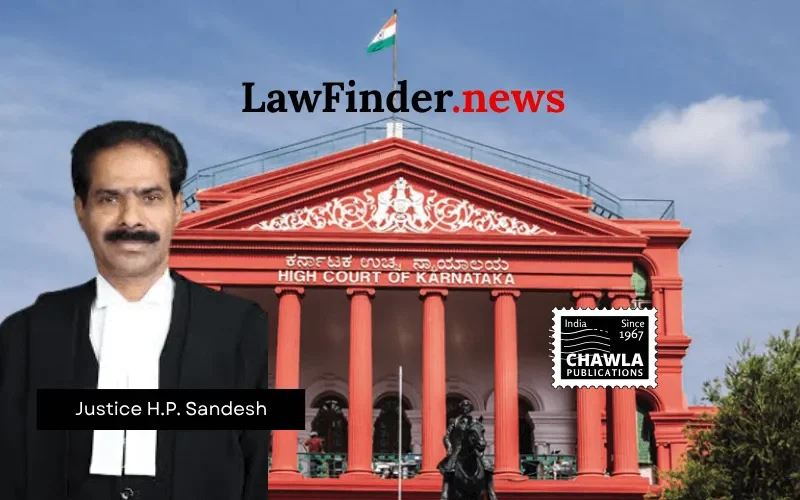
In a significant judgment delivered on October 17, 2026, the Karnataka High Court, presided over by Justice H.P. Sandesh, dismissed a petition seeking to quash criminal proceedings initiated against advocate M. Prasanna Kumar for practicing law without clearing the mandatory All India Bar Examination (AIBE). The court held that criminal jurisdiction could be invoked against advocates practicing illegally, notwithstanding the disciplinary jurisdiction of the Bar Council.
The case arose from a private complaint filed by another advocate, alleging that the petitioner, enrolled in 2011, had been practicing for nearly a decade without passing the AIBE, a mandatory requirement introduced by the Bar Council of India in 2010. The complaint invoked offences under Sections 419 (cheating), 420 (cheating and dishonestly inducing delivery of property), 120B (criminal conspiracy), and 511 (attempt to commit offence) of the Indian Penal Code (IPC), along with Section 45 of the Advocates Act, 1961, which penalizes unauthorized practice of law.
The petitioner contended that his enrollment certificate did not indicate provisional status, and he had practiced under the bona fide belief that he was entitled to do so. He also argued that subsequent clearing of the AIBE in 2021 validated his practice retroactively and that only the Bar Council had jurisdiction over professional misconduct, rendering criminal proceedings an abuse of process.
Rejecting these contentions, the High Court emphasized that the disciplinary jurisdiction of the Bar Council does not exclude the criminal court's jurisdiction if the allegations disclose a criminal offence. It noted that the petitioner's failure to clear the AIBE within the prescribed two-year period suspended his right to practice, and continuing practice thereafter constituted an offence under Section 45 of the Advocates Act independently of IPC offences. The court further observed that the complainant had locus standi to file the criminal complaint after the police issued a Non-Cognizable Report (NCR) and refused to register a case, thereby justifying recourse to the Magistrate under Section 200 of the Criminal Procedure Code (Cr.P.C.).
Importantly, the court clarified procedural aspects relating to Section 156(3) Cr.P.C., stating that a Magistrate must either take cognizance or refer the matter for investigation but not both simultaneously. However, it held that the procedural error did not vitiate the order referring the case for investigation.
In light of the judgment, the Karnataka High Court issued a series of directions to the Karnataka State Bar Council to curb illegal practice of law by unenrolled or suspended advocates. These include: creating a digital system to track enrollment dates and the two-year window for clearing the AIBE; maintaining a list of suspended advocates; verifying AIBE results with the Bar Council of India; instituting mechanisms for periodic review and identification of defaulting advocates; providing opportunities for hearings before disciplinary action; and reporting compliance within 45 days.
The court underscored the significance of maintaining high professional standards and ethics in the legal profession, recognizing that illegal practice undermines the administration of justice and affects society at large. It reiterated that subsequent clearing of the AIBE does not retrospectively validate unauthorized practice.
This judgment reinforces the legal framework ensuring that only qualified advocates who have cleared the AIBE can practice law in India, affirms the complementary roles of disciplinary and criminal jurisdictions, and mandates proactive measures by Bar Councils to safeguard the integrity of the legal profession.
Bottom Line:
Advocates Act, 1961 - Practice without clearing All India Bar Examination - Private complainant can set criminal law in motion for offences under IPC and Section 45 of Advocates Act - Bar Council disciplinary jurisdiction does not exclude criminal court jurisdiction - Magistrate can refer complaint under Section 156(3) Cr.P.C. for investigation - High Court declined to quash proceedings and issued directions to Karnataka State Bar Council to create mechanism to identify illegally practicing advocates.
Statutory provision(s):
Advocates Act, 1961 Sections 24, 35, 45, 49; Criminal Procedure Code, 1973 Sections 156(3), 190, 200, 482; Indian Penal Code, 1860 Sections 419, 420, 120B, 511
M. Prasanna Kumar v. State of Karnataka, (Karnataka) : Law Finder Doc Id # 2999820