Division Bench reaffirms that writ petitions under Articles 226 and 227 of the Constitution are not maintainable against arbitral awards under Section 18 of the MSMED Act without exhausting remedy under Section 34 of the Arbitration and Conciliation Act, 1996
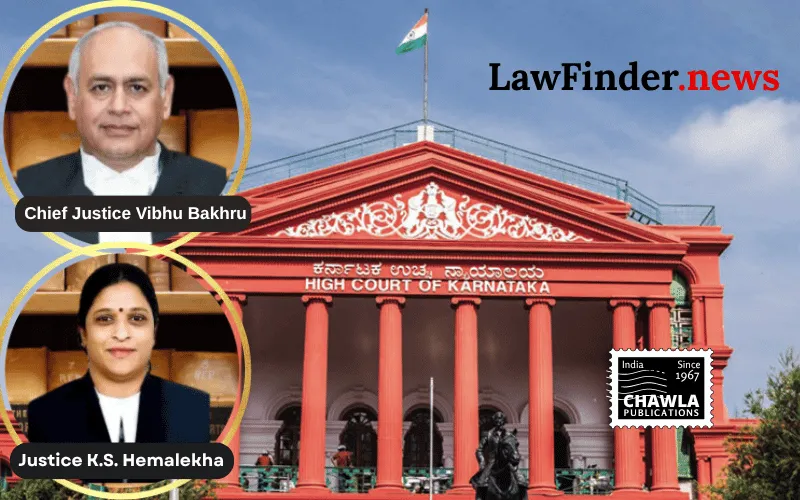
In a significant judgment dated September 3, 2026, the Division Bench of the Karnataka High Court, comprising Chief Justice Vibhu Bakhru and Justice K.S. Hemalekha, dismissed an appeal filed by the Commissioner of the Bhoomi Monitoring Cell, Revenue Department, Government of Karnataka. The appeal challenged a Single Judge's order rejecting a writ petition filed against an arbitral award passed by the Karnataka Micro and Small Enterprises Facilitation Council (MSEFC) under Section 18 of the Micro, Small and Medium Enterprises Development Act, 2006 (MSMED Act).
The dispute arose from a tender process initiated by the appellant (Government of Karnataka) for the supply of handheld devices for the Bhoomi Project. The respondent, a supplier, successfully bid and supplied devices, raising invoices for the payments. While part of the payment was cleared, the balance amount of Rs. 29,32,813 remained unpaid. The supplier approached the Facilitation Council, which passed an arbitral award directing the appellant to pay the outstanding dues with interest. The appellant failed to file an application to set aside the award under Section 34 of the Arbitration and Conciliation Act, 1996 (A&C Act) within the prescribed time and instead filed a writ petition under Articles 226 and 227 of the Constitution, challenging the award on merits.
The Single Judge dismissed the writ petition after examining the merits, but the appellant appealed before the Division Bench seeking a review of the arbitral award.
The Court reiterated the binding precedent of the Supreme Court in M/s India Glycols Limited vs Micro and Small Enterprises Facilitation Council (2023 SCC Online SC 1852), which categorically held that writ petitions under Articles 226 and 227 are not maintainable against arbitral awards under the MSMED Act when statutory remedies under Section 34 of the A&C Act are available and have not been exhausted. The Court emphasized that the writ jurisdiction is not a substitute for statutory remedies and is subject to judicial restraint unless exceptional circumstances arise such as violation of fundamental rights, principles of natural justice, lack of jurisdiction, or challenge to the vires of legislation.
While acknowledging that the Supreme Court in M/s Tamil Nadu Cements Corporation Limited vs MSEFC (2025 INSC 91) had expressed reservations about the absolute bar on writ petitions and referred the issue to a larger Bench, the Karnataka High Court held itself bound by the existing precedent in India Glycols Limited. The Court further noted that the appellant failed to demonstrate any exceptional circumstances or grounds such as jurisdictional errors or violation of natural justice to justify invoking writ jurisdiction.
Moreover, the Court observed that the writ petition was filed after the limitation period for filing an application under Section 34 of the A&C Act had expired, and no explanation was offered for such delay. The Court held that the appellant could not bypass the statutory remedy by seeking extraordinary relief through a writ petition.
In conclusion, the Division Bench dismissed the appeal and upheld the dismissal of the writ petition at the threshold. The judgment reinforces the principle that alternative statutory remedies must be exhausted before approaching the High Court under its writ jurisdiction in arbitration-related disputes under the MSMED Act.
Bottom Line:
A writ petition under Articles 226 and 227 of the Constitution of India is not maintainable against an arbitral award passed under Section 18 of the MSMED Act, particularly when the statutory remedy under Section 34 of the Arbitration and Conciliation Act, 1996 has not been exhausted.
Statutory provision(s):
Micro, Small and Medium Enterprises Development Act, 2006 Section 18, Arbitration and Conciliation Act, 1996 Section 34, Constitution of India Articles 226, 227