Court Holds Compassionate Appointment Intended for Immediate Relief; Rejects Petition Citing Delay and Family Pension
In a significant judgment delivered on October 7, 2026, the Madhya Pradesh High Court, Jabalpur Bench, dismissed a writ petition filed by Rampyari Dhurve seeking a compassionate appointment following the death of her father, Shri Kajju, an employee who passed away on October 10, 1998. The court emphasized that compassionate appointments are meant to provide immediate financial relief to the bereaved family and cannot be claimed after an inordinate delay.
The petitioner, Rampyari Dhurve, had moved the application only on August 10, 2019, nearly 21 years after the death of her father. Earlier, the widow of the deceased employee, Millo Bai, had applied for a compassionate appointment for the petitioner's husband (the son-in-law of the deceased), which was rejected. The petitioner's delayed application became the subject matter of the writ petition, which the High Court ultimately rejected.
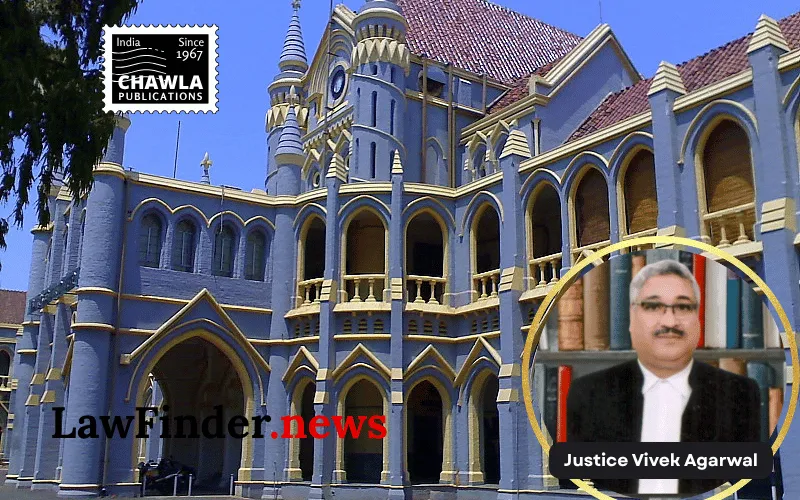
Justice Vivek Agarwal, presiding over the case, observed that the principle behind compassionate appointments is to provide immediate assistance to the family of the deceased employee who was the sole breadwinner. The court cited several precedents from the Supreme Court of India, including Umesh Kumar Nagpal v. State of Haryana (1994), Director of Education v. Pushpendra Kumar (1998), and Chief Commissioner, Central Excise and Customs v. Prabhat Singh (2012), to assert that delay and laches are valid grounds for rejecting such claims.
The court further reiterated that public employment must be open to all eligible candidates based on merit, in line with Article 14 of the Constitution of India. Compassionate appointments are exceptions to this rule, granted only under compelling circumstances where the death of the sole breadwinner causes immediate financial hardship. Since the petitioner's family had survived the loss for nearly three decades and the widow was receiving family pension, the court found no justification to extend this exception.
The judgment also referenced the Supreme Court's ruling in State of West Bengal v. Debabrata Tiwari (2023), which reinforced that delayed claims for compassionate appointments should not be entertained as it defeats the purpose of such appointments.
However, Justice Agarwal granted liberty to the petitioner to revive the writ petition if it is established that the widow is not receiving the family pension. This clause leaves a door open for reconsideration under changed circumstances.
This ruling underscores the judiciary's firm stance on the timely exercise of rights to compassionate appointments and highlights the importance of immediate financial relief for families of deceased public servants. It also serves as a caution against the misuse of compassionate appointment provisions many years after the death of the employee.
Bottom Line:
Compassionate appointment cannot be claimed after an inordinate delay of about 21/28 years from the death of the employee, as the very object of such appointment is to provide immediate financial relief to the bereaved family; where the family has survived and widow is stated to be receiving pension, no case for compassionate appointment survives.
Statutory provision(s):
Article 14, Constitution of India (Right to Equality)
Rampyari Dhurve v. Chairman Managing Director, (MP)(Jabalpur Bench) : Law Finder Doc Id # 2995584