Court reiterates that State is not a privileged litigant and bureaucratic red tape cannot justify delay in filing appeals under Limitation Act, 1963
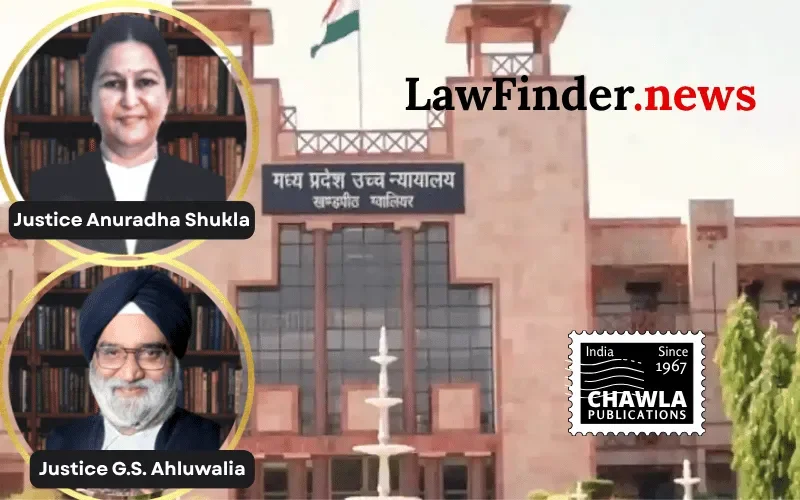
In a significant judgment delivered on October 13, 2026, the Division Bench of the Madhya Pradesh High Court, Gwalior, comprising Justices G.S. Ahluwalia and Anuradha Shukla, dismissed a writ appeal filed by the State of Madhya Pradesh due to a delay of 213 days in filing. The court refused to condone the delay, emphasizing that mere procedural and administrative formalities, including the movement of files through various government authorities, obtaining legal opinions, and waiting for administrative permissions, do not constitute "sufficient cause" under Section 5 of the Limitation Act, 1963.
The case arose when the State sought to challenge an order dated December 9, 2025, by filing a writ appeal. However, the appeal was filed only on October 8, 2026, well beyond the prescribed limitation period. The State explained the delay by citing the internal process involving multiple police and government officials, legal opinion acquisition, and awaiting permission from the Department of Home. The court, however, found these reasons insufficient, noting that no satisfactory explanation was provided for the lack of due promptitude.
Drawing upon authoritative precedents, including the Supreme Court's decisions in State of M.P. v. Ramkumar Choudhary (2024) and State of Odisha v. Managing Committee of Namatara Girls High School (2026), the High Court reiterated that while some latitude might be given to government litigants due to the procedural nature of governmental decision-making, such latitude is not unlimited. Bureaucratic delay and administrative red tape have their boundaries, and courts cannot condone delay merely because the litigant is the State.
The court highlighted the Supreme Court's earlier observations that government authorities must streamline their legal processes, fix responsibility for lapses, and avoid delays that cause prejudice to public interest. The judgment sternly reminded government departments that despite the institutional nature of their decisions, they must act with reasonable promptitude to protect public interests and ensure judicial efficiency.
Consequently, the High Court rejected the State's application for condonation of delay and dismissed the writ appeal as barred by limitation.
This ruling underscores the judiciary's firm stance against casual bureaucratic delays and emphasizes the responsibility of government officials to act expeditiously in legal matters. It sends a clear message that the State, while deserving some procedural latitude, is not above the law and cannot expect the courts to overlook delays caused by administrative inertia.
Bottom Line:
Limitation Act, 1963 Section 5 Condonation of delay - Mere movement of file through different government authorities, obtaining legal opinion and administrative permission do not by themselves constitute "sufficient cause" - State is not a privileged litigant - In absence of satisfactory explanation for delay of 213 days, delay not condoned and writ appeal dismissed as barred by limitation.
Statutory provision(s):
Limitation Act, 1963 Section 5
State of Madhya Pradesh v. Rakesh Singh Jadon, (MP)(DB)(Gwalior) : Law Finder Doc Id # 3000475