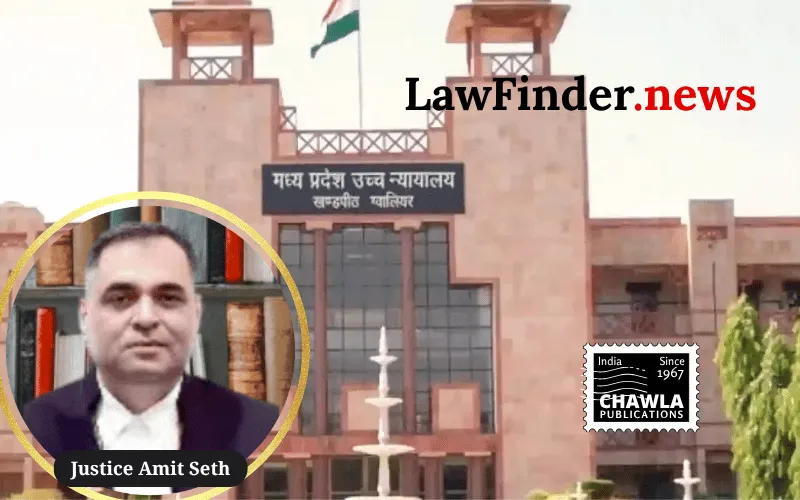
Court says Section 9 Hindu Marriage Act proceedings are civil in nature and cannot be short-circuited through supervisory jurisdiction; factual disputes must be decided by Family Court.
The Madhya Pradesh High Court at Gwalior has dismissed a husband’s petition seeking quashing of his wife’s restitution of conjugal rights case pending before the Family Court, holding that Article 227 of the Constitution cannot be used to terminate civil proceedings at the threshold.
Justice Amit Seth ruled that proceedings under Section 9 of the Hindu Marriage Act, 1955 are civil proceedings and that the Family Court functions as a civil court for such matters. The Court observed that the husband’s allegations that the wife’s petition was an abuse of process and a counter-blast to his divorce proceedings involved disputed questions of fact, which can only be examined by the trial court on evidence.
The petitioner had argued that the wife’s Section 9 petition was filed only to harass him, pointing out that he had earlier filed a similar application in 2018 and that the couple had allegedly been living separately since 2007. He sought quashing of the wife’s petition under the High Court’s supervisory jurisdiction under Article 227.
The respondent-wife opposed the petition on maintainability, contending that Article 227 is meant only to supervise subordinate courts and cannot be invoked to bypass statutory remedies or to challenge the maintainability of a civil petition. She also pointed out that an earlier order allowing the husband’s petition had already been recalled in review by a coordinate bench.
Relying on Supreme Court rulings in Jacky v. Tiny Alias Antony and K. Valarmathi v. Kumaresan, the High Court reiterated that constitutional powers under Articles 226 and 227 cannot be used to question a plaint or similar civil proceeding, especially where the dispute requires evidence. The Court further noted that procedural law provides the proper mechanism for deciding such issues and that short-circuiting the process would undermine the rule of law.
The Court also rejected the husband’s reliance on Surya Dev Rai and other High Court decisions, observing that the law laid down by the Supreme Court directly covered the issue. It added that judicial orders of civil courts are not amenable to writ jurisdiction under Article 226, and that Article 227 is distinct from Article 226.
Importantly, the Court held that the earlier review order had attained finality between the parties and was binding. In view of the settled legal position and the nature of the allegations raised, the petition was dismissed as not maintainable, though liberty was granted to the husband to pursue remedies available under law.
Bottom Line :
Article 227 of the Constitution cannot be invoked to quash proceedings under Section 9 of the Hindu Marriage Act pending before Family Court, as such proceedings are civil in nature and disputed questions of fact must be decided by the trial court in accordance with statutory procedure.
Statutory provision(s): Article 227 of the Constitution of India, Article 226 of the Constitution of India, Section 9 of the Hindu Marriage Act, 1955, Section 10 of the Family Courts Act, 1984, Section 28 of the Hindu Marriage Act, 1955
Devashish Yadav v. Gunjan Yadav, (Madhya Pradesh)(Gwalior) : Law Finder Doc id # 2987227