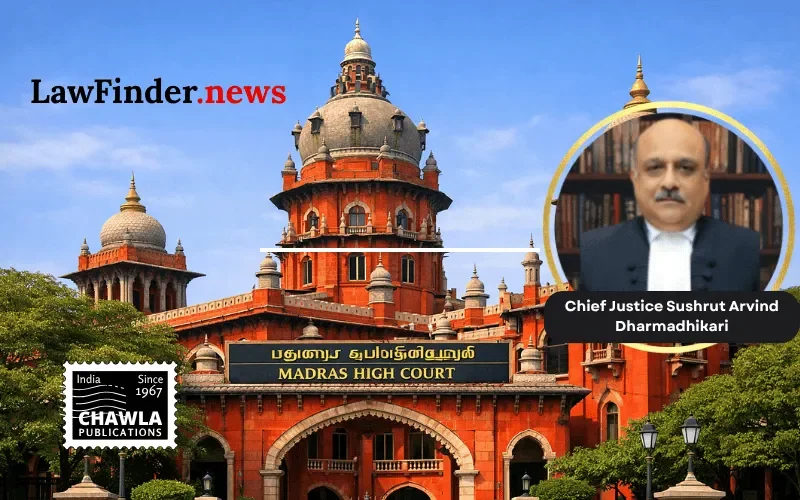
Court Upholds Prima Facie Validity of Arbitration Agreement under Section 11(6) of Arbitration and Conciliation Act, 1996; Fixes Chennai as Arbitration Seat with Eminent Former Judges as Arbitrators
In a significant ruling delivered on October 8, 2026, the Madras High Court has constituted a three-member Arbitral Tribunal to adjudicate substantial commercial disputes between Radhe Krishna Infrastructure (petitioner) and Larsen & Toubro (respondent) arising from a sub-contract agreement related to infrastructure works in Rajkot Smart City, Gujarat. The disputes involve claims exceeding Rs. 74 crore by the petitioner and counterclaims over Rs. 23 crore by the respondent, reflecting the high stakes involved in the project.
The petitioner, a civil construction partnership firm, was awarded a sub-contract by Larsen & Toubro for executing extensive infrastructure works including drains, culverts, bridges, water supply, sewerage, and power systems under the Rajkot Municipal Corporation. Despite contractual defaults by the respondent such as delayed handing over of encumbrance-free right of way, interference by other contractors, and withholding of payments, the petitioner successfully executed nearly the entire roadwork spanning 22 kilometers. However, the respondent issued a termination notice in March 2024, leading to invocation of arbitration proceedings by the petitioner.
The legal tussle centered on the appointment of arbitrators. The petitioner invoked Clause 41 of the Sub-Contract Agreement, which provides for a three-member Arbitral Tribunal comprising the parties' nominee arbitrators and a presiding umpire, with arbitration proceedings to be conducted in Chennai. The petitioner nominated Hon'ble Mr. Justice M.G. Gaikwad, Former Judge of the Bombay High Court. The respondent, while disputing the applicability of Clause 41, acknowledged the existence of arbitrable disputes and nominated Mr. M. Aravind Subramaniam, Senior Advocate, proposing a sole arbitrator under Clause 17.3 of the General Conditions of Contract.
The Court clarified that under Section 11(6) of the Arbitration and Conciliation Act, 1996, the High Court's role is limited to a prima facie examination of the existence and validity of the arbitration agreement. Complex issues such as contractual supersession or priority of inter-related contractual clauses are to be adjudicated by the Arbitral Tribunal under Section 16. Given the substantial claims and counterclaims and the commercial nature of the dispute, the Court deemed it appropriate to constitute a three-member tribunal.
To complete the tribunal, the Court appointed Hon'ble Mrs. Justice R. Banumathi, Former Judge of the Supreme Court of India, as the Presiding Arbitrator. The arbitration proceedings will be held at Chennai under the aegis of the Madras High Court Arbitration Centre, following its procedural rules and fee regulations. The Court left all contentions, claims, and defenses on merits open for determination by the Arbitral Tribunal.
This decision underscores the judiciary's balanced approach in arbitration matters-ensuring procedural fairness while respecting the autonomy of arbitral processes. It also highlights the Court's recognition of the complexity and monetary magnitude of infrastructure disputes necessitating a multi-member tribunal.
Bottom Line:
Arbitration and Conciliation Act, 1996 - In a petition under Section 11(6), the High Court is only required to examine the prima facie existence and validity of the arbitration agreement - Questions regarding supersession of contractual clauses or priority between inter-related contractual documents are to be decided by the Arbitral Tribunal under Section 16 - Where substantial claims and counterclaims existed and arbitrable disputes were undisputed, Court constituted a three-member Arbitral Tribunal and fixed Chennai as seat and venue.
Statutory provision(s):
Arbitration and Conciliation Act, 1996, Sections 11(6), 16, 21
Radhe Krishna Infrastructure v. Larsen & Toubro, (Madras) : Law Finder Doc Id # 2993552