Court holds that absence of statutory service rules does not deny service benefits; quashing of criminal and departmental cases entitles employee to subsistence allowance
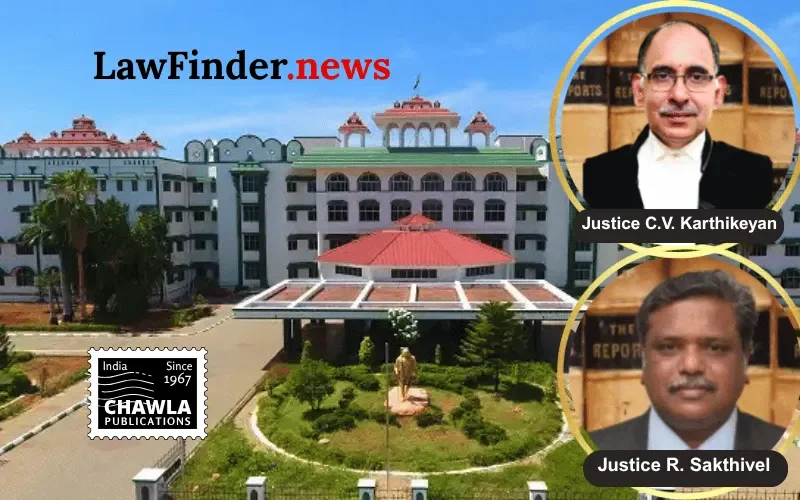
In a significant judgment delivered on August 27, 2026, the Division Bench of the Madras High Court at the Madurai Bench upheld the substantive nature of the post of Noon Meal Organizer under the Tamil Nadu Government. The Court dismissed the appeal filed by the District Collector of Madurai District and others, affirming the decision of a Single Judge which quashed suspension-related orders and directed payment of eligible benefits to the employee concerned.
The case arose when P. Pushpam, a retired Noon Meal Organizer, challenged the denial of service benefits for the period she was placed under suspension from August 22, 2011, to February 27, 2014. Pushpam had been implicated in three criminal cases related to her official duties, and departmental proceedings were initiated against her. However, the criminal cases were quashed on the basis of a compromise with the complainant, and the departmental inquiry concluded that the charges were not established.
Despite being cleared, the appellants contended that since the post of Noon Meal Organizer was created under a government scheme without formal statutory service rules, it did not constitute a government cadre post. Therefore, they argued, Pushpam was not entitled to service benefits such as regularization of suspension period or subsistence allowance.
Rejecting this contention, the High Court relied on earlier precedents, including the 2007 judgment in G. Periannan v. Government of Tamil Nadu and the Supreme Court ruling in Ramesh K. Sharma v. Rajasthan Civil Services (2001), to clarify the scope of "service rules." The Court explained that service conditions and recruitment modalities can be governed by administrative or executive orders issued under Article 162 of the Constitution of India, even in the absence of formal statutory rules framed under Article 309. Thus, the Noon Meal Organizer post, having been created by a Government Order under Article 162, is a substantive post within the Tamil Nadu Government service.
Consequently, the Court held that once the employee was exonerated in both criminal and departmental proceedings, the period of suspension must be regularized, and eligible subsistence or service benefits must be paid. The Court emphasized that benefits attached to such substantive posts cannot be denied merely because the appointment was under a scheme or lacked separate statutory rules.
This judgment reinforces the principle that government employees appointed under executive orders enjoy substantive service rights and protections, including during suspension, thereby strengthening employee rights in similar service contexts.
Detailed Analysis and Background:
The Noon Meal Organizer post was created by a Government Order issued under Article 162, which empowers the Tamil Nadu Government to make executive decisions regarding service matters. The controversy centered on whether such posts, created administratively without formal statutory service rules, qualify as substantive government service posts with attendant benefits.
The appellants argued that absence of statutory service rules meant the appointment was "ad hoc" or temporary without entitlement to service benefits during suspension. However, the Court relied heavily on the definition of "service rules" and the principle that such rules include administrative orders prescribing conditions of service and recruitment.
The Court cited the Supreme Court's decision in Ramesh K. Sharma, which clarified that appointments made by government order to posts without statutory rules do not automatically become "ad hoc" appointments if the government order specifies recruitment and service conditions. This interpretation widens the protection for government employees appointed under such schemes.
Since Pushpam's criminal cases were quashed and departmental charges were found unproven, the Court held the suspension period must be regularized and subsistence allowance must be paid, affirming the fundamental right of employees to fair treatment pending final adjudication.
Implications:
This judgment is a landmark for government employees appointed under various welfare schemes or executive orders without formal service rules, affirming their substantive status and entitlement to service protections. It discourages arbitrary denial of benefits during suspension when employees are eventually cleared of allegations.
The ruling also clarifies that government orders under Article 162 carry statutory weight in prescribing service conditions, thereby broadening the understanding of "service rules" beyond formal statutory enactments under Article 309.
Conclusion:
The Madras High Court's decision strengthens the position of government employees like Noon Meal Organizers by recognizing their posts as substantive and protecting their service benefits during suspension upon acquittal. It underscores the principle that government employees cannot be deprived of their rightful benefits on technical grounds of absence of statutory service rules when appointed under valid executive orders.
This judgment is a welcome development for public servants across India appointed under similar conditions and contributes to the jurisprudence on service law and constitutional governance of public employment.
Bottom Line:
Noon Meal Organizer appointed under Government Order issued under Article 162 of the Constitution holds a substantive post under the Tamil Nadu Government; on quashing of criminal cases and exoneration in departmental proceedings, suspension period is liable to be regularized and eligible subsistence/service benefits cannot be denied on the ground that no statutory service rules exist.
Statutory provision(s):
Article 162 of the Constitution of India, Article 309 of the Constitution of India