Judgment clarifies that burial rights in another local body's cremation ground must be constitutionally or customarily recognized.
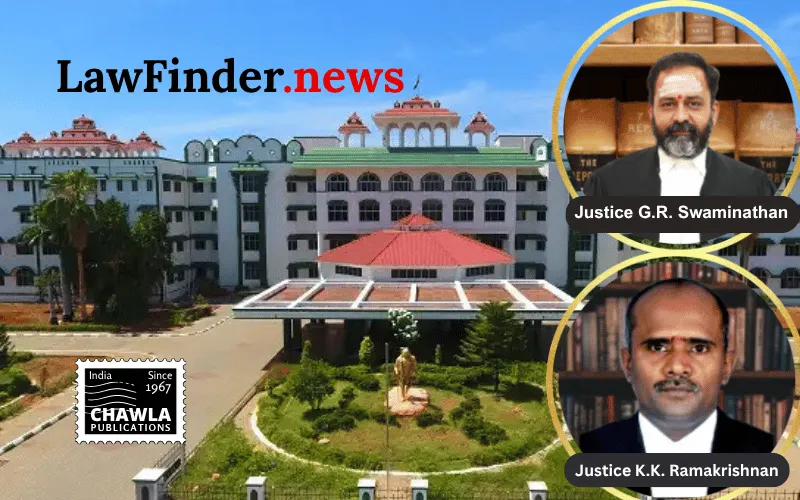
In a significant ruling, the Madurai Bench of the Madras High Court, comprising Justices G.R. Swaminathan and K.K. Ramakrishnan, dismissed a writ petition filed by residents of Bommaiahgoundanpatti Village seeking rights to use the Sukkuvadanpatti cremation ground. The court emphasized that such rights can only be grounded in constitutional or customary recognition.
The case arose when Bommaiahgoundanpatti villagers, now part of Theni-Allinagaram Municipality, faced resistance from Sukkuvadanpatti residents in using their cremation facilities. Sukkuvadanpatti locals had collectively purchased and developed a crematorium now under the jurisdiction of Oonchampatti Village Panchayat.
The petitioners argued for convenience due to proximity, while the court held that rights cannot be based on convenience alone. It clarified that statutory provisions under the Tamil Nadu Panchayats Act, 1994, limit burial and cremation grounds' usage to residents within the local body. These provisions mandate local bodies to cater to their residents' needs, as highlighted in sections 110(f) and 134 of the Act.
The court referenced historical and legal precedents, notably Hughes v. Lloyd (1888), to support its stance that non-residents cannot demand burial rights in another jurisdiction without explicit statutory or customary rights. The ruling reiterated that local governance frameworks under Article 243G of the Constitution and related schedules grant local bodies authority over these community assets.
Although Article 21 of the Constitution ensures dignity in death, and Article 25 safeguards religious practices, the court noted the petitioners neither claimed a fundamental right under these articles nor proved any customary rights. The judgment distinguished this case from others where religious and cultural beliefs substantiated such claims, citing the Kerala High Court's decision on Ivor Madom as an example.
In conclusion, the court dismissed the petition, reaffirming the jurisdictional limitations on burial rights and emphasizing the absence of constitutional or customary grounds for the petitioners' claim. This decision aims to resolve ongoing conflicts between the villages regarding cremation rights.
Bottom line:-
A resident of one local body cannot claim a right of burial/cremation in the burial/cremation ground vested with another local body unless such a right is recognized as a fundamental right under Article 25 of the Constitution or as a customary right.
Statutory provision(s):
Articles 21, 25, 243G of the Constitution of India, Sections 110(f) and 134 of the Tamil Nadu Panchayats Act, 1994, Tamil Nadu Village Panchayats (Provision of burial and burning grounds) Rules, 1999, Registration of Births and Deaths Act, 1969
Anbalagan P. v. District Collector, (Madras)(DB)(Madurai Bench) : Law Finder Doc id # 2942466