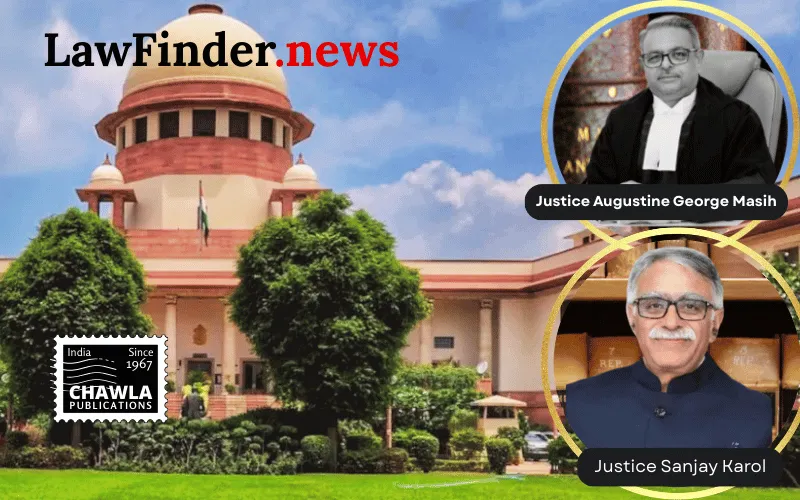
Supreme Court Upholds Settlement, Dismisses Wife's Appeal for Additional Maintenance, Clause 9 of Settlement Petition Declared Satisfied; No Further Maintenance Obligations for Husband
In a significant ruling, the Supreme Court of India has dismissed an appeal filed by Vijayalakshmi R., challenging the interpretation of a settlement agreement regarding maintenance obligations for her son. The judgment, delivered on July 21, 2026, by a bench comprising Justices Sanjay Karol and Augustine George Masih, upheld the concurrent findings of the Family Court and the High Court of Karnataka.
The case revolved around the interpretation of Clauses 8, 9, and 10 of a settlement petition filed by Vijayalakshmi R. and her former husband, C.L. Balaji, during the dissolution of their marriage. The settlement included a provision for a lump sum payment of Rs. 2.20 crore for the maintenance of their minor son, Aarav C. Balaji. The crux of the dispute was whether Clause 9, which stipulated an interim maintenance of 20% of the husband's annual income, was an independent and continuing obligation.
The Family Court and the High Court had previously ruled that upon the payment of Rs. 1 crore as per Clauses 8 and 10, the interim obligation under Clause 9 ceased to exist. Vijayalakshmi R. contended that Clause 9 was a separate and enforceable obligation, requiring ongoing payments until her son attained the age of 23 or completed his post-graduation.
The Supreme Court, however, found no merit in the appeal. It concluded that Clauses 8, 9, and 10 constituted a single, interconnected arrangement. The judgment clarified that the payment of Rs. 1 crore discharged the husband's further maintenance obligations, and the remaining balance of Rs. 1.20 crore had also been settled.
Justice Masih, writing for the bench, emphasized that the executing court's role is to enforce the decree as it stands, without embarking on a fresh adjudication of rights. The court noted that the language of Clause 10 was unambiguous, marking the end of the interim obligation upon the specified payment.
The judgment also addressed the appellant's request for creating a corpus for the son's higher education under Article 142 of the Constitution. The court declined this request, stating that it would effectively alter a settlement that had been fulfilled and acted upon by both parties.
In an empathetic gesture, the court recorded the husband's voluntary transfer of Rs. 1 crore to the son's account for his educational expenses, relinquishing any claim to reimbursement. This decision underscores the court's commitment to upholding settlements while ensuring the welfare of the child involved.
Statutory provision(s):
Hindu Marriage Act, 1955 Section 13B, Civil Procedure Code, 1908 Section 36, Constitution of India, 1950 Article 136, Constitution of India, 1950 Article 142
Vijayalakshmi R. v. C.L. Balaji, (SC) : Law Finder Doc id # 2944549