Court holds retired Judge transferred to Calcutta High Court entitled to domestic help, driver, secretarial, security, and telephone benefits from Orissa High Court, subject to non-duplication condition
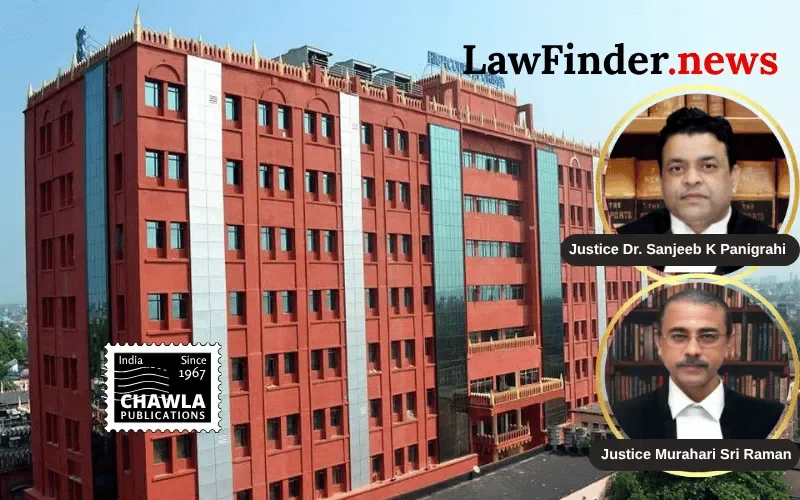
In a landmark judgment dated November 2, 2026, the Orissa High Court (Division Bench) has ruled in favour of Shri Chitta Ranjan Dash, a retired High Court Judge who was initially appointed to the Orissa High Court but transferred to the Calcutta High Court where he retired. The bench comprising Dr. Sanjeeb K Panigrahi and Murahari Sri Raman, JJ., held that Shri Dash is entitled to elect his parent High Court-Orissa High Court-for availing post-retirement allowances such as domestic help, driver, secretarial assistance, security, and telephone facilities.
The petitioner, who retired on May 20, 2024, challenged the State of Odisha's denial of these benefits from the Orissa High Court, which had only granted him medical facilities. The State had contended that since Shri Dash retired from the Calcutta High Court, he was not eligible for other allowances under Odisha's scheme designed for retired Judges of the Orissa High Court.
The Court extensively analyzed the prevailing Supreme Court directions, especially those related to the implementation of the Andhra Pradesh model for retired Judges' allowances, which include monthly consolidated amounts for domestic help, driver, security, secretarial assistance, and telephone facilities. The Orissa High Court emphasized that these allowances are not mere discretionary concessions but enforceable welfare measures mandated to ensure dignified post-retirement life for Judges.
Crucially, the Court referred to a Supreme Court clarification dated April 15, 2025, which recognized that the "concerned State Government" responsible for post-retirement benefits can be either the State where the Judge was first appointed or the State from which the Judge retired. Applying this principle, the Court rejected the State's narrow interpretation that limited benefits only to the place of retirement.
The Orissa High Court further interpreted the State's own Home Department notification dated April 24, 2025, which stipulated that benefits would be available only if the retired Judge was not availing similar facilities from any other High Court. The Court held this condition aims to prevent duplication of benefits and cannot be construed as disqualifying a transferred Judge who opts to receive benefits from his parent High Court.
The judgment underscores that a transfer within the judiciary is an incident of service and does not erase the institutional association with the parent High Court. The Court mandated the State to extend the full spectrum of post-retirement allowances to Shri Dash, subject to verification that he is not receiving similar benefits from any other High Court. The arrears, if any, must be paid within eight weeks.
The judgment also echoed the Supreme Court's concern for retired Judges' dignity and welfare, emphasizing that medical assistance, domestic help, and communication facilities are necessary support measures, not favours. It called for the elimination of avoidable administrative hurdles that hinder retired Judges from accessing entitled benefits.
This decision sets a significant precedent ensuring that retired Judges transferred during service are not deprived of welfare benefits due to their place of retirement. It aligns with ongoing Supreme Court efforts to standardize post-retirement benefits for Judges across States, reflecting a commitment to uphold the dignity of the judiciary beyond active service.
Bottom Line:
Service conditions/Post-retirement benefits of retired High Court Judges - Retired Judge initially appointed in Orissa High Court and later transferred to Calcutta High Court - Entitled to elect parent High Court for availing post-retirement allowances such as domestic help, driver, secretarial assistance, security and telephone facilities - Benefits cannot be denied solely on ground that he retired from transferee High Court, so long as he is not availing similar facilities from any other High Court.
Statutory provision(s):
Article 14, Article 21 of the Constitution of India
Shri Chitta Ranjan Dash v. State of Odisha, (Orissa)(DB) : Law Finder Doc Id # 3010968