New Delhi, Sep 18 The Supreme Court on Friday said that provisions of the POSH Act cannot be applied in a "straitjacket manner" to aggrieved women who belong to the legal profession.
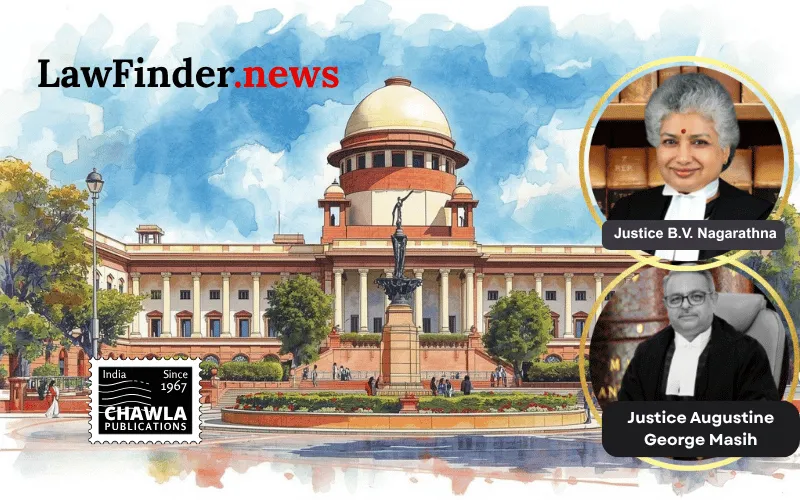
A bench of justices B V Nagarathna and Augustine George Masih asked the parties, including the Centre, to have a joint consultation for drafting a set of regulations applicable to all courts, tribunals and quasi-judicial authorities.
The top court was hearing two petitions, including the one seeking implementation of the Sexual Harassment of Women at Workplace (Prevention, Prohibition and Redressal) Act, 2013, (POSH) for women advocates enrolled with the State Bar Councils or Bar Association.
During the hearing, the bench perused the Gender Sensitisation and Sexual Harassment of Women at the Supreme Court of India (Prevention, Prohibition & Redressal) Regulations, 2013.
The bench observed that these regulations have been made with regard to the Supreme Court precincts only.
"In order to have a wider coverage of these regulations in so far as the high courts and all courts under the district judiciary as well as tribunals of the central and state governments, other quasi-judicial authorities etc., it is necessary that a separate set of regulations are made as we find that the provisions of the Sexual Harassment of Women at Workplace (Prevention, Prohibition and Redressal) Act, 2013, cannot be applied in a straitjacket manner to the aggrieved women who belong to the legal profession," the bench said.
It noted that the counsel representing the Bar Council of India has submitted that she would seek instructions in the matter and endeavour to bring about a common regulation applicable to aggrieved women who are in the legal profession.
"We also request the counsel for the Bar Council of India to ascertain from the Bar Councils of the states as to whether any extant regulations are being implemented in this regard," the bench said and posted the matter for hearing on November 25.
It asked the counsel appearing for the parties in the matter to have a joint meeting and come up with model regulations.
In August last year, the top court had agreed to examine a plea seeking directions to implement and apply the 2013 Act to women advocates enrolled with State Bar Councils/Bar Associations.
The plea has also sought directions to constitute/continue internal committees under the Act to hear complaints of women advocates.
It said in the absence of a clear precedent on this issue of applicability of the 2013 Act to state Bar Councils or Bar Associations, women lawyers were at risk of an uneven protection across states, which is against the mandate of the statute.