Court says long, continuous engagement and CPF deductions cannot be ignored merely because the employee was initially appointed on a part-time basis
In a significant ruling on service regularisation, the Punjab and Haryana High Court has set aside a Single Judge’s order and directed the Bhakra Beas Management Board (BBMB) to reconsider the case of a woman employee who has served as a part-time sweeper since 1991.
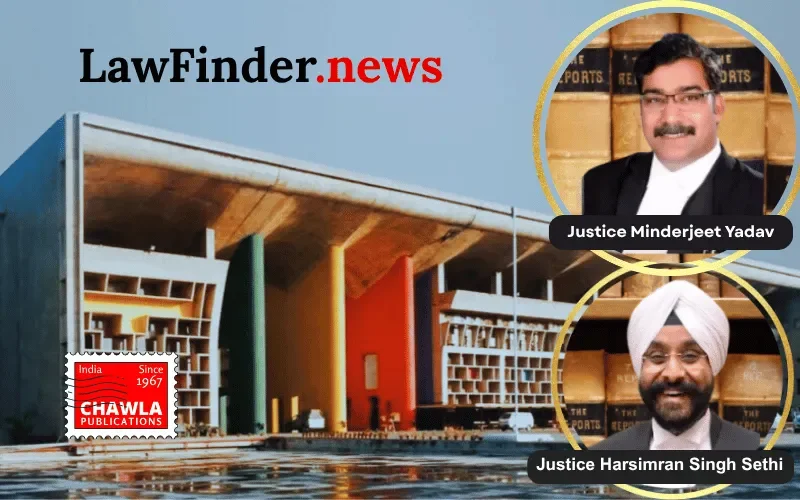
A Division Bench comprising Justice Harsimran Singh Sethi and Justice Minderjeet Yadav held that the appellant’s claim could not be rejected solely on the ground that her initial appointment was part-time or because the Board claimed there was no sanctioned post in the concerned division. The Court said that the real nature of the employment, the prolonged and continuous service rendered for more than three decades, and the recurring nature of the duties performed must be examined in a substantive manner.
The appellant, Shabo Devi, had approached the Court after her writ petition seeking regularisation as a Group-D sweeper and consequential benefits was dismissed by a Single Judge in February 2024. The Single Judge had relied mainly on the Supreme Court’s decision in Union of India v. Ilmo Devi to hold that a part-time employee could not claim regularisation merely on the basis of long service.
Before the Division Bench, the appellant argued that she had continuously discharged sweeping duties for over 30 years and that the Board had itself deducted contributions towards a Contributory Provident Fund account, indicating a continuing employer-employee relationship. She also relied on BBMB’s regularisation policies and contended that the actual nature of her work, not merely the label of “part-time” attached at the time of appointment, ought to have been considered.
The BBMB, however, maintained that she was engaged only as a part-time worker and not against a sanctioned post, and that its regularisation policies did not extend to such employees.
The High Court examined a line of Supreme Court and High Court decisions, including Secretary, State of Karnataka v. Umadevi (3), Ilmo Devi, Jaggo v. Union of India, Dharam Singh v. State of U.P., Shripal v. Nagar Nigam, Ghaziabad, and Sukhendu Bhattacharjee v. State of Assam. The Bench observed that while regularisation cannot be used as an alternative mode of recruitment, public employers cannot mechanically deny relief by relying only on the initial description of employment, especially where services have been continuously utilised for decades for essential and recurring work.
The Court also noted that BBMB had not satisfactorily addressed the appellant’s plea regarding CPF deductions or the factual aspects of its recruitment practice, which had earlier been called for on record during the writ proceedings. It held that the absence of a sanctioned post in one division could not, by itself, conclusively defeat the claim without examining the broader employment reality and the relevant records.
Allowing the appeal, the Bench set aside the Single Judge’s judgment and directed BBMB to determine the appellant’s entitlement to regularisation in light of the Court’s findings. The authority has been asked to verify her continuity of service, service records, CPF records, eligibility under the applicable legal framework, and her work and conduct. If she is found eligible, BBMB must issue a consequential order of regularisation. The entire exercise is to be completed within eight weeks.
Statutory provision(s): Articles 14 and 16 of the Constitution of India
Shabo Devi v. Bhakhra Beas Management Board, (Punjab And Haryana)(DB) : Law Finder Doc id # 3024106