Court holds that dismissal without inquiry permissible only when inquiry is not "reasonably practicable" with reasons recorded in writing; mere non-cooperation or absence insufficient justification.
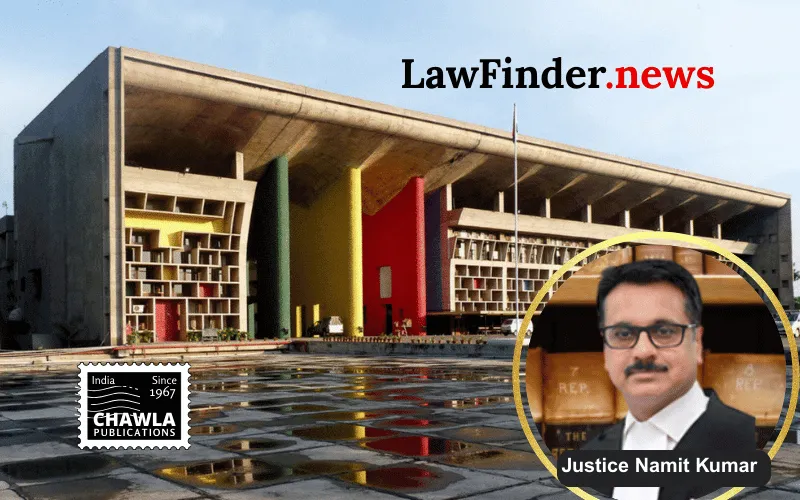
In a landmark judgment delivered on September 1, 2026, the Punjab and Haryana High Court, through Justice Namit Kumar, quashed the dismissal order of Gursher Singh Sandhu, a Deputy Superintendent of Police (DSP) in Punjab Police, who was dismissed from service without a departmental enquiry by invoking Article 311(2)(b) of the Constitution of India. The Court underscored that the power to dispense with departmental inquiry is an extraordinary provision, to be exercised sparingly and only when holding such inquiry is not reasonably practicable, supported by valid reasons recorded in writing.
The petitioner, Gursher Singh Sandhu, was dismissed on January 2, 2025, on allegations related to misconduct and negligence concerning an unauthorized interview of gangster Lawrence Bishnoi while in police custody. Despite initiation of departmental proceedings including issuance of show-cause notices, suspension, and charge-sheet, the State Government invoked Article 311(2)(b) to dispense with the inquiry citing the petitioner’s alleged non-cooperation and evasion in receiving the charge-sheet.
Justice Namit Kumar’s detailed judgment extensively analyzed the constitutional provision under Article 311(2) and the Supreme Court’s authoritative rulings, particularly the landmark decision in Union of India v. Tulsiram Patel & Others (1985), which delineates the scope and limits of dispensing with departmental enquiry. The Court reiterated that:
- 1. Article 311(2)(b) allows dispensing with inquiry only if the authority is genuinely satisfied that holding inquiry is not reasonably practicable, and such satisfaction must be based on objective material and recorded in writing.
- 2. Mere non-cooperation, absence, or serious allegations against an employee do not justify bypassing the mandatory inquiry. The inquiry may continue ex parte if the employee refuses to participate.
- 3. The reasons recorded must be specific, plausible, and not vague or mere reproductions of the constitutional language.
- 4. The exercise of power under Article 311(2)(b) is subject to judicial review to prevent arbitrariness, mala fide intentions, or ulterior motives.
In the present case, the Court found that the petitioner had actively participated in the departmental proceedings initially, submitted replies to show-cause notices, and sought documents to effectively respond. There was no material to show that he threatened witnesses, intimidated officials, or created circumstances making inquiry impracticable. Furthermore, the same inquiry was being conducted against other officers involved in the same case, negating the claim that an inquiry against the petitioner was unfeasible.
The Court also criticized the State for sending the charge-sheet to an outdated address despite knowledge of the petitioner’s current address, which undermined the allegation of deliberate evasion of service. The judgment observed that the State’s invocation of Article 311(2)(b) appeared mechanical and devoid of proper justification.
Consequently, the Court held the dismissal order illegal, arbitrary, and violative of the principles of natural justice. It set aside the dismissal order and directed the reinstatement of the petitioner with all consequential benefits. However, the judgment clarified that this reinstatement does not preclude continuation of the departmental enquiry initiated against the petitioner.
The Court further noted the repeated misuse of Article 311(2)(b) in Punjab police dismissals and called for strict adherence to the legal principles and guidelines issued by the High Court and the Supreme Court.
This judgment reaffirms the constitutional safeguards for civil servants, emphasizing fairness, reasoned decision-making, and the right to be heard before dismissal, thereby upholding the rule of law and protection against arbitrary state action.
Bottom Line:
Dismissal of a government servant without departmental enquiry under Article 311(2)(b) of the Constitution is permissible only if holding such enquiry is not "reasonably practicable" and reasons for such satisfaction are recorded in writing; mere non-cooperation or absence does not justify dispensing with enquiry.
Statutory provision(s):
Article 311(2)(b) of the Constitution of India, Rule 8 of The Punjab Civil Services (Punishment and Appeal) Rules, 1970, Rule 16.24 of the Punjab Police Rules, 1934
Gursher Singh Sandhu v. State of Punjab, (Punjab And Haryana) : Law Finder Doc id # 2972169