Court Upholds Strict Interpretation of Compassionate Appointment Rules, Denying Plea for Wider Interpretation
In a significant ruling, the Rajasthan High Court dismissed an appeal filed by Harshit Solanki seeking compassionate appointment following his father's severe disability. The Court upheld the stringent interpretation of the Rajasthan Compassionate Appointment of Dependents of Permanent Total Disabled Government Servants Rules, 2023, emphasizing that compassionate appointments are not a matter of right but a statutory concession governed by specific legislative criteria.
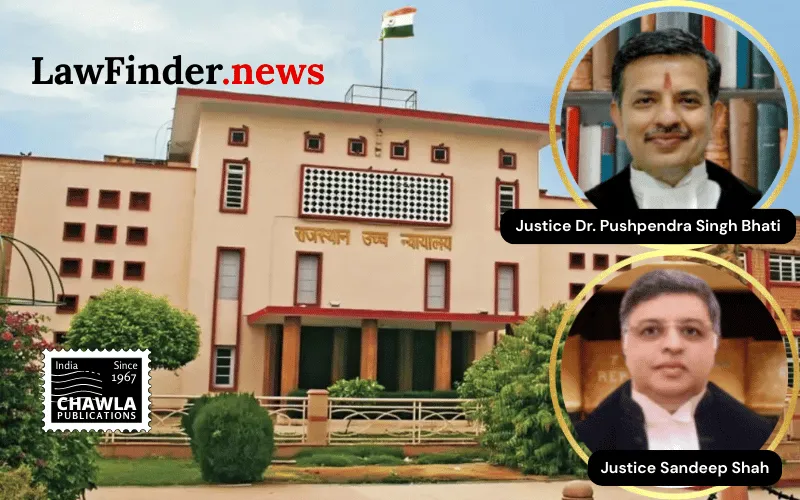
The Division Bench, comprising Justices Dr. Pushpendra Singh Bhati and Sandeep Shah, examined the case where Solanki's father, a Personal Assistant in the State Insurance and Provident Fund department, suffered a 75% disability due to a brain stroke. Solanki sought compassionate appointment, arguing that the disability should be considered an "accident" under the Rules.
The bench scrutinized Rules 2(b) and 2(f), which define "Permanent Total Disabled Government Servant" and "Permanent Total Disability," respectively. The Court reiterated that the Rules explicitly limit compassionate appointments to cases where disability arises solely from an accident while on duty, as enumerated in eight specific categories under Rule 2(f).
The Court noted that the legislative intent was clear in confining benefits to explicitly defined situations, and judicial interpretation could not extend beyond these boundaries. The judgment emphasized that the Rules' language was exhaustive, not inclusive, and any deviation would undermine legislative intent.
The Court addressed the appellant's plea for a broader interpretation, acknowledging the welfare nature of the legislation but underscoring that such an approach could not override the statute's clear terms. The judgment referenced previous rulings but maintained that the specific language of the current Rules dictated the outcome.
Despite recognizing the appellant's hardships, the Court concluded that Solanki's situation did not meet the statutory requirements for compassionate appointment. The judgment highlighted the Court's duty to adhere to legislative frameworks, even in sympathetic cases.
The decision affirms the judiciary's role in interpreting statutes within their defined scope, underscoring the balance between legislative intent and judicial interpretation in welfare legislation.
Bottom line:-
Compassionate appointment under the Rajasthan Compassionate Appointment of Dependents of Permanent Total Disabled Government Servants Rules, 2023, is a statutory concession and not a matter of right. The eligibility for such appointment must strictly conform to the conditions prescribed under Rules 2(b) and 2(f), which define "Permanent Total Disabled Government Servant" and "Permanent Total Disability," respectively.
Statutory provision(s): Rajasthan Compassionate Appointment of Dependents of Permanent Total Disabled Government Servants Rules, 2023 - Rules 2(b) & 2(f)
Harshit Solanki v. State of Rajasthan, (Rajasthan)(DB) : Law Finder Doc id # 2941910