Court Emphasizes Judicial Restraint in Tender Matters, Upholds Jaipur Development Authority's Executive Decision Backed by Technical Survey and Statutory Sanction
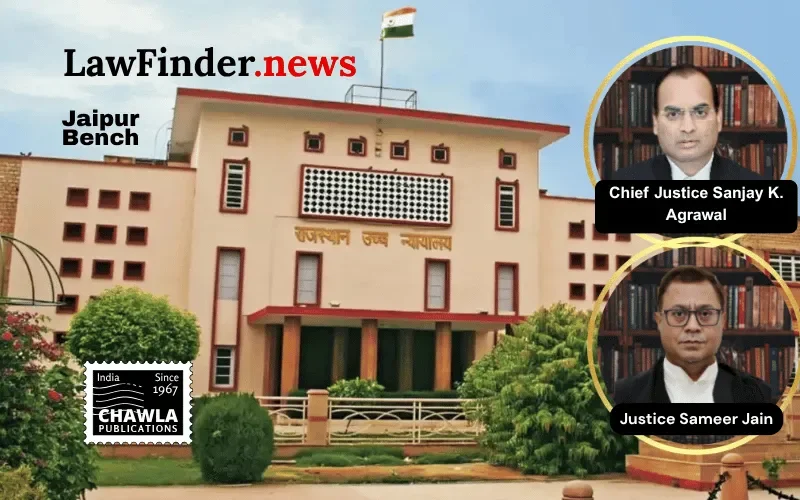
In a significant judgment dated October 27, 2026, the Rajasthan High Court (Division Bench, Jaipur Bench) dismissed a Public Interest Litigation (PIL) filed by Gyanesh Kumar Sharma challenging the tender issued by Jaipur Development Authority (JDA) for the construction of a one-way underpass at Purani Chungi Junction, Ajmer Road, Jaipur. The court underscored the principle of judicial restraint in matters concerning public infrastructure tenders and held that a PIL by a non-participant in a purely commercial contract is not maintainable unless there is clear evidence of arbitrariness, mala fides, statutory illegality, or violation of constitutional rights.
The petitioner had contended that the underpass project, estimated at Rs.19.18 crores, was flawed due to serious technical, safety, drainage, and financial concerns highlighted in an initial feasibility report. He argued that the project was being pursued despite being located in a flood-prone area, conflicting with existing infrastructure, and contrary to the traffic recommendations, urging the court to order a fresh Techno-Economic Feasibility Study and Flood Risk Assessment.
Respondents, represented by the State of Rajasthan and JDA, countered by submitting that the project was based on comprehensive and finalized traffic data, including a detailed 72-hour traffic survey and Passenger Car Unit peak-hour analysis, conducted by reputed consultants. They affirmed that the Public Works Committee had accorded valid administrative and technical approval under Section 16 of the Jaipur Development Authority Act, 1982. Further, technical safeguards such as underground utility mapping and automated heavy-duty pumping infrastructure for monsoon drainage had been integrated into the project plan. The respondents emphasized that the design and execution of such infrastructure projects fall within the exclusive domain of the executive and technical experts, and courts should not substitute their judgment in these matters.
The court referred extensively to the Supreme Court precedents, including Villianur Iyarkkai Padukappu Maiyam v. Union of India, Rajeev Suri v. Delhi Development Authority, Travancore Devaswom Board v. Ayyappa Spices, and N.G. Projects Limited v. Vinod Kumar Jain, which collectively establish that judicial intervention in tender or contractual matters is warranted only when there is demonstrable public interest grounded in violation of constitutional rights or manifest arbitrariness. The court reiterated that commercial tenders are primarily governed by the principle of freedom of contract and fair play, and constitutional courts are not appellate authorities to re-examine technical or financial wisdom behind executive decisions.
The bench observed that the petitioner, being a stranger to the tender process and not a participant, failed to demonstrate any substantial public interest or constitutional violation that could justify judicial interference. The court noted that the JDA's decision to construct the underpass was a well-considered executive policy decision, supported by technical data, statutory approvals, and necessary safeguards, and that no material was placed on record to show mala fides or illegality. Further, in line with the intent of the legislature and the Specific Relief Act, 1963, infrastructure projects should not be stalled by litigation unless there is a compelling reason.
Ultimately, the Rajasthan High Court dismissed the PIL, leaving the parties to bear their own costs, and reinforced the principle that courts should exercise restraint and respect the autonomy of executive agencies in technical and commercial decisions related to public infrastructure.
Bottom Line:
Tender/Public Interest Litigation - PIL by a non-participant challenging tender for construction of public infrastructure underpass is not maintainable in absence of demonstrable public interest, arbitrariness, mala fides or statutory illegality - Courts should exercise restraint in contractual and tender matters and should not interfere with executive policy decisions based on technical evaluation.
Statutory provision(s): Article 14, Article 21, Article 226 of the Constitution of India, Section 16 of the Jaipur Development Authority Act, 1982, Section 41(ha) of the Specific Relief Act, 1963
Gyanesh Kumar Sharma v. State of Rajasthan, (Raj)(DB)(Jaipur Bench) : Law Finder Doc Id # 3012540