Court Seeks Authoritative Clarification on Applicability of 1958 vs 2021 Parole Rules and Impact of New Criminal Procedure Code
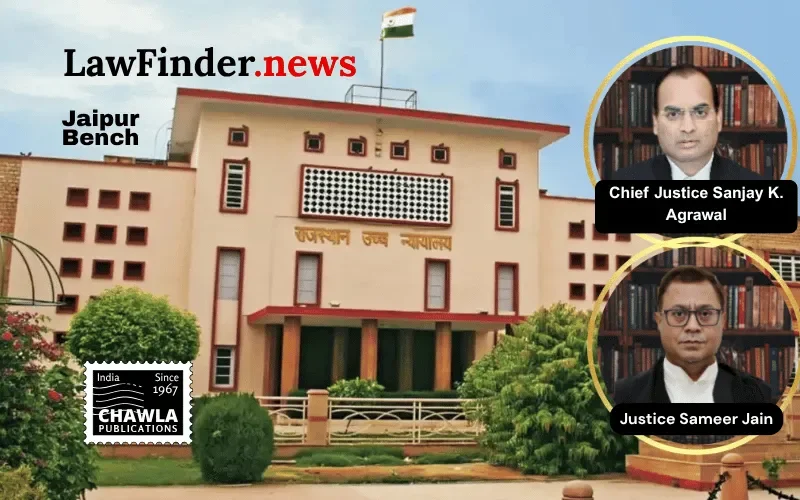
In a significant development concerning prisoner parole laws, the Rajasthan High Court (Jaipur Bench, Division Bench) has referred a batch of connected writ petitions to a Larger Bench for an authoritative ruling on several pivotal legal questions regarding parole in the state. The referral order was passed on October 29, 2026, by a bench comprising Chief Justice Sanjay K. Agrawal and Justice Sameer Jain.
The matter arose from petitions filed by several prisoners, including Ashok and others, challenging the State Committee's rejection of their applications for permanent parole under the Rajasthan Prisoners (Release on Parole) Rules, 1958 ("Rules of 1958"). The petitioners argued that despite the invocation of Rule 14(d) of the 1958 Rules to deny their parole, other prisoners in similar circumstances had been granted permanent parole, raising issues of fairness and consistency.
Further complicating the matter is the introduction of the Rajasthan Prisoners (Release on Parole) Rules, 2021 ("Rules of 2021") and the recent replacement of the Code of Criminal Procedure, 1973 (Cr.P.C.) by the Bharatiya Nagarik Suraksha Sanhita, 2023 (BNSS). The court flagged several unresolved questions:
1. Which parole rules govern prisoners convicted before the 2021 Rules came into force-the 1958 Rules or the 2021 Rules? This question seeks to clarify the retrospective or prospective application of parole regulations.
2. Whether the grant of parole constitutes a "temporary suspension of sentence" under Section 401 of the Cr.P.C. or Section 432 of the BNSS, an issue that affects the legal understanding and procedural handling of parole.
3. The effect of the repeal of the Cr.P.C. and its replacement by BNSS on the continued applicability and operation of the Rajasthan Prisoners (Release on Parole) Rules, 1958.
The court noted conflicting precedents cited by the parties. Petitioners relied on Supreme Court rulings such as Maru Ram v. Union of India (1981) and Hitesh v. State of Gujarat (2024), which support parole considerations, whereas the State referred to cases like Poonam Lata v. M.L. Wadhawan (1987) and Sunil Fulchand Shah v. Union of India (2000) to emphasize stricter parole norms and procedural constraints. The Advocate General also pointed out that neither the Cr.P.C. nor the BNSS contains explicit provisions for parole, raising questions about the statutory basis for parole rules.
Given the complex interplay between old and new rules, the court deemed it necessary to convene a Larger Bench to resolve these issues and provide clear guidance to ensure uniform application of parole laws. The referral aims to address discrepancies and ensure prisoners' rights are balanced against public safety and legal consistency.
The Registry has been directed to proceed with the constitution of the Larger Bench and related procedural steps. Meanwhile, the impugned orders denying permanent parole remain stayed pending the Larger Bench's decision.
This judgment underscores the evolving nature of criminal procedural law in Rajasthan in light of new statutory frameworks and the need for judicial clarity on parole-a critical aspect of prisoner rehabilitation and custodial management.
Bottom Line:
Parole - Reference to Larger Bench - Court framed questions regarding applicability of Rajasthan Prisoners (Release on Parole) Rules, 1958 or Rules of 2021, whether parole amounts to temporary suspension of sentence under Section 401 Cr.P.C./Section 432 BNSS, and effect of repeal of Cr.P.C. by BNSS on operation of Rules of 1958.
Statutory provision(s):
Rajasthan Prisoners (Release on Parole) Rules, 1958, Rajasthan Prisoners (Release on Parole) Rules, 2021, Section 401 Cr.P.C. (Code of Criminal Procedure, 1973), Section 432 BNSS (Bharatiya Nagarik Suraksha Sanhita, 2023)
Ashok v. State of Rajasthan, (Raj)(DB)(Jaipur Bench) : Law Finder Doc Id # 3012541