Bench emphasizes alternative remedy under Section 107 of CGST/RGST Act, 2017 and refuses to entertain writ petition involving disputed factual questions in tax confiscation matter
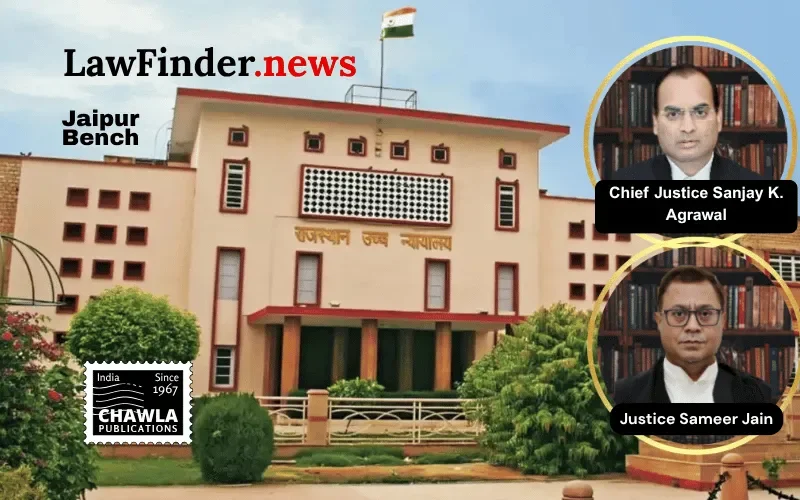
In a significant ruling delivered on October 29, 2026, the Division Bench of the Rajasthan High Court at Jaipur, comprising Chief Justice Sanjay K. Agrawal and Justice Sameer Jain, dismissed a writ petition filed by Smt. Usha challenging a final confiscation order under the Central/Rajasthan Goods and Services Tax (CGST/RGST) Act, 2017. The petitioner had contested the order of confiscation passed under Section 130 of the Act, along with a demand for a bank guarantee amounting to over Rs. 42 lakhs.
The petitioner, proprietor of M/s Madhav Cotton & Oil Mill, was caught in a legal tussle following the interception of a vehicle transporting edible oil, which was purportedly Soyabean Refined Oil but was found to be Mustard Oil upon physical verification. The vehicle had deviated from the declared route, and the driver absconded, raising suspicions of tax evasion. After an initial interim order allowing release of the goods and vehicle upon furnishing a bank guarantee, the adjudicating authority passed a detailed 23-page speaking order confirming confiscation.
Smt. Usha approached the High Court via a writ petition invoking Article 226 of the Constitution of India, alleging arbitrariness, excess fine beyond statutory limits, double penalty, breach of natural justice, and disputing the factual findings related to route deviation, travel time, and absence of toll/RFID data. The petitioner contended that the appellate remedy under Section 107 was not efficacious and that the writ jurisdiction should be exercised.
The Court, however, reiterated the well-settled principle that the CGST/RGST Act is a self-contained code with a robust statutory appellate mechanism. It held that the availability of an efficacious alternative remedy under Section 107 precludes the invocation of extraordinary writ jurisdiction, particularly where disputed questions of fact predominate. The Court observed that the petitioner had been served with a show-cause notice, submitted detailed replies, and was afforded personal hearing opportunities, thereby negating claims of violation of natural justice.
Moreover, the Court noted that the writ jurisdiction is not designed to function as a fact-finding or appellate forum to re-examine evidentiary issues such as the nature of goods, route deviations, or electronic data verification. It emphasized that such controversies are best adjudicated by the designated Appellate Authority under the CGST/RGST Act.
In light of these findings, the Court dismissed the writ petition as not maintainable and directed the petitioner to pursue remedy before the statutory appellate forum. The judgment reinforces the principle that litigants cannot circumvent statutory appeal procedures via writ petitions, thereby upholding the sanctity of the legislative framework and ensuring judicial discipline in tax matters.
Bottom Line:
GST - Writ petition challenging confiscation order under Section 130 of CGST/RGST Act held not maintainable when efficacious statutory appeal under Section 107 is available - Disputed questions of fact regarding nature of goods, route deviation, travel time and toll/RFID data cannot be adjudicated in writ jurisdiction - Exception to rule of alternative remedy not attracted where show-cause notice, reply and personal hearing were duly afforded.
Statutory provision(s):
Constitution of India Article 226, CGST/RGST Act, 2017 Sections 107, 130
Smt Usha v. Union of India, (Rajasthan)(Jaipur Bench)(DB) : Law Finder Doc Id # 3011078