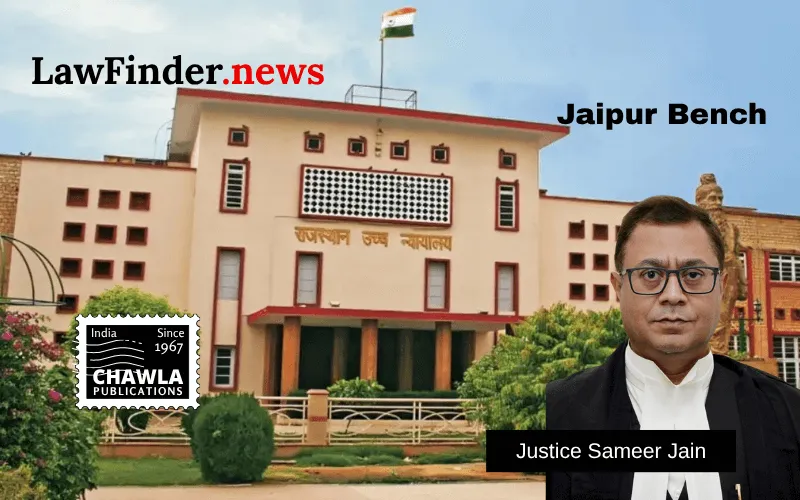
Court Calls for Improved Functionality of Rajasthan Civil Services Appellate Tribunal and Establishment of Transparent Transfer Guidelines
In a significant ruling, the Rajasthan High Court, Jaipur Bench, led by Justice Sameer Jain, has addressed a multitude of writ petitions concerning arbitrary transfer orders issued by various government departments, boards, and public sector undertakings. The court emphasized the need for a systematic approach to transfers, urging the State Government to formulate a comprehensive and uniform transfer policy.
The judgment came in response to petitions filed by Dr. Mahesh Meena and others, challenging the legality and arbitrariness of transfer orders that allegedly disregarded individual circumstances and statutory provisions. Highlighting the inherent administrative prerogative, the court noted that while employees do not have an absolute right to remain posted at a particular station, transfer powers must be exercised transparently, fairly, and without arbitrariness.
Justice Jain underscored the inefficacy of the Rajasthan Civil Services Appellate Tribunal (RCSAT) due to non-availability of requisite members, resulting in delayed adjudication. The court directed the State Government to appoint a retired High Court Judge as a supervisory authority to ensure the tribunal's effective functioning.
The court also mandated the creation of a State-Level Committee to draft a comprehensive transfer policy, considering factors such as tenure, medical conditions, and proximity to retirement. This initiative aims to address recurring grievances and ensure a balanced approach to employee transfers.
In its directive, the court provided interim protection to the petitioners, allowing them to submit representations to competent authorities for reconsideration of their transfer orders. It also stressed the importance of a structured administrative mechanism to handle transfer grievances efficiently.
The ruling aims to strike a balance between the administrative prerogative of the State and the fair treatment of employees, ensuring transparency and consistency in transfer decisions.
Bottom Line:
Transfer orders by administrative authorities are subject to judicial scrutiny only if they violate statutory rules, show mala fide intent, are arbitrary, or result from colorable exercise of power. Employees do not have an absolute right to remain posted at a particular station based on personal hardship or preference.
Statutory provision(s):
- Article 226 of the Constitution of India
- Rajasthan Civil Services (Classification, Control & Appeal) Rules, 1958
- Section 20, 89(8)(ii) of the Rajasthan Panchayati Raj Act, 1994
- Rajasthan Service Rules, 1951
- Section 336(1) of the Rajasthan Municipalities Act, 2009
Dr. Mahesh Meena v. State of Rajasthan, (Rajasthan)(Jaipur Bench) : Law Finder Doc id # 2967618