Court criticizes Jaipur Discom for failing to provide detailed reasons in disciplinary and appellate orders, upholding principles of natural justice.
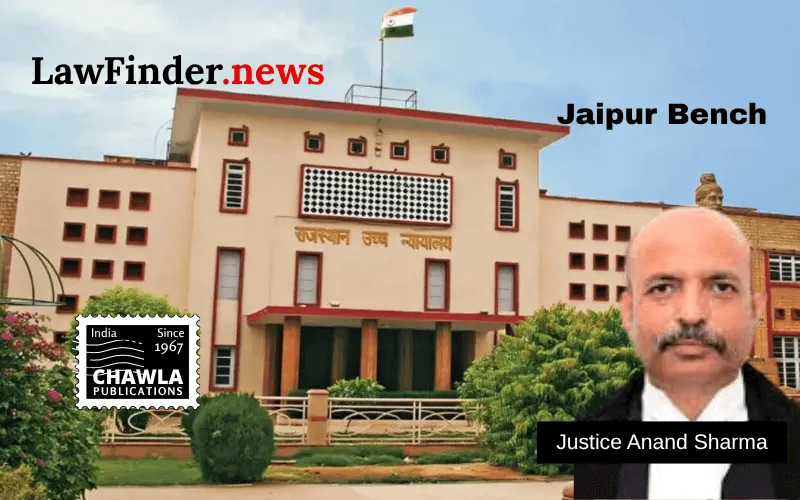
In a significant decision reinforcing the principles of natural justice, the Rajasthan High Court, Jaipur Bench, quashed the penalty imposed on Deepak Meena, a Junior Engineer with Jaipur Vidhyut Vitran Nigam Limited (Jaipur Discom). The judgment, delivered by Justice Anand Sharma, highlighted the failure of the disciplinary and appellate authorities to provide reasoned orders, thereby violating established legal standards.
The case arose from an incident in October 2021, where a transformer failure was attributed to Meena's alleged failure to distribute load to an additional transformer. A disciplinary charge-sheet was issued, and subsequently, a penalty of withholding one annual grade increment without cumulative effect was imposed on Meena. His appeal against this decision was also dismissed.
In his petition, Meena contended that the orders were passed without due consideration of his defense, which included detailed explanations and evidence negating the charges. The High Court agreed, emphasizing that mere recitals of "consideration" in the orders do not suffice as valid consideration under law.
Justice Sharma cited several precedents, including the Supreme Court's ruling in Chairman Life Insurance Corporation of India v. A. Masilamani and S. N. Mukherjee v. Union of India, to underline that administrative and quasi-judicial orders must reflect active application of mind and provide reasons for decisions. The Court noted that the absence of reasons in the penalty and appellate orders indicated a mechanical and predetermined approach, failing to meet the standards of fairness and transparency.
The judgment further criticized the appellate authority for not independently evaluating the grounds of appeal, rendering its order arbitrary and susceptible to judicial review. The Court underscored that detailed reasoning is crucial, particularly in cases where minor penalties are imposed through summary procedures, to ensure accountability and prevent arbitrariness.
Concluding that the orders against Meena were unsustainable, the High Court quashed both the penalty and appellate orders. It directed Jaipur Discom to provide consequential relief to Meena within 60 days.
This decision serves as a reminder to disciplinary bodies across sectors of the judiciary's vigilance in upholding procedural fairness and the requirement for reasoned decision-making in administrative actions.
Bottom Line :
Service Law - Minor penalty proceedings - Mere recital in disciplinary and appellate orders that reply and record were "considered" is not sufficient - Orders imposing minor penalty must disclose active application of mind and reasons dealing with defence of delinquent employee - Unreasoned penalty and appellate orders are liable to be quashed.
Statutory provision(s): Rajasthan State Electricity Board Employees (Classification, Control & Appeal) Regulations 1962, Principles of Natural Justice, Case Laws: Chairman Life Insurance Corporation of India v. A. Masilamani, S. N. Mukherjee v. Union of India.