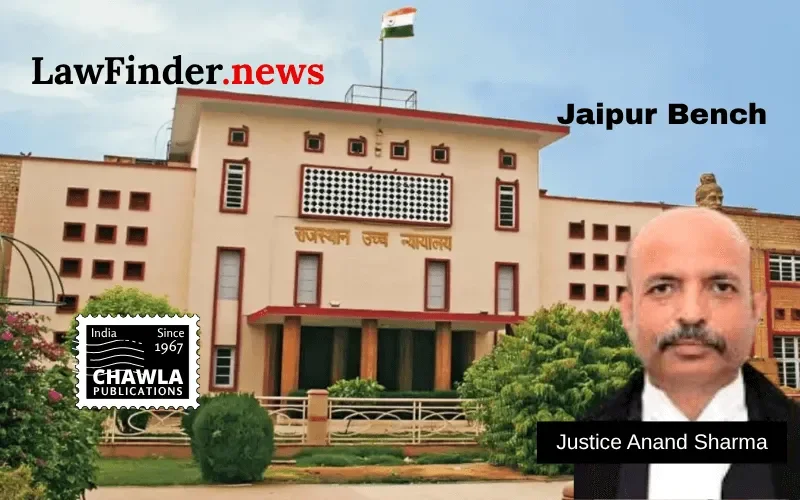
Court Emphasizes Natural Justice and Section 12 Protection, Orders Reinstatement with Continuity and Benefits for Petitioner Who Was Minor at Time of Conviction
In a significant judgment delivered on October 5, 2026, by the Rajasthan High Court (Jaipur Bench), Justice Anand Sharma set aside the termination order of Vikram Singh, who was appointed on compassionate grounds after the demise of his father, a former employee of Ajmer Vidyut Vitran Nigam Limited (AVVNL). The petitioner's services were terminated on grounds of alleged suppression of a criminal conviction in his appointment affidavit. However, the Court meticulously examined the facts and legal provisions, particularly under the Probation of Offenders Act, 1958, and held that the termination was unjustified.
The petitioner, Vikram Singh, had applied for compassionate appointment following his father's death and was appointed as a `Helper-II' on probation in February 2015. The appointment order included Condition No. 10, which allowed termination if any misrepresentation or concealment of facts regarding character or antecedents was found. Subsequently, a police verification report revealed a criminal case registered against him under Sections 19 and 54 of the Rajasthan Excise Act, 1950, in 2013, wherein he was convicted but released on probation under Section 4 of the Probation of Offenders Act.
A crucial fact established by the Court was that Vikram Singh was a minor at the time of the FIR registration, conviction, and even when he submitted his affidavit declaring no pending criminal case or conviction. The Court underscored that Section 12 of the Probation of Offenders Act explicitly states that no disqualification shall be attached to a conviction if the offender has been granted the benefit of probation under Section 4. Hence, the petitioner's conviction could not legally disqualify him from employment.
Furthermore, the Court found that the notice for personal hearing issued to the petitioner was vague and failed to specify the precise allegations of suppression, violating the principles of natural justice. The opportunity to be heard must be real and effective, which was not the case here, as the petitioner was not adequately informed of the charges that led to his termination.
Drawing upon precedents from the Supreme Court, including Avtar Singh v. Union of India and Commissioner of Police v. Sandeep Kumar, the Court reiterated that an employer's decision regarding suppression of criminal antecedents must be based on a holistic assessment. Factors such as the nature and gravity of the offence, age of the candidate, circumstances surrounding the offence, and the nature of the post must be considered, rather than a mechanical cancellation based solely on non-disclosure.
The Court also distinguished the present case from others where multiple serious offences or charges were involved, emphasizing that the petitioner's youthful age, trivial nature of the offence, and statutory protection under the Probation of Offenders Act warranted a different approach.
Concluding that the termination order suffered from non-application of mind, violation of natural justice, and disregard of statutory protections, the Court quashed the termination and directed immediate reinstatement of the petitioner with continuity of service. The petitioner was also entitled to notional benefits for the period between termination and reinstatement and actual benefits from the date of the judgment.
This judgment reinforces the protective ambit of the Probation of Offenders Act and the necessity for employers to exercise discretion judiciously while ensuring procedural fairness in service matters, especially involving youthful offenders granted probation.
Bottom Line:
Compassionate appointment - Termination for alleged suppression of conviction - Petitioner was minor at all material times and had been granted benefit of probation under Section 4 of the Probation of Offenders Act - In view of Section 12, conviction did not operate as disqualification - Vague notice and ineffective hearing violated principles of natural justice - Termination quashed and reinstatement with continuity and consequential benefits directed.
Statutory provision(s):
Probation of Offenders Act, 1958 Sections 4 and 12; Rajasthan Excise Act Sections 19 and 54; Constitution of India Article 226
Vikram Singh v. State of Rajasthan, (Rajasthan)(Jaipur Bench) : Law Finder Doc Id # 2994352