Court Rules That Repeal of Negotiable Instruments (Amendment) Act, 2018 Does Not Nullify Sections 143-A and 148 Incorporated Into Parent Act; Rejects Financial Hardship Claims as Grounds to Waive Deposit
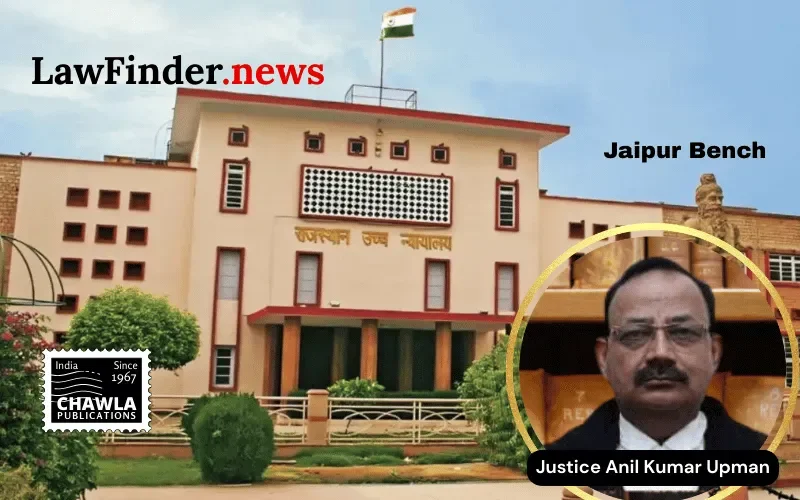
In a significant judgment dated 25th September 2026, the Rajasthan High Court (Jaipur Bench) dismissed a batch of petitions filed by A.L.D. Infratech Pvt. Ltd. and its director Deepak Kumar challenging orders that directed them to deposit 20% of the compensation awarded in multiple convictions under Section 138 of the Negotiable Instruments Act, 1881 (NI Act). The petitions arose from complaints filed by Baljeet Singh, alleging dishonour of cheques issued in connection with real estate transactions.
The petitioners contended that the orders directing deposit of 20% of the compensation were passed mechanically without considering the unique facts, including their plea that the cheques were issued only as security instruments and that there was a dispute regarding the underlying transactions. They also argued that the financial burden of deposit was onerous, claiming financial hardship. Crucially, they challenged the applicability of Section 148 of the NI Act, which empowers courts to order such deposits during the pendency of appeals, on the ground that the Negotiable Instruments (Amendment) Act, 2018 - which had inserted Sections 143-A and 148 into the NI Act - was repealed by the Repealing and Amending Act, 2025.
Rejecting these contentions, Justice Anil Kumar Upman observed that once amendments such as Sections 143-A and 148 are incorporated into a parent Act, they become an integral part of that Act. The subsequent repeal of the amending legislation (the 2018 Amendment Act) does not erase these provisions. The Court relied on the saving clause in the Repealing and Amending Act, 2025, and Section 6-A of the General Clauses Act, 1897, which preserve the continuance of such amendments notwithstanding repeal of the amending Act. The Court also referred to authoritative Supreme Court precedents, including Independent Schools' Federation of India v. Union of India (2024) and Jethanand Betab v. State of Delhi (1960), which support this principle.
Further, the Court held that the statutory language of Section 148, which uses the word "may" regarding the imposition of the deposit condition, still contemplates judicial discretion. However, the normal rule is that courts should direct deposit of at least 20% of the compensation awarded, with exceptions allowed only in "exceptional circumstances" supported by recorded reasons. The Court found that the petitioners' arguments - disputing the nature of the transaction, asserting cheques were security, or alleging financial hardship - were not sufficient to constitute such exceptional circumstances. Notably, the director had admitted issuance and signing of the cheques and owned companies with assets exceeding Rs.100 crore, undermining the financial hardship claim.
The High Court upheld the impugned orders directing deposit of 20% of compensation and dismissed the petitions. However, recognizing the complexity and peculiarity of the case, the Court directed the Appellate Court to expedite hearing of the appeals and conclude them within three months from receipt of the judgment copy.
This ruling reinforces the enforceability of Section 148 of the NI Act even after the repeal of the 2018 Amendment Act, underscoring that the repeal of an amending statute does not invalidate the amendments once incorporated into the principal legislation. It also clarifies the strict approach courts take towards deposit of compensation in appeals under Section 138, emphasizing that financial hardship or disputes on merits do not ordinarily exempt parties from this requirement.
Bottom Line:
Negotiable Instruments Act, 1881 Section 148 Repeal of the Negotiable Instruments (Amendment) Act, 2018 by the Repealing and Amending Act, 2025 does not wipe out Sections 143-A and 148 already incorporated in the parent Act - Appellate Court can continue to direct deposit of minimum 20% compensation in appeal against conviction under Section 138 - Mere plea that cheques were issued as security, dispute regarding underlying transaction, or assertion of financial hardship is not by itself an exceptional circumstance to dispense with such deposit.
Statutory provision(s):
Negotiable Instruments Act, 1881 Sections 138, 143-A, 148; Bharatiya Nagarik Suraksha Sanhita, 2023 Section 528; Repealing and Amending Act, 2025 Section 4; General Clauses Act, 1897 Section 6-A
A.L.D. Infratech Pvt. Ltd. v. Baljeet Singh, (Rajasthan)(Jaipur Bench) : Law Finder Doc Id # 2994147