Lucknow Bench sets aside Raebareli Executive Engineer’s order, holds electricity access part of dignified life under Article 21 and directs fresh decision within 10 days
The Allahabad High Court, Lucknow Bench, has ruled that a pending title or ownership dispute over a property cannot by itself be used to deny a fresh domestic electricity connection to a person who is in occupation of the premises and is willing to furnish an indemnity bond as required under the Electricity Supply Code, 2005.
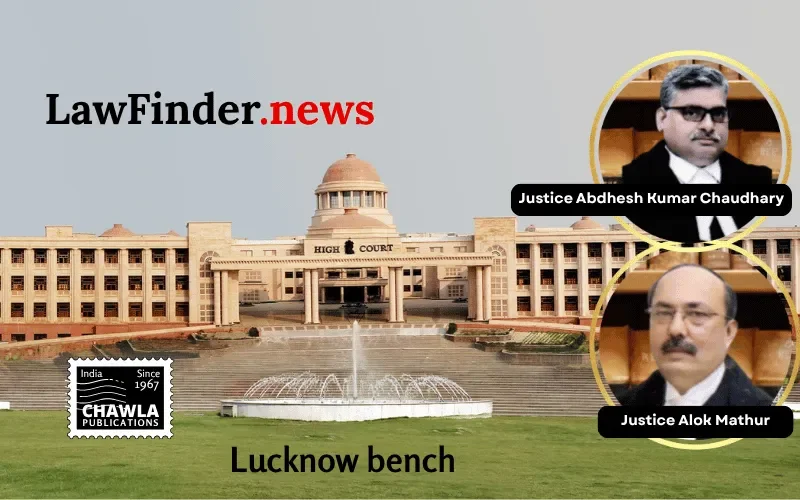
A Division Bench comprising Justice Alok Mathur and Justice Abdhesh Kumar Chaudhary passed the order in Rakesh Kumar Mishra v. State of U.P. through Principal Secretary, Energy Department and others on 5 October 2026.
The case arose after petitioner Rakesh Kumar Mishra sought a domestic electricity connection for a house in Kranti Puri, Jail Garden Road, Raebareli, where he claimed to be residing. His request was rejected by the Executive Engineer, Vidyut Vitran Khand-I, Raebareli, through an order dated 28 July 2026. The authority had held that a connection could be granted only on production of documents such as a registered sale deed, succession certificate, or no-objection certificate.
Before the High Court, the petitioner argued that the rejection was contrary to Clause 4.4 of the Electricity Supply Code, 2005. He contended that the provision does not restrict eligibility only to owners or persons holding title documents, but also permits proof of occupancy and even submission of an indemnity form as per Annexure 4.2.
The dispute over the property was already pending before a civil court in Raebareli in a suit concerning title and ownership. Opposite Party No. 5 opposed the petition, arguing that since the petitioner was not the owner and the civil suit was pending, no electricity connection should be granted during the pendency of the proceedings.
The High Court rejected that reasoning. It found that the Executive Engineer had considered only a part of Clause 4.4 and ignored the portion that allows an applicant to rely on an indemnity form. The Bench observed that the Code clearly permits consideration of a fresh electricity connection even where the applicant may not be the owner, provided he is in occupation and is ready to comply with the legal requirements, including payment of dues and furnishing of indemnity.
The court further held that access to electricity has a strong constitutional connection with Article 21 of the Constitution, which protects the right to life. It said that in modern society, electricity is closely linked with human dignity and is necessary for basic activities such as lighting, water access, cooking, refrigeration, communication, education, healthcare and livelihood. For this reason, the Bench said, access to electricity forms an important element of a dignified life and is reinforced by Article 14 and the Directive Principles of State Policy.
At the same time, the court clarified that this does not create an absolute right to free or unlimited electricity. Any such entitlement remains subject to lawful charges, technical standards, safety norms and other statutory requirements under the Electricity Act, 2003 and the regulations framed under it.
Relying also on the Supreme Court’s decision in Chameli Singh v. State of U.P. (1996) 2 SCC 549, the Bench noted that the right to shelter means more than mere physical occupation and includes the conditions necessary for living with dignity. It added that electricity authorities are generally expected to examine whether the applicant is in occupation and whether statutory and technical conditions are met, rather than adjudicate private title disputes between rival claimants.
Holding the rejection order to be illegal and arbitrary, the High Court allowed the writ petition and set aside the order dated 28 July 2026. It remitted the matter to the Executive Engineer for fresh consideration in accordance with law.
The Bench directed the authority to decide the petitioner’s application afresh within 10 days from the date a certified copy of the order is produced. It specifically said that if the petitioner is ready and willing to furnish the indemnity form, the application must not be rejected merely because a title dispute is pending before a competent civil court. If the application is allowed, the electricity connection is to be provided forthwith.
The ruling is significant as it reinforces that access to basic utilities cannot be denied arbitrarily and that electricity distribution authorities should not refuse connections solely because ownership claims are under challenge in civil litigation.
Bottom Line:
Electricity Supply Code, 2005 - Fresh domestic electricity connection - Mere pendency of title dispute before civil court cannot by itself be a ground to deny electricity connection to a person in occupation, if he is willing to furnish indemnity bond as per Clause 4.4 - Access to electricity held to be an important element of dignified life under Article 21 of the Constitution, though subject to statutory requirements.
Statutory provision(s): Constitution of India, Article 21, 226 and 14, Electricity Act, 2003, Electricity Supply Code, 2005, Clause 4.4; Electricity Supply Code, 2005, Annexure 4.2.
Rakesh Kumar Mishra v. State of U.P., (All)(DB)(Lucknow) : Law Finder Doc id # 3000389