Court clarifies Section 311 Cr.P.C. empowers courts to summon or recall witnesses at any trial stage, overruling trial court's dismissal; emphasizes no conflict with Section 362 Cr.P.C. which bars review of final judgments only
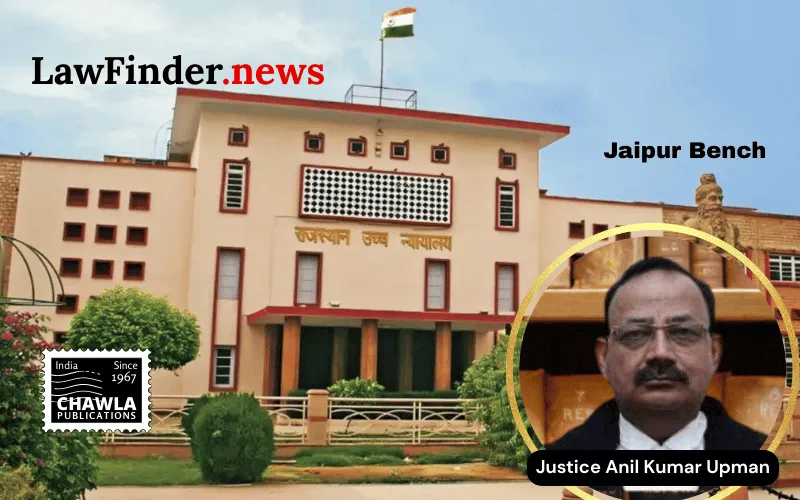
In a significant judgment dated August 19, 2026, the Rajasthan High Court (Jaipur Bench), presided over by Mr. Justice Anil Kumar Upman, reaffirmed the broad discretionary power of criminal courts under Section 311 of the Code of Criminal Procedure, 1973 (now Section 348 of the Bharatiya Nagarik Suraksha Sanhita, 2023) to summon or recall witnesses at any stage of trial, even after the prosecution evidence has been formally closed.
The case, Sattar v. State of Rajasthan, arose from a criminal trial in Sessions Case No. 05/2012 at the Additional District & Sessions Judge court, Kaman, District Deeg. The petitioner, Sattar, initially lodged an FIR and was examined as PW-1 along with other witnesses. After evidence was closed, additional accused were summoned and charged, necessitating examination of certain material prosecution witnesses again. However, the trial court refused to re-summon these witnesses, holding that such a request would amount to reviewing its earlier order closing evidence, which it deemed barred by Section 362 Cr.P.C. (corresponding to Section 403 BNSS), prohibiting review or alteration of final judgments or orders.
Challenging this order, the petitioner contended that Section 311 Cr.P.C. confers an independent and substantive power on the court to summon or recall witnesses if their evidence is essential for a just decision, and that this power is distinct from and not curtailed by Section 362 Cr.P.C.
Justice Upman analyzed the scope of Section 311 Cr.P.C., emphasizing the Supreme Court precedents which describe it as a "vast" power exercisable at any stage of trial. The court cited the Supreme Court's rulings in Mohanlal Shamji Soni v. Union of India (1991), Vijay Kumar v. State of Uttar Pradesh (2011), and Varsha Garg v. State of Madhya Pradesh (2022), which underscore that closure of evidence does not oust the court's jurisdiction to summon or recall witnesses if their testimony is necessary for just adjudication.
The court further clarified the distinction between Sections 311 and 362 Cr.P.C. Section 362 restricts review only of signed final judgments or orders, not interim orders or the exercise of power during trial. The Court held that the trial court's order closing prosecution evidence was not a final order within the ambit of Section 362, and thus the trial court was not functus officio (without jurisdiction) to entertain an application under Section 311.
Applying these principles to the facts, the High Court found that the material witnesses sought to be re-examined were crucial for a just decision, especially since charges had been framed against additional accused after the initial closure of evidence. The Court observed that no prejudice would be caused to the accused as they would have full opportunity to cross-examine the witnesses.
Accordingly, the High Court set aside the trial court's order dismissing the application under Section 311 Cr.P.C. and directed the trial court to summon and examine/re-examine the witnesses PW-1 (Sattar), PW-2 (Imran), PW-3 (Anisha), and PW-5 (Ummed Haji) in accordance with law. The court also instructed that the accused be afforded full opportunity to cross-examine and directed the trial court to proceed further with the trial.
This ruling reaffirms the judiciary's commitment to preventing failure of justice due to procedural technicalities, ensuring courts retain necessary powers to consider all material evidence. It also clarifies that the power to summon or recall witnesses remains exercisable throughout the trial until final judgment, facilitating a fair trial process.
Bottom Line:
Section 311 of the Code of Criminal Procedure, 1973 (now Section 348 of the Bharatiya Nagarik Suraksha Sanhita, 2023) confers independent and substantive power upon the court to summon, recall, or re-examine witnesses at any stage of trial or inquiry, even after the evidence has been closed, if such evidence is essential for a just decision of the case.
Statutory provision(s):
Section 311 Cr.P.C. (now Section 348 BNSS), Section 362 Cr.P.C. (now Section 403 BNSS), Sections 148, 302, 323, 341, 34 IPC, Section 319 Cr.P.C. (now Section 358 BNSS)
This report summarizes the Rajasthan High Court's decision emphasizing the independent and substantive nature of Section 311 Cr.P.C. powers and their interplay with Section 362 Cr.P.C., ensuring justice is not defeated by premature closure of evidence in criminal trials.
Sattar v. State of Rajasthan, (Rajasthan)(Jaipur Bench) : Law Finder Doc Id # 2971968