Court Rules Taxable Event is Possession in Business, Not Actual Road Use; Validates Provisions Including Trade Certificate Scheme and Rejects Constitutional Challenges
In a significant judgment delivered on November 6, 2026, the Rajasthan High Court (Division Bench, Jaipur) ruled in favor of the State of Rajasthan in a batch of writ petitions filed by Honda Motorcycle and Scooter India Pvt. Ltd. and others challenging the levy of tax under Section 4(1)(d) of the Rajasthan Motor Vehicles Taxation Act, 1951. The petitioners had contended that the tax should be levied only if the motor vehicles manufactured and held by them inside their factories were actually used on roads in Rajasthan. They also challenged the vires of the proviso to Section 39 of the Motor Vehicles Act, 1988, Rule 33 of the Central Motor Vehicles Rules, 1989, and the notification dated March 31, 2000 issued under the State Act.
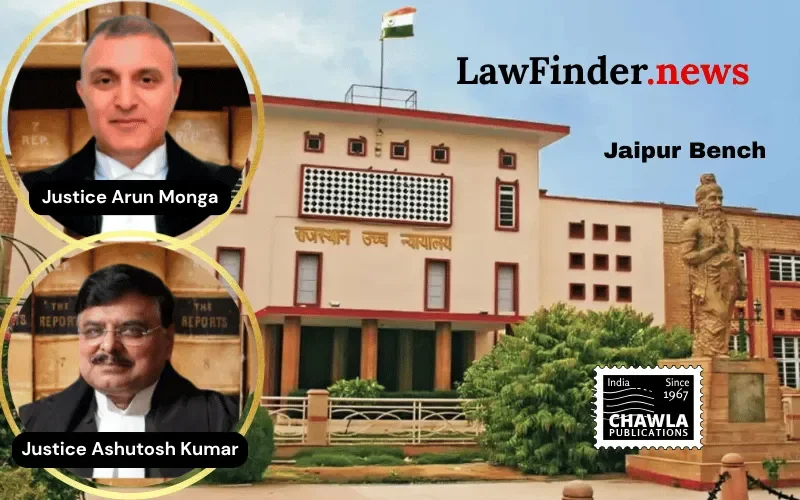
The Court, presided by Justices Arun Monga and Ashutosh Kumar, examined the constitutional entries, the State and Central enactments, and precedents to settle three key legal questions: the nature of the taxable event under Section 4(1)(d), the applicability and validity of the trade certificate scheme, and the constitutional validity of the tax levy.
On the first issue, the Court held that the taxable event is the possession of motor vehicles by a dealer or manufacturer in the course of business, and not the actual use of the vehicles on State roads. It interpreted the phrase "used or kept for use in the State" in the statute as indicating availability for use, not actual use. The Court noted that vehicles adapted for use on roads, held by manufacturers inside their Rajasthan factories pending dispatch, fall within the charge, regardless of whether they are driven on Rajasthan roads.
On the second issue concerning the Motor Vehicles Act, 1988, and the trade certificate rules, the Court held that Section 39 extends to the driving of unregistered vehicles within private premises, including factory yards and internal roads, which qualify as "any other place" under the provision. Therefore, a trade certificate is necessary whenever the vehicle is moved, even within factory premises. The challenge to Rule 33 of the Central Motor Vehicles Rules, which extends the exemption from registration to manufacturers in addition to dealers, was rejected. The Court observed that Rule 33 confers an exemption and not a burden, and even if it extends beyond the proviso to Section 39, it does not invalidate the State tax provision.
On the constitutional validity of the tax, the Court rejected the petitioners' claim that the levy is in substance a duty of excise and hence beyond the State's legislative competence. It held that the levy targets possession in the course of business, not manufacture per se, and is thus within Entry 57 of List II of the Constitution. The Court further clarified that after the Supreme Court's ruling in Jindal Stainless Limited v. State of Haryana (2017), the compensatory character of the levy is not a constitutional requirement. It also dismissed claims under Articles 301 and 304 concerning trade freedom and discrimination, holding the levy non-discriminatory and not an impediment to inter-state trade.
The Court distinguished the ruling in Tarachand Logistic Solutions Limited v. State of Andhra Pradesh (2025), which confined the levy to vehicles used in "public places," noting that Section 4(1) of the Rajasthan Act does not include such a limitation. It also differentiated the Ultratech Cement Limited v. State of Gujarat (2026) judgment, which involved vehicles adapted solely for use within enclosed premises and thus excluded from the tax.
Finally, the Court upheld the validity of the challenged provisions and dismissed the writ petitions to the extent they contested the constitutional validity of the tax. However, it allowed the petitioners liberty to challenge individual assessment orders on grounds such as breach of natural justice, incorrect computation of vehicles for tax, interest, or penalty before the designated authorities. Interim orders in favor of the petitioners were vacated, but appeals filed within eight weeks would be entertained without limitation.
This ruling clarifies that manufacturers holding motor vehicles within Rajasthan are liable to pay tax under the State Motor Vehicles Taxation Act regardless of whether the vehicles have been driven on State roads, thus reinforcing the State's power to levy motor vehicle tax on possession in the course of business.
Bottom Line:
The taxable event under Section 4(1)(d) of the Rajasthan Motor Vehicles Taxation Act, 1951, is the possession of motor vehicles by a dealer or manufacturer in the course of their business. Proof of actual use of state roads is not required, as the expression "used or kept for use in the State" denotes availability for use and not actual use. The levy under Section 4(1)(d) is constitutionally valid and is not a duty of excise, nor does it contravene Articles 14, 301, or 304 of the Constitution.
Statutory provision(s):
Rajasthan Motor Vehicles Taxation Act, 1951 Section 4(1)(d), Motor Vehicles Act, 1988 Section 39, Central Motor Vehicles Rules, 1989 Rule 33, Notification S.O. 413 dated 31.03.2000