Supreme Court Slams Arbitrary Vehicle Repossession, Awards Rs. 10 Lakh Compensation to Truck Owner,Apex Court directs Cholamandalam Finance to refund Rs. 4.5 lakh sale proceeds, close loan accounts, and orders RBI to enforce Fair Practices Guidelines strictly after midnight seizure of truck found violative of Articles 14 and 21
New Delhi, September 16, 2026: In a landmark ruling with far-reaching implications for millions of vehicle loan borrowers across India, the Supreme Court on Tuesday set aside a high court order that had dismissed a writ petition filed by a small truck owner whose vehicle was repossessed in the dead of night without prior notice and subsequently sold without his knowledge.
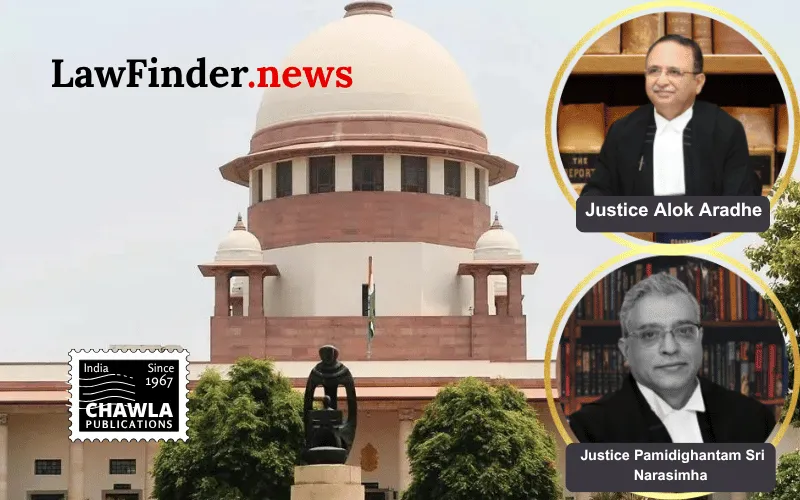
A Division Bench comprising Justices Pamidighantam Sri Narasimha and Alok Aradhe delivered the ruling in Hari Dutta Sharma v. State of U.P. & Ors. (Civil Appeal No. 12950 of 2026), holding that the repossession of a financed vehicle by Cholamandalam Investment and Finance Company Limited was arbitrary, illegal, and violative of fundamental rights guaranteed under Articles 14 and 21 of the Constitution of India.
Background of the Case
The appellant, Hari Dutta Sharma, a man of modest means from Ayodhya, Uttar Pradesh, had obtained a commercial vehicle loan of approximately Rs. 10.40 lakh in March 2019 for a Tata SFC 407 truck, which served as his sole source of livelihood. While he did default on loan instalments, the manner of repossession was deeply contested.
According to the appellant, on the night of April 9, 2023, at around 1:00 a.m., while his truck was parked under CCTV surveillance at a consignor's godown in Ayodhya, four unidentified persons broke open the vehicle's steering lock and drove it away. The appellant lodged an FIR the same day, believing the vehicle had been stolen. It was only on September 30, 2023, that he received a legal notice from the company disclosing that the truck had already been sold on August 31, 2023 for Rs. 4.50 lakh, and that he still owed a balance of Rs. 1.25 lakh.
The Allahabad High Court had dismissed his writ petition, holding that he had approached the court belatedly and had been a defaulter. The Supreme Court reversed this finding entirely.
Supreme Court's Findings
The Bench made several critical observations. First, it noted that no seven-day notice as mandated by Article 11(a)(i) of the loan agreement itself was issued to the appellant before repossession. Second, the possession memorandum did not bear the appellant's signature, confirming that possession was taken without following due process. Third, the vehicle was seized by breaking open the steering lock at midnight — a mode the Court described as bearing "every mark of the very 'goonda-ism'" condemned by the Supreme Court in ICICI Bank Ltd. v. Prakash Kaur (2007) and by RBI in successive guidelines.
The Court further scrutinized Article 11 of the Loan Agreement, which permitted the company to waive notice at its own discretion and authorized recovery agents to enter any premises to seize the asset. The Bench held that such clauses were neither in conformity with RBI Guidelines on Fair Practices Code for Lenders nor with the Indian Contract Act, 1872, as they placed the borrower entirely at the mercy of the financier's unilateral discretion.
Rejecting the High Court's finding of delay, the Court noted that the appellant had diligently filed an FIR on the day of incident, pursued criminal remedies under Section 156(3) CrPC, and continued to receive traffic challans for the vehicle even after the company claimed to have sold it — a circumstance the Court said demanded explanation.
Constitutional Violation and Compensation
The Court held unequivocally that the arbitrary deprivation of the appellant's truck — his sole means of livelihood — constituted a violation of Articles 14 and 21 of the Constitution, entitling him to compensation. The Bench directed:
- - The company shall close both loan accounts of the appellant;
- - The company shall refund Rs. 4,50,000 (the sale proceeds of the vehicle) with interest at 6% per annum from the date of sale;
- - The appellant is awarded Rs.10,00,000 as compensation for mental agony and loss of livelihood;
- - Costs of Rs. 50,000 imposed on the company.
Stern Direction to RBI
In one of the most significant aspects of the judgment, the Court directed the Reserve Bank of India to take effective steps to secure genuine compliance by NBFCs and Scheduled Commercial Banks with its Guidelines, Master Circulars, and Clarifications issued from time to time. The Court bluntly observed that the RBI's guidelines "have existed only on paper" and that no meaningful steps have been taken to implement them, directing the Registry to send a copy of the judgment to the RBI.
The ruling is expected to serve as a crucial precedent protecting lakhs of small borrowers — particularly truck operators and transporters — from coercive and extrajudicial recovery practices.
Bottom Line:
he repossession of a vehicle financed by a company must adhere to the procedural safeguards outlined in RBI Guidelines and the Indian Contract Act, 1872. Arbitrary repossession and sale without notice violate Articles 14 and 21 of the Constitution and entitle the borrower to compensation.
Statutory Provision(s):
Section 35A of the Banking Regulation Act 1949, Articles 14 and 21 of the Constitution of India 1950, Indian Contract Act 1872, Section 156(3) of the Code of Criminal Procedure 1973, RBI Guidelines on Fair Practices Code for Lenders 2003, RBI Guidelines on Fair Practices Code for NBFCs 2006, RBI Master Circulars on Recovery Agents 2008-2015
Hari Dutta Sharma v. State of U.P., (SC) : Law Finder Doc Id # 2979834