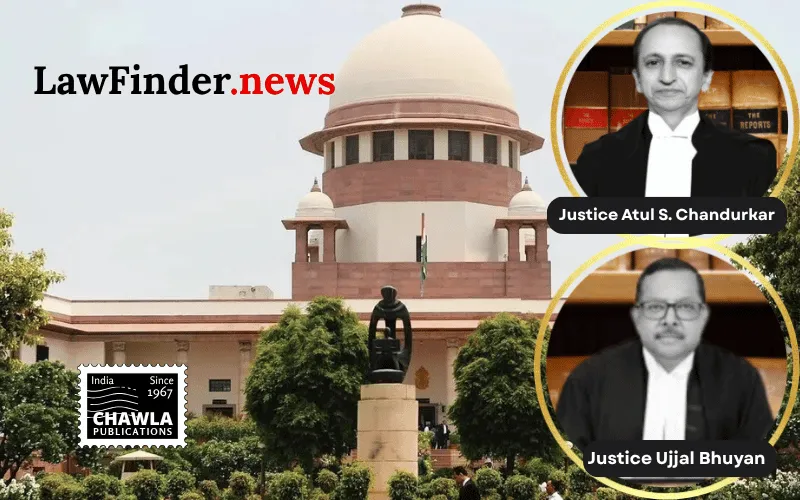
Supreme Court Rules Chennai Tribunal Had No Jurisdiction Over Andhra Pradesh Road Accident Claim, Apex Court Upholds Madras High Court Order Transferring Motor Accident Case to Chittoor Tribunal, Clarifies Insurer's Office Location Cannot Confer Territorial Jurisdiction
New Delhi, September 16, 2026: The Supreme Court of India on Tuesday dismissed an appeal challenging the transfer of a motor accident compensation claim from Chennai to Chittoor, Andhra Pradesh, delivering a significant ruling on the territorial jurisdiction of Motor Accidents Claims Tribunals under the Motor Vehicles Act, 1988.
A bench comprising Justices Ujjal Bhuyan and Atul S. Chandurkar held that the presence of an insurance company's office at a particular location does not, by itself, confer territorial jurisdiction upon the Claims Tribunal at that location to adjudicate a compensation claim.
Background of the Case
The case arose from a road accident on October 25, 2022, when appellant K. Rashik was riding his two-wheeler along with his brother in District Tirupati, Andhra Pradesh. A mini truck driven by the second respondent collided with their vehicle, causing injuries. The appellant received treatment at a hospital in Tirupati, and a First Information Report was registered at Yerravaripalem Police Station, District Tirupati.
Despite the accident occurring in Andhra Pradesh and the claimant's permanent address being in Chittoor district, Andhra Pradesh, the appellant filed his compensation claim before the Motor Accidents Claims Tribunal in Chennai. The basis for this choice was the presence of the National Insurance Company Limited's office in Chennai.
Tribunal's Initial Order and High Court Intervention
The Chennai Tribunal initially upheld its own jurisdiction, ruling that since the insurer conducted business in Chennai, it had the competence to hear the matter. However, National Insurance Company Limited successfully challenged this order before the Madras High Court under Article 227 of the Constitution of India.
A learned Single Judge of the Madras High Court on March 16, 2026, set aside the Tribunal's order, holding that the accident occurred in Tirupati and the claimant resided in Chittoor. Since no part of the cause of action arose within Chennai's jurisdiction, the Tribunal there lacked territorial authority. The proceedings were accordingly transferred to the Tribunal at Chittoor.
Supreme Court's Analysis
Upholding the Madras High Court's decision, the Supreme Court extensively analyzed Section 166(2) of the Motor Vehicles Act, 1988, which governs territorial jurisdiction for filing compensation claims. The Court identified the four options available to a claimant:
1. Where the accident occurred
2. Where the claimant resides
3. Where the claimant carries on business
4. Where the defendant resides
The Court drew a critical distinction: while a claimant can file a claim where they reside or carry on business, the jurisdiction based on the defendant's location is confined to where the defendant resides — notably excluding where the defendant carries on business. This deliberate legislative omission, the Court noted, contrasts with Section 20 of the Code of Civil Procedure, 1908, which does permit jurisdiction based on where a defendant carries on business.
Insurer Not a "Defendant" for Jurisdictional Purposes
The Court further clarified that the term "defendant" in Section 166(2) does not ordinarily refer to an insurer. Since impleading an insurer as a party is optional — not mandatory — under the scheme of the Act, the insurer's business location cannot form the basis for territorial jurisdiction. The Court observed that under Section 168(1) of the Act, the Tribunal is required to notify the insurer regardless of whether it is formally impleaded as a party.
Insurer's Right to Object Upheld
Addressing the appellant's argument that the insurer had no locus to raise jurisdictional objections, the Court relied on the three-Judge Bench ruling in United India Insurance Co. Ltd. v. Shila Datta (2011), reaffirming that once an insurer is impleaded as a party-respondent by a claimant, it is entitled to contest the proceedings on all grounds — including territorial jurisdiction — without restriction.
Original Stage vs. Appellate Stage Distinguished
The Court also clarified the legal distinction between jurisdictional objections raised at the original stage and those raised at the appellate stage. When raised before the Tribunal at the initial stage, the requirements of Section 166(2) must be strictly satisfied. However, when raised at the appellate stage after an award has been passed, Section 21 of the Code of Civil Procedure is also attracted, requiring the objecting party to demonstrate failure of justice resulting from the jurisdictional defect.
Since in the present case, the objection was raised at the preliminary stage before the Tribunal itself, Section 21 of the CPC was held inapplicable, and only the requirements of Section 166(2) needed to be satisfied.
Court's Conclusion
The Supreme Court concluded that since the claimant resided in Chittoor, the accident occurred in Tirupati, and no part of the cause of action arose in Chennai, the Chennai Tribunal was entirely devoid of territorial jurisdiction. The Court emphasized that while the Motor Vehicles Act is a beneficial legislation requiring a liberal interpretation, such interpretation must remain anchored to the plain language of the statute.
The Civil Appeal was dismissed with no order as to costs, and the Tribunal at Chittoor was directed to adjudicate the claim expeditiously.
Bottom Line:
Motor Vehicles Act, 1988 - Territorial jurisdiction for filing a claim under Section 166(1) is governed by Section 166(2) - Claimant has the option to file the claim in the area where the accident occurred, where the claimant resides or carries on business, or where the defendant resides - The insurer's business location does not confer territorial jurisdiction unless the specific conditions under Section 166(2) are met.
Statutory Provisions: Section 166(1) of the Motor Vehicles Act 1988, Section 166(2) of the Motor Vehicles Act 1988, Section 168(1) of the Motor Vehicles Act 1988, Section 169 of the Motor Vehicles Act 1988, Section 149(2) of the Motor Vehicles Act 1988, Section 170 of the Motor Vehicles Act 1988, Section 20 of the Code of Civil Procedure 1908, Section 21 of the Code of Civil Procedure 1908, Article 227 of the Constitution of India, Article 142 of the Constitution of India
K Rashik v. National Insurance Company Ltd., (SC) : Law Finder Doc Id # 2979569