New Delhi, Aug 7 The Supreme Court on Friday directed two private hospitals in Ghaziabad to pay a total of Rs 12 lakh to the family of a four-year-old rape victim who died after allegedly being denied emergency medical treatment.
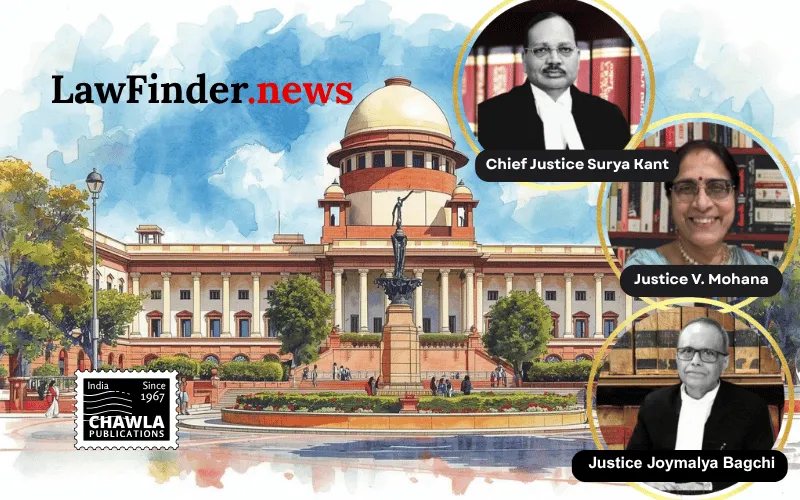
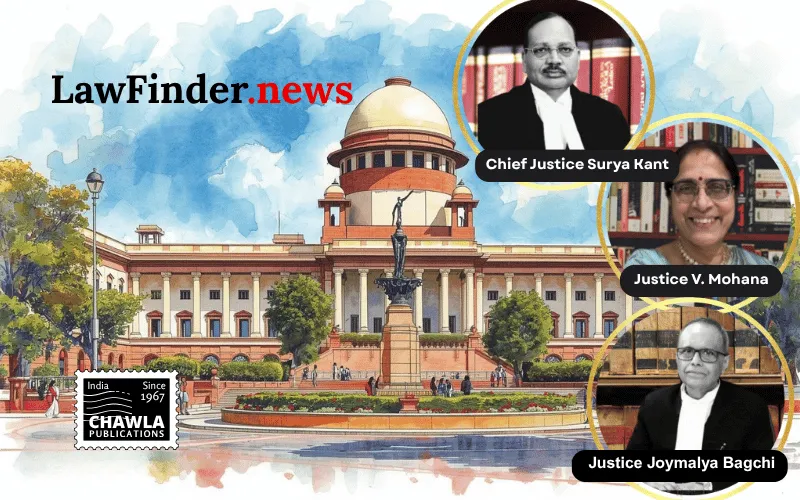
Observing that the case exposed a "disturbing" gap between legal safeguards and their implementation on the ground, a bench comprising Chief Justice Surya Kant and justices Joymalya Bagchi and V Mohana said it would frame broad guidelines for hospitals and law enforcement agencies on handling victims of grave offences to ensure that such lapses do not recur.
Taking note of the SIT's findings that the child remained alive for nearly five hours after sustaining grievous injuries but was denied timely medical care, the bench directed St. Joseph (Mariam) Hospital to pay Rs 10 lakh and Khajan Singh Mannvi Health Care to pay Rs 2 lakh to the girl's father within four weeks.
The bench was hearing a petition filed by the girl's father, a daily wage labourer, seeking a court-monitored probe into the March incident.
The court had earlier constituted a Special Investigation Team (SIT) after expressing serious concern over the handling of the case by Uttar Pradesh Police and the refusal of private hospitals to treat the child.
The case relates to the alleged rape and murder of the girl on March 16 after she was allegedly lured away by a neighbour. According to the petition, the child was found unconscious and bleeding profusely by her family.
She was first taken to the two private hospitals, both of which allegedly refused to provide emergency treatment, before she was shifted to a government hospital where she was declared dead.
The SIT report, placed before the court, found that the child had survived for nearly five hours after the assault and that the refusal of the two private hospitals to provide immediate medical care contributed to her death.
Senior advocate N Hariharan, appearing for the victim's family, said that the hospitals had the necessary facilities to stabilise the child but failed to do so.
He argued that the first hospital did not even attempt to call emergency doctors despite having the facility, while the second multi-speciality hospital also failed to provide life-saving treatment.
"It is a clear case of negligence on the part of the hospitals. The child could have been alive," Hariharan said, saying that the court to direct compensation and issue systemic directions to prevent similar incidents.
It was "a case of sheer negligence by hospitals", the bench said, adding it had been considering directing compensation to the victim's family.
Hariharan also highlighted alleged lapses in the police investigation, saying that the police failed to faithfully record the father's statement while registering the FIR and initially invoked only the offence of murder despite the circumstances indicating sexual assault.
He pointed to a delay of nearly 30 hours in registration of the FIR and submitted that insensitive investigation practices often multiply the trauma suffered by victims' families.
The matters involving victims of grave offences are sometimes handled in "an insensitive, inhuman and degraded manner" that compounds victimisation, the bench said.
Emphasising the need for institutional reforms, it said that while statutory safeguards, constitutional protection under Article 21 and established legal mechanisms exist, their promise often remains confined to the "rarefied atmosphere of the courts", when victims encounter a very different reality on the ground.
"The law is there and the law is in motion. But there is a gap. The question is how to bridge that gap," the bench said.
The CJI said that there was a need for greater sensitisation of police personnel through periodic training and orientation programmes so that empathy and prompt action become integral to criminal investigations.
The bench said that police officers dealing with victims at crucial moments must demonstrate sensitivity to maintain public trust and confidence in the justice system.
It also underscored the obligation of medical institutions to preserve life, observing that Article 21 imposes a duty on every hospital to provide emergency medical care irrespective of other considerations.
Justice Bagchi questioned the conduct of one of the hospitals, observing that referring a critically injured child to another facility merely two kilometres away could prove fatal.
"Two kilometres for a victim who is haemorrhaging can be fatal," Justice Bagchi said, adding that just as heart attack patients have a "golden window" for treatment, the four-year-old victim should have at least been administered blood or other emergency care before being referred elsewhere.
Referring to the SIT report, Justice Bagchi said that emergency doctors could have been summoned but no such effort was made.
Hariharan, describing the ordeal faced by the family, submitted that the child remained alive for nearly five hours while her parents desperately searched for medical assistance.
The bench had earlier, in April, criticised Ghaziabad Police for its "insensitive approach" and reluctance in promptly registering an FIR and conducting a proper investigation.
It had thereafter constituted the SIT to probe the incident and issued notices to the Uttar Pradesh government, the station house officer concerned, the two hospitals and the executive magistrate.