New Delhi, Aug 5 The Supreme Court, which on Wednesday commenced the final hearing on the pleas of the Uddhav Thackeray-led faction against the Election Commission's decision recognising the Eknath Shinde-led faction as the "real Shiv Sena", observed that the political party retains control over its legislature wing and its valid decisions must prevail.
The top court, however, also batted for granting some "elbow room" to elected representatives to make political decisions if the majority of them "genuinely disagree" with the directions of the political party.
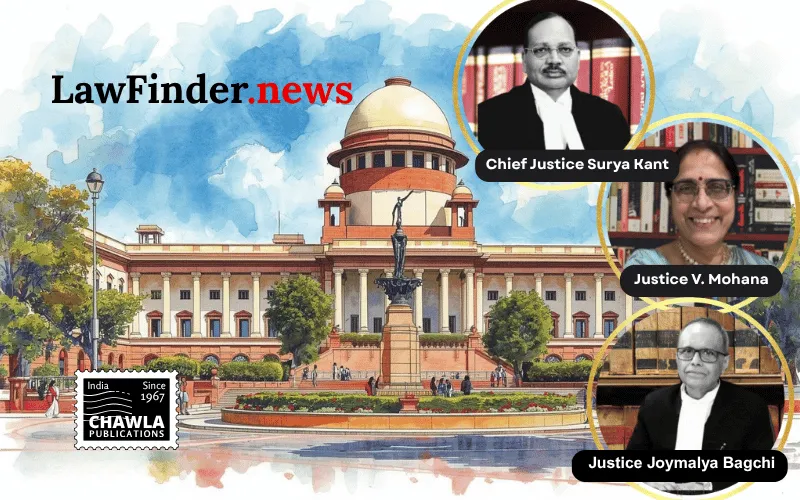
A bench comprising Chief Justice Surya Kant and Justices Koymalya Bagchi and V Mohana started the final hearing on the two pleas filed in 2024 against the poll panel's order allotting the 'bow and arrow' symbol to Maharashtra Deputy Chief Minister Eknath Shinde-led faction.
The pleas have challenged the February 17, 2023 order of the EC recognising the Shinde faction as the original Shiv Sena.
At the outset, senior advocate Kapil Sibal, appearing for the Thackeray-led party, said the Election Commission had ignored the party's Constitution and that it had received the amended Constitution of Shiv Sena in March 2013. It continued to remain available on the EC's website.
Sibal said the core issue is whether the legislative party can upstage and take over the political party. He contended that the answer is "No".
“This is the law… But now something new is happening, not merely with reference to this case. There is an entirely new phase of defections. What happens now is that the legislature party, without the political party, merges with another political party.
“Having contested on one symbol, its members then represent another political party on a different symbol. You are carrying this shenanigan to an absurd level where the entire electoral process becomes a farce because the electoral verdict can be changed through manipulation and defection. The government that comes into existence is not the government that the people voted for. This has huge repercussions,” the senior lawyer said.
Justice Bagchi took note of the submissions and orally observed, “The control of the political party subsists over the legislature party. Any valid decision of the political party has to prevail over the will even of the majority of the legislature party.”
The judge then referred to a judgement and said it had considered the issue of defections.
“But there may also be questions involving a pre-poll alliance and a post-poll alliance, as in the facts of this case. We are not going into the issue of revisiting the S.R. Bommai (judgement) or any other principle,” Justice Bagchi said.
The judge said suppose a political party enters into a pre-poll alliance and seeks votes on that basis, but after the election decides to form a government with one of the opposing political parties.
“In such a situation, if a majority of the legislators genuinely disagree and seek to take a different position, they would still have to go back to the political party.
"We have to understand representative participation in a parliamentary democracy. At the same time, we must give elected representatives some elbow room to make political decisions without losing their identity,” Justice Bagchi said.
The bench then asked whether the symbol belongs to the political party or to the leader of the legislature party.
Sibal said that the symbol always belongs to the political party.
He questioned the Maharashtra Assembly Speaker's decision to recognise the rival faction on the basis of legislative majority, saying that it runs contrary to the Constitution Bench judgment delivered by the apex court in the 2023 Maharashtra political crisis.
Referring to party records from 2018, Sibal said that Eknath Shinde was shown as a member of the Shiv Sena's National Executive under the party structure headed by Uddhav Thackeray as ‘Paksh Pramukh’.
He said that both factions had, until the split, accepted the validity of the 2013 and 2018 party Constitutions.
Under Thackeray's leadership, Shiv Sena contested and won successive Lok Sabha and Maharashtra Assembly elections between 2014 and 2019 under the same party Constitution.
He said that throughout this period, constitutional authorities, including the Election Commission and legislative authorities, recognised Thackeray's leadership and never questioned the validity of the party Constitution or his authority to lead the organisation.
He said the Election Commission exceeded its jurisdiction as under Paragraph 15 of the Election Symbols (Reservation and Allotment) Order, it was not empowered to determine the validity of a political party's Constitution.
The poll panel wrongly proceeded on the premise that the 2013 and 2018 constitutions were not on record and consequently treated the legislative majority as determinative of the party's identity, he said.
Sibal said legislators, even if constituting a majority in the legislature party, could not claim to represent the political party by acting independently of its organisational leadership.
He said the actions of the Shinde camp in moving out of Maharashtra, passing resolutions and subsequently aligning with another political formation amounted to voluntarily giving up membership of the original political party.
The CJI said there must be defined standards under the Election Commission's guidelines, the party constitution or a statute to assess majority claims.
The hearing will resume on Thursday.