New Delhi, Oct 13 The Supreme Court on Tuesday refused to entertain a plea alleging that personnel of the Uttar Pradesh Anti-Terrorism Squad (ATS) entered the petitioner's residence without wearing proper uniforms or displaying identification.
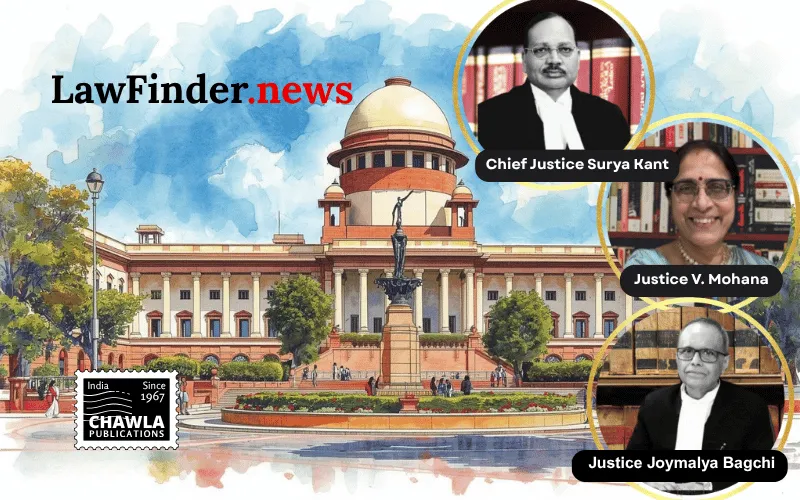
A bench comprising Chief Justice Surya Kant and Justices Joymalya Bagchi and V Mohana asked the counsel for petitioner Waiz Khan to approach the Allahabad High Court for relief.
During the hearing, the bench expressed its reluctance to entertain the petition at the first instance, saying that Khan approached the top court directly under Article 32 of the Constitution without first moving the high court.
Article 32 gives every citizen the right to approach the Supreme Court directly to enforce their fundamental rights.
“If I am coming under Article 32, the Supreme Court can't (shy away),” the counsel said.
Justice Bagchi said Articles 32 and 226 of the Constitution provide overlapping jurisdiction in matters involving violations of fundamental rights.
Article 226 empowers every high court to issue directions, orders, or writs for the enforcement of fundamental rights.
Justice Bagchi said the court of first instance should ordinarily be allowed to examine such allegations.
“We would always prefer a court of first instance to take cognisance of violation of fundamental rights,” Justice Bagchi said.
The petitioner's counsel also invoked the Supreme Court's landmark judgment in D K Basu vs State of West Bengal, which laid down safeguards against custodial abuse and illegal arrest.
Justice Bagchi, however, referred to the availability of remedies before the high court in cases involving alleged violations of personal liberty.
The counsel maintained that the petitioner had questioned how ATS personnel could enter his residence without displaying badges or proper identification.
The CJI, however, asked why the petitioner had not approached the High Court with these allegations.
The counsel persisted that an alleged violation of fundamental rights was, by its very nature, a violation of the Constitution and warranted the Supreme Court's intervention under Article 32.
“No case to entertain the petition made out. Dismissed. The petitioner, if so advised, may approach the high court,” the bench ordered.