Supreme Court Sets Aside “Natural Life” Sentence in Punjab Murder Case, Reduces Punishment to 25 Years Without Remission, Court holds Sessions Court cannot bar statutory remission while sentencing under Section 302 IPC; conviction of two men for killing a woman and her two minor daughters upheld.
The Supreme Court on September 24, 2026, partly allowed an appeal filed by Naval Kishore and another convict in a brutal triple murder case from Punjab, ruling that a Sessions Court has no authority to direct that a convict remain in prison for the rest of his natural life while sentencing under Section 302 of the Indian Penal Code.
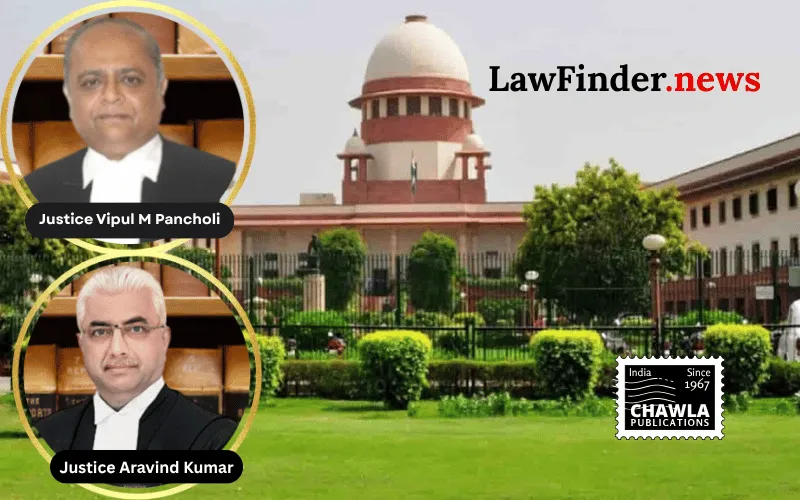
A bench of Justices Aravind Kumar and Vipul M. Pancholi upheld the conviction of the appellants for murdering Pinki @ Simran and her two minor daughters, but struck down the trial court’s direction that they should “remain in prison till rest of their life.” The Court held that such a special category sentence, which effectively excludes statutory remission and commutation, can be imposed only by Constitutional Courts such as the High Courts and the Supreme Court, and not by a Sessions Court.
The case arose from the murder of Pinki and her daughters Divya and Pooja in December 2009. According to the prosecution, the victims were found dead near railway tracks in Ludhiana with injuries caused by sharp-edged weapons. The investigation led to the arrest of Ashok Kumar, the husband of the deceased, and later his brother Jyoti Kumar and friend Naval Kishore. The prosecution relied on last-seen evidence, extra-judicial confession, recoveries made on disclosure statements, and forensic material including DNA evidence.
The trial court had convicted all three accused under Section 302 read with Section 34 IPC and sentenced them to rigorous imprisonment for life, adding that they would remain in prison for the rest of their natural lives. The High Court later affirmed both the conviction and sentence, but the Supreme Court found that the special life sentence had not been properly examined.
In its judgment, the Court explained that while “imprisonment for life” ordinarily means imprisonment for the remainder of the convict’s natural life, it remains subject to remission and commutation powers under Sections 432 to 435 of the Code of Criminal Procedure, as well as the constitutional powers of the President and Governors. It relied on earlier decisions including Swamy Shraddananda (2), Union of India v. V. Sriharan, Ravinder Singh, and Kiran v. State of Karnataka to reiterate that only Constitutional Courts can impose a punishment beyond the ordinary remission framework.
The bench also noted that Parliament has, in certain later provisions, expressly stated that life imprisonment shall mean imprisonment for the remainder of the person’s natural life. Since Section 302 IPC contains no such wording, the trial court could not read that punishment into the provision on its own.
Bottom Line:
Sessions Court cannot impose a special category sentence directing that convict shall remain in prison for the rest of natural life so as to exclude statutory remission/commutation - Such power is available only to Constitutional Courts, i.e. High Courts and Supreme Court - In exercise of such power, Supreme Court modified sentence from life imprisonment till remainder of natural life to rigorous imprisonment for 25 years without statutory remission.
Naval Kishore v. State of Punjab, (SC) : Law Finder Doc Id # 2985006