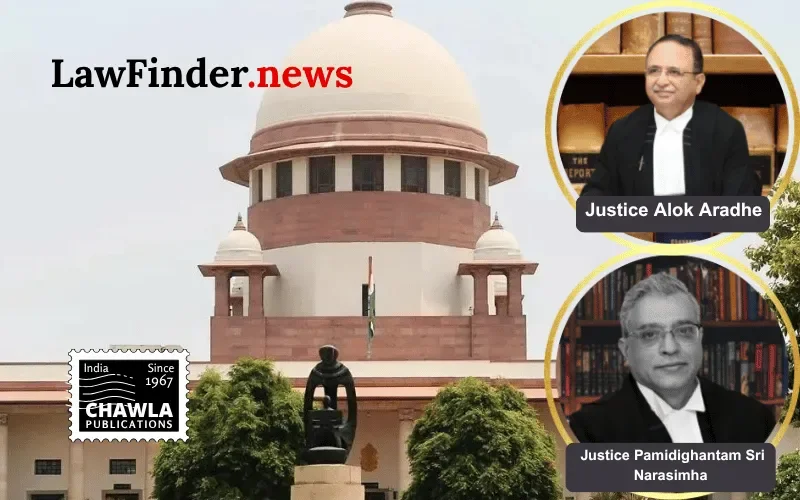
Top court says no enforceable contract arises in public auction until allotment letter and conveyance deed are issued; administration can cancel pre-conveyance sale to maximise public revenue if action is fair
The Supreme Court has directed the Chandigarh Administration to conduct a fresh e-auction of Nursing Home Site No. 4 in Sector 33C, Chandigarh, after holding that no enforceable contract had come into existence in favour of Bedi Hospital despite acceptance of its bid, payment of the full sale price, and execution of an agreement to sell.
A Bench of Justices Pamidighantam Sri Narasimha and Alok Aradhe delivered the judgment on October 16, 2026, in appeals filed by Satinder Pal Singh and others and the Chandigarh Administration against a Punjab and Haryana High Court order that had quashed the cancellation of Bedi Hospital’s bid and agreement to sell.
The dispute arose from an e-auction conducted by the Chandigarh Administration in October 2022 for two identical nursing home sites in Sector 33C. Both plots measured 744.44 square yards and had a reserve price of Rs 6.91 crore. While Site No. 3 fetched Rs 18.25 crore, Site No. 4 was knocked down in favour of Bedi Hospital for Rs 12.58 crore.
After being declared the highest bidder for Site No. 4, Bedi Hospital deposited 25% of the amount, executed an agreement to sell, and later paid the remaining 75%. However, before the allotment letter was issued and before any conveyance deed was executed, the Chandigarh Administration revisited the matter and cancelled the bid on January 27, 2023. It said the price secured for Site No. 4 did not reflect market trends, especially when the adjacent site of the same size had fetched nearly Rs 6 crore more on the same day. The administration refunded the full amount and stated that Bedi Hospital could participate in a fresh auction.
Bedi Hospital challenged the cancellation before the High Court. During the pendency of the writ petition, the High Court allowed the administration to proceed with a fresh auction but directed that the process should not be finalised. In the re-auction held on September 6, 2023, the appellant emerged as the highest bidder at Rs 18.30 crore. Bedi Hospital did not participate in that auction.
The Supreme Court held that under the Chandigarh Estate Rules, 2007, and the auction terms, the agreement to sell did not by itself create an enforceable contract. The Bench said enforceable rights would crystallise only after issuance of the allotment letter and execution of the conveyance deed. Until that stage, the administration retained the power to withdraw the site or reject the highest bid.
The court relied on Rule 5 of the Chandigarh Estate Rules and the auction conditions, which expressly reserve to the Estate Officer the right to withdraw a site from auction or reject the highest bid. It also referred to Section 2(h) of the Indian Contract Act, 1872, observing that only an agreement enforceable by law becomes a contract. In the present case, the conveyance deed had not been executed, and therefore the contractual process had not reached finality.
At the same time, the Bench emphasised that such power of cancellation is not absolute and remains subject to public law principles of fairness and non-arbitrariness. On facts, however, it found the Chandigarh Administration’s decision justified. The court noted that sale of public property must aim at price maximisation and that securing a substantially higher price for public assets is a valid public purpose. Since the adjacent identical site had fetched about Rs 6 crore more, the administration’s conclusion that the earlier bid did not reflect market value was held to be neither illegal nor arbitrary.
The court also distinguished earlier decisions cited before it. It said the ruling in CIDCO v. Shishir Realty was inapplicable because that case dealt with cancellation of concluded lease deeds, whereas the present dispute concerned cancellation before allotment and conveyance. Similarly, the court found that the principles in Golden Food Products India were not violated because the administration had clearly communicated the reason for cancellation, refunded the amount, and allowed Bedi Hospital to participate again.
While upholding the administration’s power to cancel the original bid, the Supreme Court did not confirm the rights of the subsequent highest bidder either. It found that the High Court’s interim order had created a complicated situation by allowing a fresh auction to proceed without finality, thereby generating competing equities. The Bench observed that the High Court, while later allowing Bedi Hospital’s writ petition, failed to address the consequences of the subsequent auction and the rights arising from it.
During the hearing, the Supreme Court even explored whether Bedi Hospital was willing to match the later bid of Rs 18.30 crore. Though Bedi Hospital expressed willingness, the appellant opposed any such substitution, pointing out that Bedi Hospital had chosen not to participate in the re-auction despite being permitted to do so.
In the end, the court held that neither restoration of Bedi Hospital’s original allotment nor confirmation of the second auction would serve justice. Instead, it ordered a completely fresh e-auction of Site No. 4, to be conducted strictly in accordance with the Chandigarh Estate Rules, 2007, within three months.
The judgment is significant for clarifying that in public auctions of government property, acceptance of the highest bid and even full payment do not by themselves create vested rights unless the statutory process culminates in allotment and conveyance. It also reinforces that public authorities may revisit auction sales before finalisation to protect public revenue, provided the decision is transparent, reasoned, and non-arbitrary.
Bottom Line:
Public auction of government property - Before issuance of allotment letter and execution of conveyance deed, no enforceable contract comes into existence merely on acceptance of bid, payment of full consideration and execution of agreement to sell - Administration can cancel auction and re-auction for price maximization, provided action is not arbitrary - In peculiar facts where subsequent auction held under High Court's interim order created competing equities, Supreme Court directed fresh e-auction.
Statutory provision(s): Rule 5(iv), Rule 5(v), Rule 5(vi), Explanation I to Rule 5 of the Chandigarh Estate Rules, 2007, Section 2(h) of the Indian Contract Act, 1872, Section 3 of the Capital of Punjab (Development and Regulation) Act, 1952, Section 22 of the Capital of Punjab (Development and Regulation) Act, 1952
Satinder Pal Singh v. Bedi Hospital, (SC) : Law Finder Doc id # 2998736