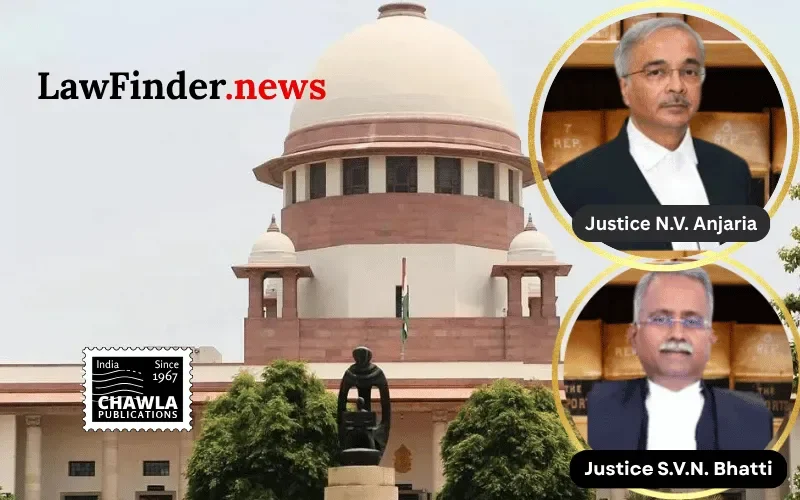
In Tejaram v. State of Rajasthan, the apex court upheld charges against a Rajasthan constable, ruling that Section 17A of the Prevention of Corruption Act does not shield acts of illegal gratification
The Supreme Court has held that prior approval under Section 17A of the Prevention of Corruption Act, 1988 is not required in cases involving demand of bribes by public servants, clarifying that such conduct is a “pure criminal act” and not part of official duty.
A Bench of Justices S.V.N. Bhatti and N.V. Anjaria delivered the ruling on October 16, 2026, in Tejaram v. State of Rajasthan, dismissing the appeal of a Rajasthan police constable who had challenged the criminal proceedings initiated against him.
The appellant, Tejaram, was posted as a constable in the office of the Deputy Superintendent of Police, Sirohi, Rajasthan. The case arose from allegations that he demanded a bribe of Rs. 1.5 lakh from another constable, Devendra Kumar, allegedly in the name of the Superintendent of Police. Based on the complaint, an FIR was registered in 2021 under the Prevention of Corruption Act and Section 120B of the Indian Penal Code. After investigation, a chargesheet was filed under Section 7 of the Prevention of Corruption Act, and the trial court framed charges in September 2024.
Tejaram challenged the framing of charges, arguing that as a public servant he was entitled to the protection of Section 17A of the Prevention of Corruption Act. He contended that no enquiry or investigation could have been initiated against him without prior approval from the competent authority, and that the absence of such approval vitiated the entire prosecution.
Rejecting this argument, the Supreme Court examined the language and scope of Section 17A and held that the protection applies only when the alleged offence is connected to a “recommendation made” or “decision taken” by a public servant in discharge of official functions or duties. The Bench said the provision cannot be given a blanket application to every act of a public servant.
The Court observed that in the present case, the allegation was not related to any official recommendation or decision. Instead, it concerned a direct demand for illegal gratification, which the Court described as wholly outside the scope of official duty. It held that demanding a bribe cannot, “by no stretch of imagination,” be treated as part of discharge of official functions.
Relying on earlier rulings including CBI v. Santosh Karnani, Surendra Dhariwal v. State of Rajasthan, and Anil Daima v. State of Rajasthan, the Court reaffirmed that Section 17A does not apply to trap or bribery cases where the accusation is of demand or acceptance of illegal gratification. According to the Bench, extending prior-approval protection to such cases would defeat the purpose of anti-corruption law.
The Court also addressed the appellant’s submission that questions relating to the validity and scope of Section 17A are pending before a larger Bench in another matter. It held that such reference had no bearing on the present case because the issue could be decided independently on the clear finding that Section 17A was not attracted at all.
On the question of sanction for prosecution under Section 19 of the Prevention of Corruption Act, the Court noted that sanction had been obtained before cognizance was taken. It ruled that even if there were any defect or delay, it would amount at best to an irregularity and would not invalidate the criminal proceedings or the trial.
Upholding the Rajasthan High Court’s decision, the Supreme Court concluded that the order framing charges against the constable under Section 7 of the Prevention of Corruption Act was legally valid. The appeal was accordingly dismissed, and the criminal trial will now proceed on merits.
The ruling is significant as it narrows the protective ambit of Section 17A and reinforces that anti-corruption investigations into bribe demands by public servants do not require prior governmental approval.
Bottom Line:
Prevention of Corruption Act, 1988 Section 17A is not attracted to cases of demand of illegal gratification, as such act is a pure criminal act unconnected with any recommendation made or decision taken by a public servant in discharge of official functions or duties - Absence of prior approval under Section 17A does not vitiate prosecution in such cases.
Statutory provision(s): Prevention of Corruption Act, 1988 - Sections 7, 7A, 17A, 19; Indian Penal Code, 1860 - Sections 120B, 384, 201; Code of Criminal Procedure, 1973 - Section 197(1)
Tejaram v. State of Rajasthan, (SC) : Law Finder Doc id # 2998734