Supreme Court Acquits Chhattisgarh Man in Murder Case, Says Suspicion Cannot Replace Proof, Conviction based on circumstantial evidence, WhatsApp chats and disputed recoveries set aside after Court finds broken chain of evidence
The Supreme Court has acquitted Kusumlal Sao in a murder case from Chhattisgarh, holding that the prosecution failed to establish a complete and reliable chain of circumstantial evidence to sustain his conviction under Sections 302 and 201 of the Indian Penal Code.
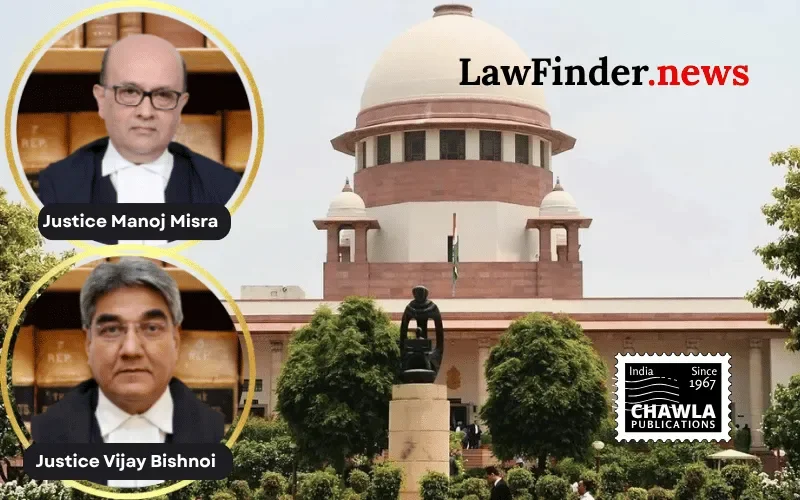
A Bench of Justice Manoj Misra and Justice Vijay Bishnoi delivered the judgment on 13 October 2026 in Kusumlal Sao v. State of Chhattisgarh, setting aside the judgments of both the Trial Court and the Chhattisgarh High Court.
The case arose from the death of Saurabh Panda, whose body was found on the morning of 9 February 2019 in an open field with a motorcycle and a yellow rope lying nearby. The matter was initially reported as an accidental death, but after inquest and post-mortem, police suspected homicide and registered an FIR against unknown persons. During investigation, the police alleged that the appellant had assaulted the deceased in his house, killed him, and later disposed of the body.
The prosecution relied mainly on three circumstances: an alleged quarrel between the accused and the deceased on the night of 7 February 2019, WhatsApp messages allegedly sent by one prosecution witness to another referring to the incident, and the recovery of an iron rod, screwdriver, blood-stained shirt and blood-stained soil from the accused’s house.
However, the Supreme Court found that the prosecution’s case collapsed on scrutiny. The Court noted that none of the witnesses supported the claim that the deceased was last seen with the accused. Key witnesses who were expected to prove the deceased’s presence in the accused’s house turned hostile. Even the deceased’s parents did not say that their son had gone with the accused on the relevant night. On the contrary, they admitted there was no animosity between the two men.
The Court was especially critical of the reliance placed on WhatsApp messages. Although the messages had been extracted from a seized mobile phone and accompanied by a certificate under Section 65-B of the Evidence Act, the alleged sender, PW-5, denied sending them and also denied knowledge of the incident. The recipient, PW-6, likewise denied witnessing anything, though he admitted receiving a message. The Bench held that merely proving extraction of electronic messages does not prove the truth of their contents. Since the authorship of the messages, the sender’s basis of knowledge, and their connection to the occurrence were not established, the chats could at best create suspicion and not prove guilt.
The Court also found serious weaknesses in the recovery evidence. While the police claimed that blood-stained soil and weapons were recovered from the accused’s house pursuant to his disclosure statement, seizure witnesses gave inconsistent accounts about where and how the articles were recovered. One witness said blood-stained soil was seized only from the place where the body was found, not from the accused’s house. Another gave a different version. The Bench held that such contradictions undermined the prosecution story.
Further, the forensic evidence did not link the recovered articles to the deceased. Although some articles tested positive for blood, the blood group could not be determined, and no DNA profiling was conducted to match the stains with the deceased. The Court observed that in a case resting wholly on circumstantial evidence, such lapses assume great significance and the benefit must go to the accused.
The medical evidence also did not conclusively support the prosecution. The autopsy surgeon had opined that the death was homicidal, but in cross-examination admitted that the injuries could also be caused by a fall from a moving motorcycle. Since the body was found in an open field next to a motorcycle and the deceased was shown to be habituated to substance abuse, the Court held that the possibility of an accident remained a probable alternative hypothesis.
The State had also relied on minor abrasions found on the accused during medical examination after arrest. But the Supreme Court held that the accused’s failure to explain those injuries could not, by itself, justify an inference of guilt, particularly when the prosecution had failed to prove that the accused and the deceased were together or fighting shortly before death.
Reiterating settled principles governing cases based on circumstantial evidence, the Bench referred to Sharad Birdhichand Sarda v. State of Maharashtra and Shivaji Sahabrao Bobade v. State of Maharashtra. The Court stressed that every circumstance must be fully established and the chain must be so complete as to exclude every hypothesis except guilt. The “mental distance,” it said, between “may be” and “must be” is long, and criminal conviction cannot rest on conjecture.
Concluding that there was “hardly any evidence” on which the conviction could be sustained, the Supreme Court allowed the appeal, acquitted Kusumlal Sao of all charges, and directed that he be released forthwith unless required in any other case.
Bottom Line:
ircumstantial evidence - Murder conviction cannot be sustained where prosecution fails to prove last seen circumstance, WhatsApp messages are not proved through their author or source of knowledge, and recovered blood-stained articles are not forensically connected with deceased - Suspicion, however strong, cannot replace proof.
Statutory provision(s): Sections 302, 201 IPC, Section 313 CrPC, Sections 6, 7, 8, 27, 65-B of the Indian Evidence Act, 1872
Kusumlal Sao v. State of Chhattisgarh, (SC) : Law Finder Doc id # 2998729