Court says property inherited by a son under Section 8 of the Hindu Succession Act becomes his exclusive property; Tamil Nadu’s daughter-coparcenary amendment held inapplicable
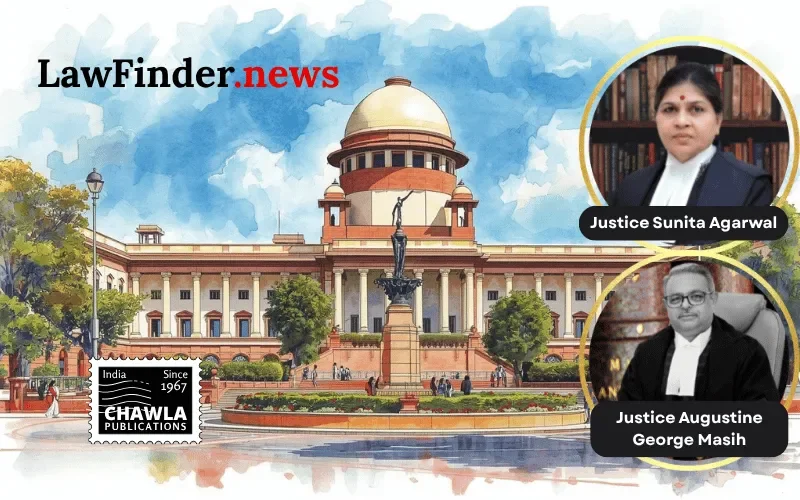
The Supreme Court has dismissed a partition claim filed by a minor grandson, holding that he has no birthright in property inherited by his father from the grandfather when the father is still alive. In J. Rajesh (Minor) through his mother and natural guardian J. Gomathi v. M. Kumaran (Dead) through LRs and Ors., a Bench of Justices Augustine George Masih and Sunita Agarwal ruled that property devolving on a son under Section 8 of the Hindu Succession Act, 1956 does not become Hindu Undivided Family (HUF) or coparcenary property vis-à-vis his own son.
The dispute arose from a suit filed in 1997 on behalf of the minor appellant seeking partition and possession of half share in a 1811 sq. ft. property in Chennai. The child claimed that the property originally belonged to his grandfather, late N. Ramakrishnan, and therefore retained the character of ancestral or joint family property in which he acquired a right by birth.
The record showed that after Ramakrishnan’s death, one of his daughters had filed a partition suit in 1993. That suit ended in a compromise decree dated February 3, 1994, under which the appellant’s father received the suit property as his share. The father later sold the property in April 1997 to third-party purchasers. The minor grandson then filed the present suit through his mother, but notably did not challenge either the 1994 compromise decree or the subsequent sale deeds.
The trial court had granted a preliminary decree for partition in favour of the minor. However, the first appellate court reversed that decision, holding that the father had become the absolute owner of the property allotted to him and that the grandson had no right by birth in it. The matter then reached the Supreme Court.
Before the apex court, the appellant argued that the property was ancestral and continued to retain its coparcenary character even after partition. He also relied on Section 29-A of the Hindu Succession (Tamil Nadu Amendment) Act, 1989, contending that the amendment, which recognized daughters as coparceners by birth, preserved the concept of coparcenary and therefore supported his own claim as a son born before the compromise decree was passed.
The Supreme Court rejected this argument. The Bench held that once a Hindu male dies intestate, his property devolves under Section 8 of the Hindu Succession Act upon Class I heirs such as son, daughter, widow and mother. A living son’s son is not a Class I heir. Therefore, the grandson cannot claim any independent right in the grandfather’s property during the lifetime of his father.
The Court emphasized that the succession opened on the death of the grandfather and the property devolved simultaneously on his Class I heirs. After partition among those heirs, each allottee held his or her share as exclusive owner and as tenant-in-common, not as part of a continuing coparcenary. As a result, the share allotted to the appellant’s father under the compromise decree became his separate property in his individual capacity.
Relying on earlier precedents including Commissioner of Wealth Tax v. Chander Sen, Yudhisthir v. Ashok Kumar, Bhanwar Singh v. Puran, and Radha Bai v. Ram Narayan, the Court reiterated that the old Hindu law concept of a son acquiring a birthright in all property coming to the father stands modified by Section 8 of the 1956 Act. The express statutory scheme excludes a grandson where his father is alive, and the inherited property in the father’s hands does not become HUF property as against his own son.
The Court also found that Section 29-A of the Tamil Nadu amendment had no application to the facts of the case. That provision, it said, applies to daughters’ rights in a subsisting Mitakshara coparcenary. Here, the grandfather’s property had already devolved by intestate succession on Class I heirs, and the coparcenary had ceased upon such devolution and later partition. Hence, the grandson could not invoke the Tamil Nadu amendment to revive a coparcenary claim.
Another important factor noted by the Court was that the minor had filed only a bare partition suit without challenging the compromise decree of 1994 or the sale deeds executed by his father in favour of the purchasers. Since the father was alive and the property had already become his exclusive property, the grandson’s claim was found legally unsustainable.
Upholding the appellate court’s decision, the Supreme Court concluded that there was no infirmity in the impugned judgment. The appeal was dismissed without costs.
The ruling is significant for Hindu succession disputes, particularly those involving claims by grandchildren over property inherited by their parents from grandparents. It clarifies that after the Hindu Succession Act, 1956, property inherited by a son from his father under Section 8 is treated as his individual property, unless a different legal situation exists. A grandson cannot seek partition merely on the ground of birthright when his father is alive and the property has devolved by intestate succession.
Statutory provision(s): Section 4, Section 6, Section 8, Section 19 of the Hindu Succession Act, 1956; Section 29-A of the Hindu Succession (Tamil Nadu Amendment) Act, 1989
Rajesh (Minor) v. M. Kumaran (Dead), (SC) : Law Finder Doc id # 3014903