Top court sets aside Uttarakhand High Court ruling, holds deduction or temporary withholding of prior service pension from PSC salary is constitutional and does not violate equal pay principles
The Supreme Court has upheld the validity of Regulation 7(2) of the Uttarakhand Public Service Commission (Conditions of Service) Regulations, 2004, ruling that retired government servants appointed as Chairman or Member of the Uttarakhand Public Service Commission (PSC) can lawfully have their earlier service pension deducted from, or kept in abeyance against, the salary payable for the constitutional post.
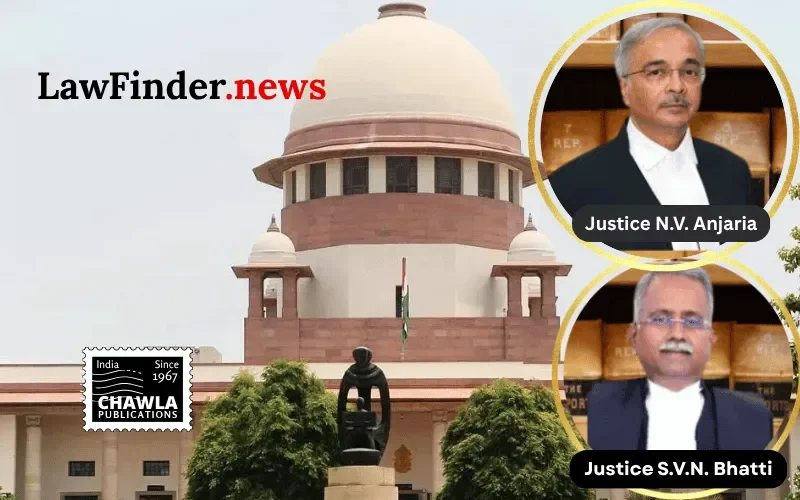
A bench of Justices S.V.N. Bhatti and N.V. Anjaria delivered the judgment in State of Uttarakhand through Chief Secretary and Others v. M.C. Bhandari and Another, allowing the State’s appeals and overturning the Uttarakhand High Court’s 2010 decision that had struck down the provision as unconstitutional.
The dispute arose after Lieutenant General (Retd.) M.C. Bhandari, who retired from the Indian Army in August 2006, was appointed Chairman of the Uttarakhand PSC in November 2006. His salary was fixed at Rs. 26,000 per month, but the pension he was already drawing from his military service was deducted while calculating his payable salary. In the connected case, Sohan Lal, a retired Provincial Civil Service officer appointed as a Member of the PSC, also faced a similar deduction of his pension from the salary attached to the post.
Both appointees challenged Regulation 7(2), arguing that pension earned from past service was a vested right unrelated to their duties as PSC office-bearers and therefore could not be deducted from the salary of the new post. The Uttarakhand High Court accepted this argument and held that the rule violated Article 14 read with Article 39(d) of the Constitution, invoking the doctrine of “equal pay for equal work.”
The Supreme Court disagreed and found that the High Court had misapplied the doctrine. The bench held that pension earned for previous service and salary payable for holding a constitutional office operate in distinct fields. According to the Court, withholding or adjusting pension during the tenure of office has no connection with the principle of equal pay for equal work.
The Court clarified that Regulation 7(2) does not permanently take away pension. Instead, it merely allows the pension to be kept in abeyance, wholly or partly, during the period the retired officer serves as Chairman or Member of the PSC. Once the tenure ends, the pension entitlement revives. On this basis, the bench held that there was no unlawful variation in service conditions to the appointee’s disadvantage under the proviso to Article 318 of the Constitution.
The judgment also rejected the argument that the Governor’s decision under Regulation 7(2), reflected in an Office Memorandum dated September 16, 2008, could not be applied because it came after the respondents’ appointments in 2006. The Court said the regulation itself was already in force at the time of appointment, and there was nothing in its language requiring the Governor’s determination to precede or coincide with the appointment. At most, the Office Memorandum operated retroactively under an already existing legal framework, not retrospectively in an impermissible manner.
The bench further observed that accepting the respondents’ case would produce anomalous results, as it would effectively allow a retired official to draw full pension in addition to the full salary of the PSC post, pushing total emoluments beyond the salary attached to the office and, in some cases, even beyond that of higher posts.
Relying on its earlier ruling in Gurmesh Prakash Bishnoi v. State of Haryana, the Supreme Court reiterated that an embargo on drawing pension during the tenure of a higher office does not extinguish the right to pension; it merely postpones payment for that period.
The Court also invoked the principle of acquiescence and estoppel. It noted that both respondents accepted their appointments with knowledge that the 2004 Regulations were already in force and continued in office for over two years before challenging the rule. Reaffirming the settled principle that a person who accepts the rules of the game cannot later challenge them, the Court held that the respondents were barred from disputing the applicability of Regulation 7(2) after knowingly accepting office.
Concluding that the High Court had committed a manifest error, the Supreme Court set aside both impugned judgments dated April 15, 2010, and allowed the State of Uttarakhand’s appeals. The ruling affirms the legality of the “pay minus pension” principle for retired government servants appointed to the Uttarakhand Public Service Commission.
Statutory provision(s): Article 14 of the Constitution of India, Article 16 of the Constitution of India, Article 39(d) of the Constitution of India, Article 318 of the Constitution of India, Uttarakhand Public Service Commission (Conditions of Service) Regulations, 2004, Regulation 7(1), Regulation 7(2)
State of Uttarakhand v. M.C. Bhandari, (SC) : Law Finder Doc id # 3011526