Supreme Court Modifies Conviction in Criminal Appeal: Appellant's Sentence Reduced, Supreme Court Upholds Grievous Hurt Conviction but Revises Sentence Considering Appellant's Age and Health
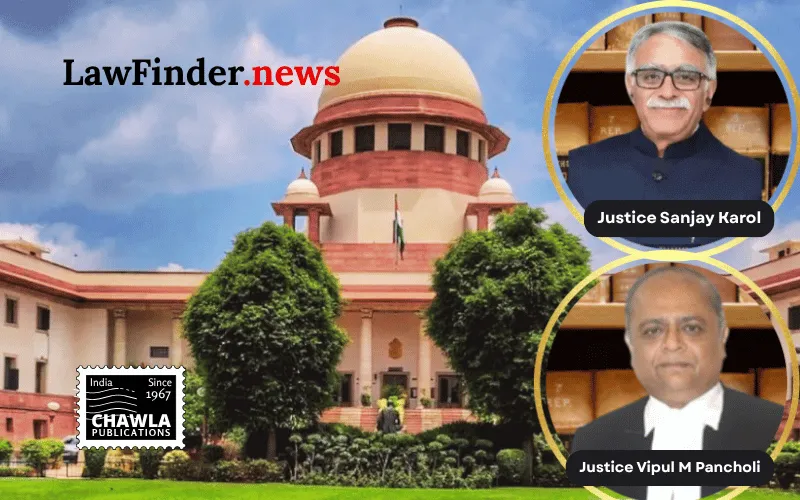
In a significant ruling, the Supreme Court of India has modified the sentence in the criminal appeal of Mani @ Subramaniyam v. State, arising from a land dispute altercation that led to charges under various sections of the Indian Penal Code (IPC). The Supreme Court bench, comprising Justices Sanjay Karol and Vipul M. Pancholi, upheld the conviction for grievous hurt under Section 326 IPC but revised the sentence considering the appellant's age and health.
The appellant, Mani @ Subramaniyam, was initially convicted by the Special Court for Scheduled Castes and Scheduled Tribes (Prevention of Atrocities) Act, 1989, and the High Court of Judicature at Madras for offences under Sections 294(b), 326, and 506(ii) IPC. The case stemmed from an incident on August 24, 2017, when the appellant allegedly assaulted the complainant with a billhook, causing multiple injuries, including a nasal bone fracture.
The Supreme Court examined whether the conviction under these sections could be sustained in law. It found that the language used by the appellant did not meet the legal definition of obscenity under Section 294(b) IPC, which requires lasciviousness, prurient appeal, and a tendency to corrupt impressionable minds. Similarly, the Court ruled that the charge of criminal intimidation under Section 506(ii) IPC was not substantiated, as there was no evidence of intent to cause alarm or compel an act or omission.
However, the Court affirmed the conviction under Section 326 IPC, noting that the medical evidence confirmed the grievous nature of the injury, specifically the nasal bone fracture, and its causation by a dangerous weapon, the billhook. The Court emphasized the importance of considering the appellant's age, approximately 70 years, and health condition, which led to the modification of the sentence. The appellant will serve the sentence till the rising of the Court on a specified day and is required to pay a fine of Rs. 50,000 within two months.
This judgment highlights the nuanced application of legal principles in determining the severity of sentences and reflects the Supreme Court's balanced approach in considering the context and circumstances surrounding criminal acts.
Bottom Line:
Section 294B IPC - Mere use of abusive or vulgar language, however distasteful or uncivil, does not amount to obscenity in law. Obscenity requires lasciviousness, prurient appeal, and tendency to corrupt impressionable minds, along with annoyance to others in a public place.
Statutory provision(s):
- Indian Penal Code, 1860 Section 294(b)
- Indian Penal Code, 1860 Section 326
- Indian Penal Code, 1860 Section 506(ii)
- Scheduled Castes and Scheduled Tribes (Prevention of Atrocities) Act, 2015 Sections 3(1)(r), 3(1)(s), and 3(2)(va)
Mani @ Subramaniyam v. State, (SC) : Law Finder Doc id # 2942335