Supreme Court Awards Rs. 11 Lakh Compensation for Illegal Detention in Landmark Case, Supreme Court Rules State Liable for Delayed Release of Convict on Parole, Citing Violation of Article 21
In a landmark judgment, the Supreme Court of India has awarded Rs. 11 lakh as compensation to Daudayal, a convict who was illegally detained for 24 days beyond his court-ordered parole release. The court held that the delay caused by bureaucratic inefficiencies violated Daudayal's fundamental right to personal liberty under Article 21 of the Indian Constitution.
The case, Daudayal v. State of Rajasthan, revolved around the appellant who had been serving a four-year sentence for various offenses, including culpable homicide not amounting to murder under the Indian Penal Code. After serving a significant portion of his sentence, Daudayal was granted parole by a Single Judge of the High Court on November 5, 2024. Despite complying with the court's conditions for release, including furnishing a personal bond and sureties, he remained in custody until December 6, 2024, due to delays in the verification process.
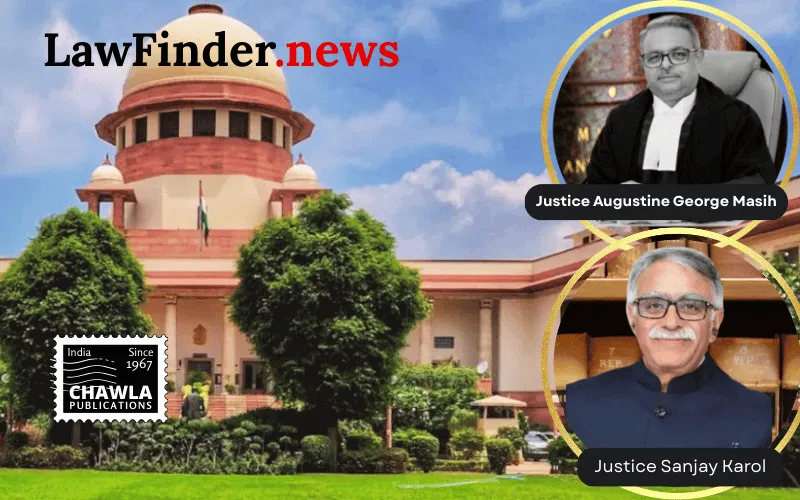
The Supreme Court, led by Justices Sanjay Karol and Augustine George Masih, sharply criticized the state authorities for the delay, emphasizing that the liberty of an individual cannot be compromised by administrative hurdles. The court underscored the principle of "obey first, appeal later," stating that the State should have complied with the release order immediately and that the decision to appeal should not have impeded Daudayal's release.
The judgment highlighted the purpose of habeas corpus, which is to provide immediate relief from unlawful detention, and reinforced the notion that compensation is a recognized remedy under public law for violations of fundamental rights. Drawing on precedents, including the cases of Rudul Sah v. State of Bihar and Nilabati Behera v. State of Orissa, the court reiterated that compensation serves as a deterrent against the misuse of state power and as a means to uphold the dignity and liberty of individuals.
The court also addressed the issue of parole, clarifying that it is a provisional release, distinct from bail, allowing a convict to serve the remainder of the term outside prison under certain conditions. The failure to release Daudayal despite fulfilling these conditions constituted illegal detention, warranting compensation.
This judgment serves as a reminder of the judiciary's role in safeguarding individual rights against bureaucratic overreach and reinforces the accountability of state authorities in upholding the rule of law.
Bottom Line:
Compensation for illegal detention granted - A convict released on parole cannot be kept in custody beyond the period stipulated by a court order, and any delay in release by the State is deemed illegal detention, entitling the individual to compensation under public law.
Statutory provision(s): Sections 148, 448, 304 Part II, 149, 323 of the Indian Penal Code, 1860; Articles 21, 32, 226 of the Constitution of India.
Daudayal v. State of Rajasthan, (SC) : Law Finder Doc id # 2909742