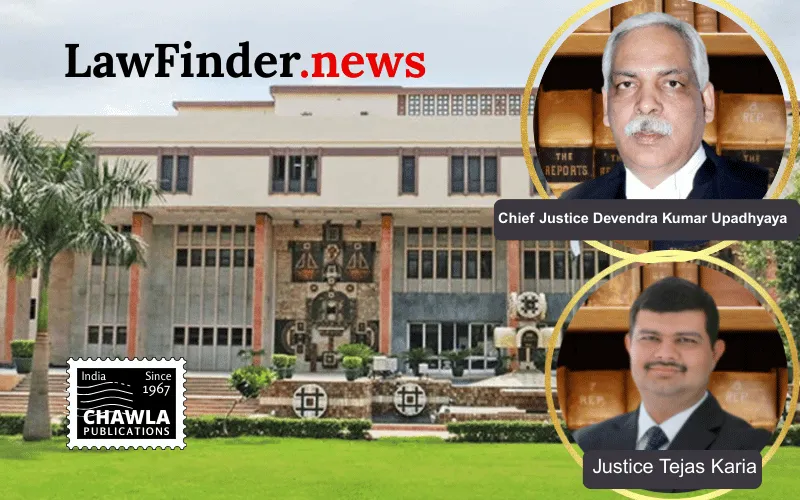
New Delhi, Jul 22 The Delhi High Court on Wednesday sought the Centre's stand on a PIL seeking a direction to reconsider and review the decision to include HPV vaccines in the Universal Immunisation Programme, citing concerns over its long-term safety, lack of informed consent and monitoring of adverse events.
A bench of Chief Justice D K Upadhyaya and Justice Tejas Karia said the plea raised a "very serious" issue as it concerned the health of girls and women in the country. The court issued notices to the central government and the Indian Council of Medical Research (ICMR)
The public interest litigation (PIL) has been filed by Dr Sujata Mittal. The matter is scheduled to be heard next on July 29.
"The (HPV) vaccination is a good scheme. (But) If there are adverse consequences, we have to see. We have to tread a cautious path. This is a serious issue. You get immunised not to get infected," the bench said.
The petitioner's counsel said the government included the HPV vaccine in the Universal Immunisation Programme as part of a nationwide vaccination programme for young girls without considering any data on adverse consequences or ensuring parental informed consent.
Internationally, "significant safety concerns" have been raised against the 'Gardasil' HPV vaccine, and incidents raising questions over the vaccine's safety have been reported in India as well, it said.
"It is respectfully submitted that a 14-year-old girl from Tamil Nadu received the HPV vaccine on 30.03.2026 at the Government Hospital, Kanai. Within three to four days, she developed serious and worsening symptoms, loss of voice, paralysis-like weakness on one side of the body, inability to walk, and blurred, dim vision.
"She was admitted to the ICU in a critical condition on oxygen support, catheter, and intravenous medication, and remained bedridden for several days without significant improvement. Similar incidents reported from Gwalior and Bihar raise serious concerns regarding vaccine safety and monitoring," the PIL claimed.
The plea asserted that the long-term effectiveness of the vaccine was also "uncertain".
While medical experts agree that regular screening of women between the ages of 30 and 65 years is the most effective way to prevent cervical cancer, the present programme focuses mainly on vaccinating young girls, and aims to vaccinate approximately 1.15 crore girls aged 14 years, who are at a relatively lower immediate risk, it said.
The PIL also sought directions to authorities to conduct and publish district-wise and state-wise epidemiological assessments, disease burden studies, cost-effectiveness analyses and public health impact evaluations before any further expansion of the HPV vaccination programme.
The authorities should also establish an independent, transparent and publicly accessible 'Adverse Events Following Immunisation' monitoring and reporting mechanism, specifically for HPV vaccination, with periodic public disclosure of all reported adverse events, it said.
New Delhi, Jul 22 The Delhi High Court on Wednesday sought responses from the Centre and the city police on two pleas alleging excessive use of force against protesters during the July 20 march to Parliament.
A bench of Chief Justice D K Upadhyaya and Justice Tejas Karia directed the authorities to preserve all relevant records in relation to the police action, including CCTV camera footage and any videography.
The bench issued notice on the PILs by Umesh Kumar and Anshul Kumar to the police, central government and the National Human Rights Commission (NHRC), and gave four weeks to the authorities to file their counter affidavits.
"Let a counter affidavit be filed on behalf of the respondents within four weeks," the court ordered, while listing the matter for hearing on September 11.
"In the meantime, we direct that the relevant record in relation to the incident as mentioned in the writ petitions, including the CCTV footage and videography, shall be preserved as per the SOP (standard operating procedure) of the Delhi Police or the Union of India," it added.
Thousands joined the Cockroach Janta Party's (CJP) "Chalo Sansad" march on July 20 to demand the resignation of Union Education Minister Dharmendra Pradhan over alleged examination irregularities.
The CJP accused the Delhi Police of using excessive force against protesters to prevent them from reaching Parliament.
Senior advocates N Hariharan, Vikas Singh and Gopal Sankaranarayanan, appearing for the petitioners, contended on Wednesday that police and the Rapid Action Force (RAF) used excessive force on the protesters, including women and children.
Seeking an inquiry into the incident, the senior counsel asserted that the protesters were exercising their fundamental right to peacefully protest against irregularities in NEET and the fact that a march to the Parliament would be held on July 20 was also known to all.
"Brutality of the largest measure was used against a peaceful agitation... The force used was excessive and uncalled for," Hariharan said, asserting that a high-level judicial inquiry and an investigation by an independent SIT should be ordered in the matter.
Hariharan, President of the Delhi High Court Bar Association (DHCBA), said although the police have the power to "regulate" a protest, they "can't take it out on children" by using disproportionate force.
"They were unarmed children. More than 90 students were injured. There is a policeman slapping ladies, molesting them," the senior lawyer contended, as he said that an FIR should be ordered against identifiable policemen.
Additional Solicitor General S V Raju, appearing for the police and the Centre, said the PILs were "in the realm of guesswork", and if any individual has a grievance, he should move the court concerned with "concrete facts" to seek registration of an FIR.
The bench, however, said that the issues raised in the PILs did not concern an "isolated incident" and asked the law officer to file a response.
"If these issues are raised in a PIL, how can you say that every individual should lodge an FIR? Had it been an isolated incident, the situation might be different," said Chief Justice Upadhyaya.
Clarifying that it was not expressing anything on the merits of the PILs, the bench added that in case of any alleged police brutality, an individual can take recourse to a remedy under "public law".
Singh submitted that persons in civil clothes attacked innocent people with police, and lathis with nails, pellets and even batons that could give an electric shock were used on protesters.
The senior lawyer, who is the president of the Supreme Court Bar Association (SCBA), said children, students, lawyers and people from all walks of life were protesting against their "genuine" concern over rigging of examinations, and a police personnel hitting a protester on the head was "impermissible".
Sankaranarayanan said hundreds of publicly available videos showed the brutality committed by police personnel, who were not even wearing their name-tags, and several were not even in their uniforms.
"Additional DCP Sandeep Lamba is seen slapping a woman who is doing nothing. She is not moving.
"I can show the video right now. Let us not be scared to name our thugs in uniform when they deserve to be named. He should be summoned here and he should be asked to be accountable," Sankaranarayanan argued.
He further asserted that no water canon, which has to be the first measure, was deployed to disperse the crowd, and instead, tear gas was thrown "at the protesters" and not away from them, despite it being the "last resort".
Hariharan added that the police ought to have given an adequate warning before using force to disperse the crowd.
He said directions should be issued to the police to place on record the footage from CCTV, drone and body-cam along with the orders of deployment, use of lathi-charge and tear gas.
Raju, on the other hand, contended that the pleas were based on social media posts and were not maintainable.
An unruly crowd resorted to violence and stone-pelting, the senior law officer said, informing that the police were injured and police vehicles were harmed by the protestors.
He said that prohibitory orders were already in place for the area.
"There are political parties who are trying to take advantage of the facts. The so-called peaceful agitation did not remain a peaceful agitation," the law officer stated.
"These are publicity-seeking petitions. Persons who are injured or allegedly beaten have not lodged any complaint," Raju contended.