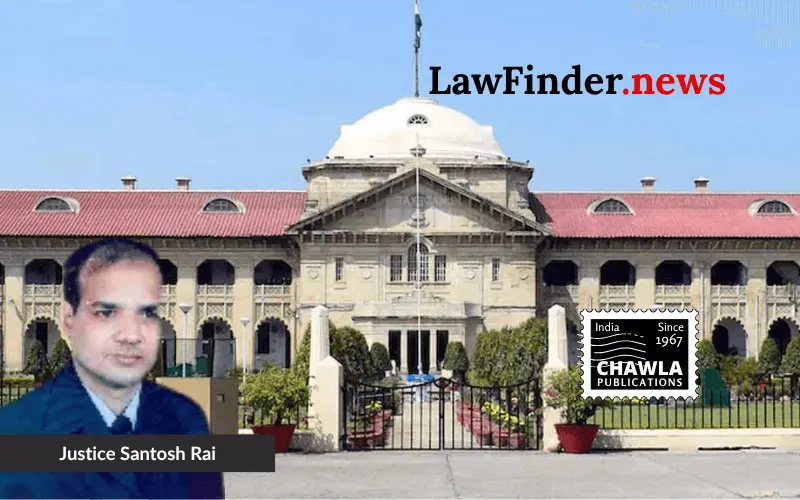
Court Finds Sufficient Evidence in Suicide Note to Frame Charges Against Accused Under Section 306 IPC and SC/ST Act
In a significant ruling, the Allahabad High Court on July 9, 2026, upheld the rejection of a discharge application by Chandrajeet Singh, the appellant, in a case involving abetment of suicide under Section 306 of the Indian Penal Code (IPC) and provisions of the Scheduled Castes and Scheduled Tribes (Prevention of Atrocities) Act, 1989. The court found prima facie evidence, including a suicide note, sufficient to frame charges against the accused.
The case stems from the suicide of Somraj, who was found hanging in his room in June 2018. The deceased's mother lodged an FIR alleging that her son was driven to suicide due to persistent harassment and humiliation by his wife Priya alias Dolly, the appellant Chandrajeet Singh, and another co-accused, Gulshan. The allegations centered around an illicit relationship between Priya and Chandrajeet, which reportedly led to mental distress for Somraj, culminating in his tragic death.
Justice Santosh Rai, presiding over the appeal, emphasized the importance of the suicide note, which specifically named the accused as responsible for the deceased's mental anguish and subsequent suicide. The note, corroborated by a Forensic Science Laboratory (FSL) report confirming its authenticity, served as a critical piece of evidence.
The court underscored the limited scope of judicial interference in such appeals, stating that its role was to assess whether a prima facie case existed rather than merely rubber-stamp the proceedings. Justice Rai highlighted that systematic humiliation touching upon domestic life and dignity could constitute instigation under Section 306 IPC, even in the absence of direct or proximate acts immediately preceding the suicide.
The appellant's counsel argued for discharge, citing precedents where indirect acts of harassment were insufficient to establish abetment. However, the court found that the specific circumstances of the case, particularly the detailed suicide note, warranted a full trial to explore the extent of the alleged instigation and the social context of harassment under the SC/ST Act.
Respondent counsel argued successfully that the trial court's rejection of the discharge application was justified, given the compelling evidence against the accused. The allegations in the suicide note suggested exploitation of the deceased's vulnerabilities, meriting charges under both IPC and SC/ST provisions.
The High Court's ruling confirms that the trial will proceed, allowing further examination of the evidence and the accused's defense. The decision underscores the judiciary's commitment to thoroughly evaluating cases of alleged abetment of suicide, especially when vulnerable communities are involved.
Bottom line:-
Rejection of discharge application under Section 227 Cr.P.C. in a case involving abetment of suicide under Section 306 IPC and SC/ST Act is justified when there exists prima facie evidence in the form of a suicide note and other corroborating materials indicating systematic humiliation and harassment by the accused.
Statutory provision(s): Section 227 CrPC, Section 306 IPC, Section 3(2)(v) SC/ST Act
This judgment is a reminder of the complexities involved in cases of abetment of suicide, highlighting the judiciary's role in balancing the need for thorough legal scrutiny with the rights of the accused. As the trial progresses, the court will further delve into the nuances of the case, aiming to deliver justice for all parties involved.
Chandrajeet Singh v. State of U.P., (Allahabad) : Law Finder Doc id # 2941889