Court upholds arbitration and civil suit clauses in contracts; emphasizes non-maintainability of writs for pure monetary claims and applies principle of constructive res judicata
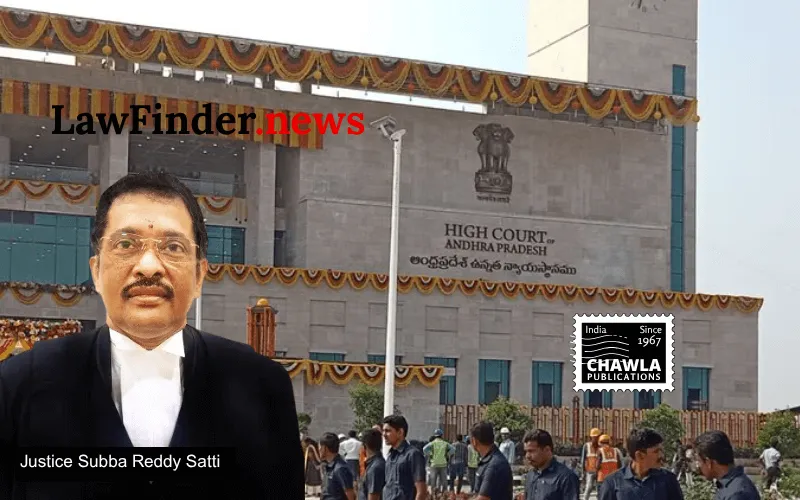
In a significant ruling delivered on July 22, 2026, the Andhra Pradesh High Court, presided over by Justice Subba Reddy Satti, dismissed a batch of writ petitions filed by several contractors seeking interest on delayed payments under executed works contracts with the State government. The petitioners, who had completed works under the Neeru Chettu Scheme in Chittoor District, claimed interest at 6% per annum on delayed payments, contending that although the principal amounts were paid, the interest was withheld.
The Court's comprehensive order addressed multiple writ petitions consolidated due to their similar nature. It emphasized that writ petitions seeking solely monetary relief, particularly interest on delayed payments under contracts, are generally not maintainable under Article 226 of the Constitution of India unless exceptional circumstances exist. The Court underscored that the agreements entered into by the petitioners explicitly contained clauses barring interest on delayed payments (Clause 69 of Andhra Pradesh Standard Specifications), and stipulated that disputes concerning claims exceeding Rs. 50,000 were to be resolved only by civil courts, not arbitration, while smaller claims could be arbitrated.
Significantly, the Court referred to its earlier orders disposing of the petitioners' prior writ petitions, which had explicitly left open the liberty to approach an "appropriate forum" for interest claims, thus invoking the principle of constructive res judicata. The petitioners could not circumvent these earlier directions by filing fresh writ petitions for the same cause of action. The Court noted that the subsequent writ petitions were barred as they re-agitated claims already addressed or impliedly refused in earlier proceedings.
Relying on binding Supreme Court precedents such as Joshi Technologies International v. Union of India (2015) and ABL International Ltd. v. Export Credit Guarantee Corporation (2004), the Court reiterated that while writ jurisdiction is plenary, it is discretionary and not intended for adjudicating contractual monetary claims, which are better suited for civil or arbitration forums. The Court also highlighted the binding nature of contractual clauses, referencing the Supreme Court's ruling in Garg Builders and Sayeed Ahmed & Co. that parties cannot claim interest contrary to express contract terms barring such claims.
Furthermore, the Court stressed the importance of pleadings in writ petitions, observing that the petitioners had failed to properly plead the relevant contract clauses and submit copies of agreements in their affidavits. It held that relief cannot be granted on grounds not pleaded or supported by evidence, in line with precedents such as Bharat Singh v. State of Haryana and Narmada Bachao Andolan v. State of M.P.
The Court also clarified that consent orders passed in unrelated writ appeals could not be invoked as binding precedent by parties who were not part of those proceedings. Consequently, the petitioners could not rely on a Division Bench consent order granting interest in other cases to buttress their claims.
In conclusion, the High Court dismissed all the writ petitions with no costs, underscoring that the petitioners must seek their claims for interest under the agreed contractual dispute resolution mechanisms-either arbitration or civil courts-as per the contract terms. The Court's ruling reinforces the principle that extraordinary writ jurisdiction is not a substitute for regular civil remedies in contractual monetary disputes, and that parties must adhere to the terms they contractually agreed upon.
Bottom Line:
Writ petitions seeking interest on delayed payments under contracts are not maintainable when the agreement explicitly bars interest and provides for alternative dispute resolution mechanisms.
Statutory provision(s):
Constitution of India, 1950 Article 226, Civil Procedure Code 1908 Section 11, Arbitration and Conciliation Act 1996 (referred indirectly), Andhra Pradesh Standard Specifications Clause 69
Yellaboina Mallaiah v. State of Andhra Pradesh, (AP) : Law Finder Doc Id # 2974553