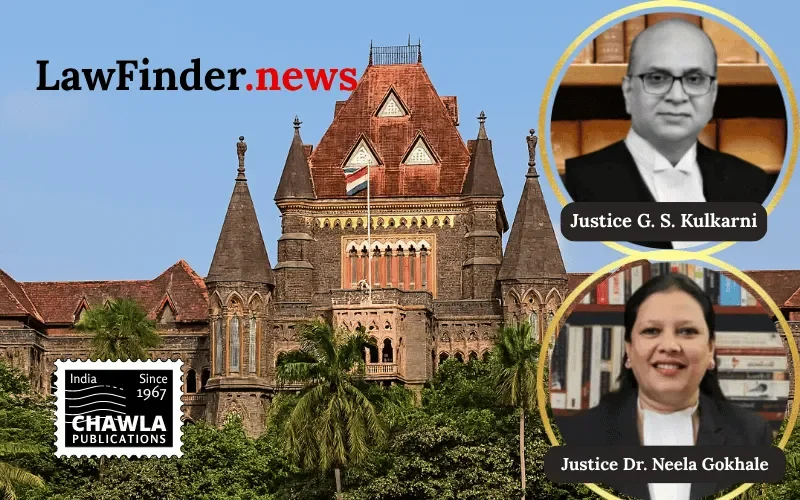
Division Bench Quashes Bail Order, Emphasizing Prima Facie True Accusations under UAPA and Rejecting Trial Court's Perverse Reasoning
In a significant judgment delivered on November 5, 2026, the Bombay High Court (Division Bench comprising Justices G. S. Kulkarni and Dr. Neela Gokhale) quashed the bail order granted to Sachin Hindurao Waze, a former Assistant Police Inspector of the Mumbai Crime Branch's Crime Intelligence Unit. The case involves grave offences under Sections 16, 18, and 20 of the Unlawful Activities (Prevention) Act, 1967 (UAPA), as well as several sections of the Indian Penal Code (IPC), including charges related to conspiracy, murder, and explosives.
Sachin Waze was accused of conspiring to place a Scorpio vehicle laden with 20 gelatin sticks and a threat note near the residence of the prominent Ambani family in Mumbai's Carmichael Road area on February 25, 2021. The threat note explicitly targeted the Ambani family, and the act was projected as a terrorist attack allegedly claimed by the group "Jaish Ul Hind" on a Telegram channel. Subsequent investigations revealed that the vehicle's registration number was falsified and belonged to Mansukh Mishrilal Hiran, who was later murdered on March 4, 2021, after refusing to take responsibility for the terror act.
The National Investigation Agency (NIA), having taken over the investigation, charged Waze and others with offences including those under UAPA, IPC, and Arms Act. The chargesheet and investigation material prima facie established Waze's central role in orchestrating the conspiracy, manipulating evidence, and eliminating key witnesses.
Initially, Waze's bail application was rejected by the trial court in 2023. After a delay of over two years, he filed a fresh bail application following the completion of investigation and framing of charges. However, the trial court surprisingly granted bail in September 2026, relying on reasons that the High Court found legally unsustainable and perverse. The trial court questioned the absence of statements from the Ambani family and discounted key witness testimonies and confession statements. It also erroneously held that the murder was independent of the terrorist act and that Section 15 of the UAPA was not attracted, despite framing charges under Sections 16 and 18 of the UAPA.
The NIA challenged the bail order before the Bombay High Court, emphasizing the statutory embargo under Section 43D(5) of the UAPA, which prohibits bail if the court, upon perusal of the case diary or chargesheet, is of the opinion that the accusation is prima facie true. The Court reiterated that the statutory standard requires a threshold inquiry based on the material presented and not a mini-trial or piecemeal evaluation of evidence. It observed that the trial court's approach ignored settled Supreme Court precedents including NIA v. Zahoor Ahmad Shah Watali (2019), Union of India v. Barakathullah (2024), and K.A. Najeeb v. Union of India (2021), which clarify the rigors of bail under UAPA and the constitutional safeguards in cases of prolonged incarceration.
The Division Bench held that the material on record, including witness statements under Sections 161 and 164 Cr.P.C., the confession of a co-accused, and other evidence, established Waze's complicity in planting the explosive-laden vehicle and the subsequent murder of Mansukh Hiran to silence him. The Court pointed out the trial court's flawed reasoning in separating the murder from the terror act and ignoring the conspiracy's interconnected nature.
Further, the Court rejected the argument that prolonged incarceration and trial delay alone warranted bail, emphasizing that the offences' grave nature and Waze's influential position justified custodial detention. The Court also dismissed the plea of parity with co-accused who were granted bail, noting the distinct roles and the principal architect status of Waze in the conspiracy.
The High Court expressed grave concern over the trial court's casual and bizarre observations, which detracted from the seriousness of the charges and the public interest involved. It emphasized that a person in uniform entrusted with public duty cannot be permitted to indulge in acts that threaten national security and economic stability.
Consequently, the High Court allowed the NIA's appeal, set aside the bail granted to Sachin Waze, and ordered the continuation of his custody. The judgment underscores the judiciary's firm stance on enforcing the stringent bail provisions under UAPA, particularly in cases involving terrorism, conspiracy, and witness intimidation.
Bottom Line:
UAPA - Bail - Section 43D(5) - Where charges are framed under Sections 16, 18 and 20 of UAPA and the chargesheet/case diary disclose prima facie true accusations showing accused's central role in conspiracy involving placing explosive-laden vehicle with threat note near residence of prominent industrialist and subsequent murder of vehicle owner to silence him, bail cannot be granted merely on ground of five years' incarceration or by dissecting evidence witness-wise - Trial Court granting bail by ignoring statutory embargo and settled principles in Watali held perverse - Order granting bail set aside.
Statutory provision(s):
Unlawful Activities (Prevention) Act, 1967 Sections 15, 16, 18, 20, 43D(5); Indian Penal Code Sections 120B, 201, 302, 364, 403; Arms Act Section 25; National Investigation Agency Act, 2008 Section 21
National Investigation Agency v. State of Maharashtra, (Bombay)(DB) : Law Finder Doc Id # 3013820