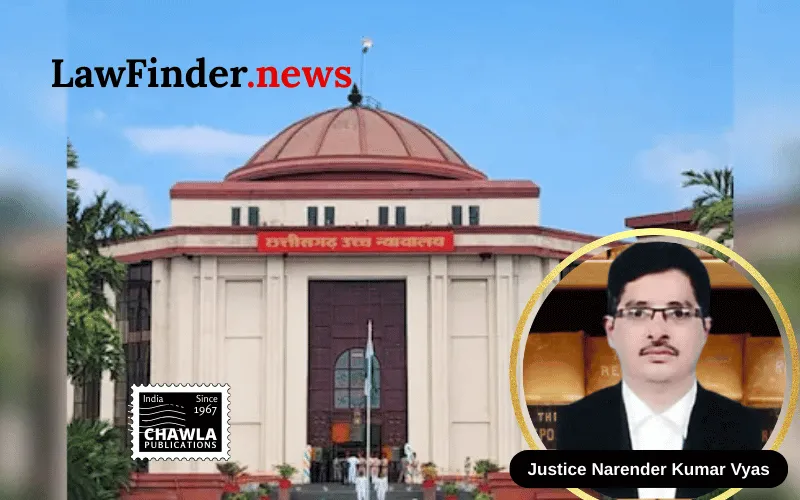
The High Court finds misuse of Section 165 of the Indian Evidence Act and applies the principle of parity, leading to the acquittal of the appellant.
In a landmark decision, the Chhattisgarh High Court has set aside the conviction of Pratap Singh, who was previously sentenced to five years of rigorous imprisonment under Section 304 Part I of the Indian Penal Code. The judgment, delivered on September 24, 2026, by Justice Narendra Kumar Vyas, highlights significant judicial intervention and the principle of parity in criminal jurisprudence.
The case originated from an incident on November 19, 2011, involving a fatal altercation between the deceased, Umrao Singh, and the accused, Pratap Singh, along with his father, Shivnadh. The trial court had convicted Pratap Singh based on the testimony of the deceased's wife, Surajwati Gond, who claimed that Singh assaulted her husband with a lathi, leading to his death. However, the trial court acquitted co-accused Shivnadh due to insufficient evidence.
The High Court's decision focused on two critical aspects: the improper application of Section 165 of the Indian Evidence Act and the inconsistency in convicting one accused while acquitting another on similar evidence. Justice Vyas observed that the trial court had overstepped its bounds by using its power to put questions to the witness, effectively filling in the gaps of the prosecution's case. This judicial prompting was deemed unsustainable, as it compromised the fairness of the trial and intimidated the witness.
Moreover, the High Court emphasized the principle of parity, stating that when evidence against co-accused is similar, one cannot be convicted while the other is acquitted without valid distinguishing material. The court referenced the Supreme Court's rulings, underscoring that like cases must be decided alike to ensure justice.
In conclusion, the judgment not only acquits Pratap Singh but also highlights the importance of maintaining judicial impartiality and consistency in criminal trials. The decision reinforces the judiciary's role in safeguarding the rights of individuals and ensuring that convictions are based on solid and unbiased evidence.
Bottom Line :
Evidence Act, 1872 Section 165 Though Court has wide power to put questions to witness to discover truth, such power cannot be used to fill lacunae in prosecution case, suggest answers, or elicit essential ingredients of offence not spoken by witness - Conviction based substantially on such judicial prompting held unsustainable - Further, on same set of evidence, when co-accused was acquitted, conviction of appellant alone was not justified.
Statutory provision(s): Indian Penal Code, 1860 Section 304 Part I, Indian Evidence Act, 1872 Section 165, Code of Criminal Procedure, 1973 Section 374(2), Bharatiya Nagarik Suraksha Sanhita, 2023 Section 481.
Pratap Singh v. State of Chhattisgarh, (Chhattisgarh) : Law Finder Doc id # 2985774