Court holds that an accidental discharge from a soldier’s own weapon can still qualify as a battle casualty if official records show operational nexus and grievous injury
The Supreme Court has ruled in favour of a retired Army officer, holding that he is entitled to the War Injury Element of pension after sustaining an accidental gunshot wound while on duty during Operation Rakshak in Jammu and Kashmir.
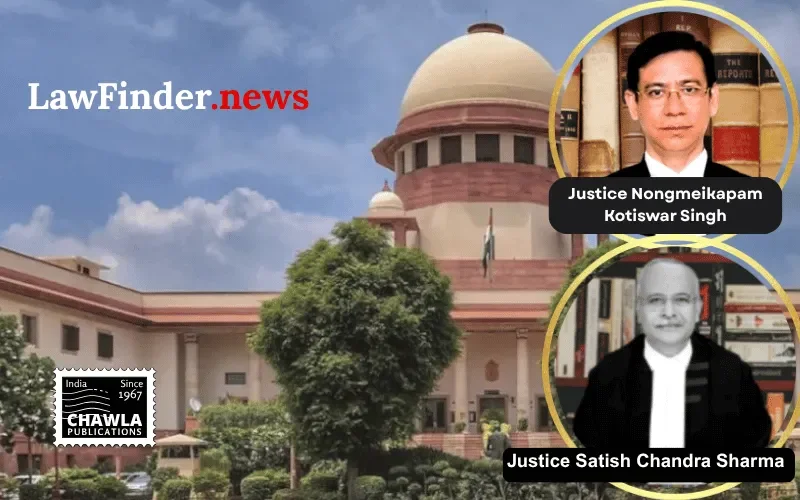
A bench of Justice Satish Chandra Sharma and Justice Nongmeikapam Kotiswar Singh allowed the appeal filed by JC-377745M Ex Sub Maj & Hony Lt Devi Singh, setting aside the Armed Forces Tribunal’s order that had denied him the enhanced pensionary benefit.
The Court found that the appellant’s injury, caused when his own loaded weapon accidentally discharged while he was on duty in an operational area, was a battle casualty within the meaning of the Pension Regulations for the Army, 2008. It held that the injury fell under Category ‘E’ of Regulation 82 and satisfied the requirements of Regulation 103 for grant of War Injury Element.
According to the judgment, the soldier was serving with 31 Sub Area Signal Company in Jammu and Kashmir on 7 August 2002 when the accidental discharge caused a bullet wound to his left thigh, damaging the femoral vein. He was evacuated and treated at 92 Base Hospital. The Release Medical Board later assessed the disability at 40% for life and found it attributable to military service. The Union of India had already granted him ordinary disability pension, but he continued to seek the higher War Injury Element.
The Tribunal had rejected his claim mainly because the final approval of battle casualty status from MP-5 was not on record and his name did not appear in the digital database. The Supreme Court disagreed, saying that contemporaneous military records carried greater evidentiary value. These included Part II Order No. BC-59, the Battle Casualty Certificate, the Attributability Certificate issued by Signals Records, and the Severity Certificate. The Court noted that the original records had been lost in the 2014 floods while in official custody, and that the absence of the appellant’s name in a later digital record could not override signed official documents.
The bench also clarified that an injury caused by a soldier’s own weapon is not automatically a self-inflicted injury. The Court said the key question is intention: unless there is evidence that the wound was deliberately caused to avoid duty, an accidental discharge does not bar battle casualty status. It relied on Army Order 1/2003/MP, which expressly includes gunshot injuries “sustained accidentally” during operations against militants within the scope of battle casualties, provided the injury is grievous.
Referring to the earlier decision in Union of India v. Saroj Devi, the Court reiterated that official certificates prepared by
JC-377745M Ex Sub Maj & Hony Lt Devi Singh v. Union of India, (SC) : Law Finder Doc id # 3219400