Court sets aside National Commission and Delhi High Court orders, restores DDA’s revision petition, and stresses that “sufficient cause” must be assessed cumulatively in the interest of substantial justice.
The Supreme Court has ruled that a delay in filing a consumer revision petition by the Delhi Development Authority (DDA) should be condoned, holding that courts must adopt a justice-oriented and liberal approach while examining “sufficient cause” under the law of limitation.
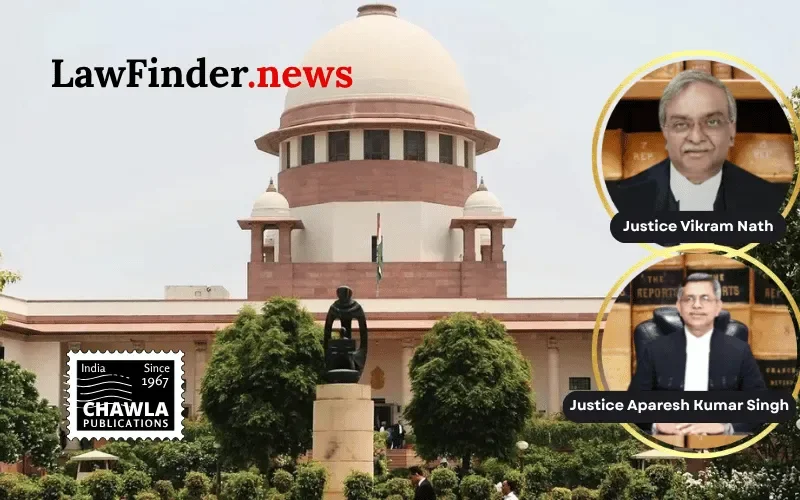
A Bench of Justice Vikram Nath and Justice Aparesh Kumar Singh allowed DDA’s appeal against the Delhi High Court’s judgment dated 23 October 2024, which had upheld the National Consumer Disputes Redressal Commission’s refusal to condone a delay of 95 days in filing a revision petition. The Supreme Court set aside both orders and restored the matter to the National Commission for decision on merits.
The dispute traces back to a housing allotment under DDA’s Expandable Housing Scheme, 1996. Smt. Bachhi Devi, the predecessor-in-interest of the respondents, had been allotted a flat in Narela after a draw of lots in 1997. DDA claimed it sent the demand-cum-allotment letter to the address provided by the allottee, but payment was not made. The allotment was later cancelled. The allottee challenged the cancellation before the consumer fora, alleging deficiency in service.
While the District Forum dismissed the complaint in 2015, the State Commission reversed that decision in 2021 and directed DDA to allot an alternative flat at the rates prevailing at the time of the original allotment. DDA then approached the National Commission in December 2022 along with an application seeking condonation of delay.
DDA argued that a substantial portion of the delay stood excluded due to the Supreme Court’s orders during the COVID-19 pandemic extending limitation periods. The remaining delay, it said, was caused by administrative approval processes, change of counsel, and time taken to obtain a certified copy of the order.
The National Commission rejected the explanation and dismissed the revision petition as time-barred. The Delhi High Court also declined to interfere, observing that DDA had not acted with due diligence. The Supreme Court, however, took a different view.
Referring to earlier decisions in Collector, Land Acquisition, Anantnag v. Mst. Katiji and N. Balakrishnan v. M. Krishnamurthy, the Court reiterated that “sufficient cause” must receive a liberal interpretation to advance substantial justice. It said the length of delay is not decisive; what matters is whether the explanation is acceptable. The Court also noted that the explanation must be considered cumulatively, not in isolation.
On the facts, the Bench observed that although DDA could have acted with greater diligence, there was nothing to suggest that the delay was deliberate or intended to gain an unfair advantage. The Court said the National Commission had adopted an unduly restrictive approach and the High Court had failed to give adequate weight to the overall circumstances.
Emphasising that disputes should ordinarily be decided on merits rather than being terminated at the threshold, the Supreme Court concluded that sufficient cause had been made out for condonation of delay.
Accordingly, the appeal was allowed, the impugned orders were quashed, and the revision petition was restored before the National Commission for hearing on merits. The Court clarified that it had expressed no opinion on the merits of the underlying consumer dispute.
Statutory provision(s): Consumer Protection Act, 1986, Limitation Act, 1963, Article 227 of the Constitution of India
Delhi Development Authority v. Sudarshan Manjhi, (SC) : Law Finder Doc id # 3208585