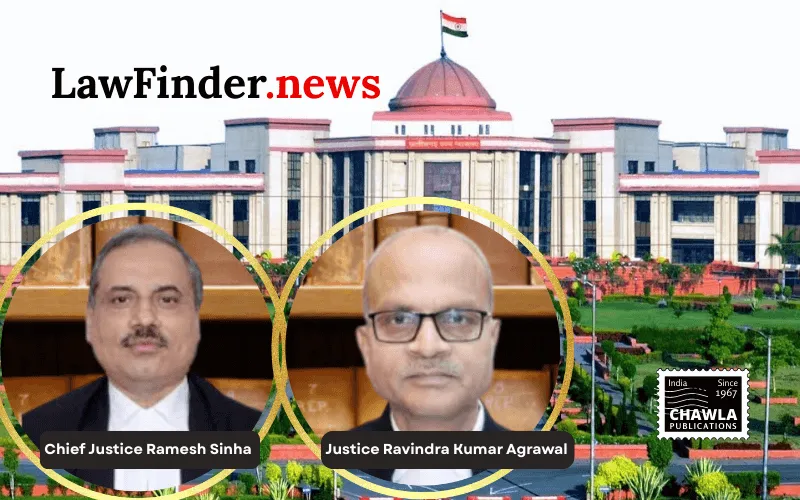
Court issues directives for police accountability following procedural lapses in arrest of Ajay Agrawal's son, emphasizing statutory compliance.
In a recent judgment, the Chhattisgarh High Court addressed significant procedural lapses in the arrest and remand processes conducted by police officials in the case involving Ajay Agrawal's son. The Court, while disposing of the writ petition filed by Ajay Agrawal, emphasized the importance of strict adherence to the statutory provisions laid down in the Bharatiya Nagarik Suraksha Sanhita, 2023, and the precedent set by the Supreme Court in Arnesh Kumar v. State of Bihar.
The case arose when police officials from Balco Police Station conducted a warrantless search and arrest at Ajay Agrawal's residence, allegedly assaulting family members and removing CCTV evidence. Despite findings by the Judicial Magistrate First Class, Korba, that the police actions were illegal, no immediate departmental action was taken against the concerned officers.
Upon hearing the case, the High Court noted the failure of the police to adhere to procedural safeguards during the arrest. The Court demanded an explanation from the Superintendent of Police, Korba, who subsequently filed an affidavit detailing the actions taken. The affidavit acknowledged procedural negligence by Head Constable Guruwar Singh, who received a formal warning for his first-time lapse.
The High Court underscored that issuing a warning should not be the final remedy and highlighted the need for ongoing monitoring of police conduct to prevent future lapses. The Court instructed the Superintendent of Police to keep a vigilant eye on Guruwar Singh's future conduct and emphasized the necessity for all police personnel to adhere strictly to legal procedures during arrests and investigations.
The judgment serves as a reminder of the judiciary's role in ensuring police accountability and upholding the rule of law, reinforcing that procedural fairness is essential for maintaining public trust in law enforcement.
Bottom line:-
Police officials must strictly adhere to statutory safeguards under the Bharatiya Nagarik Suraksha Sanhita, 2023, and comply with the principles laid down by the Supreme Court in Arnesh Kumar v. State of Bihar, (2014) 8 SCC 273. Procedural lapses in arrest and remand proceedings must not be treated casually.
Statutory provision(s): Article 226 of the Constitution of India, Bharatiya Nagarik Suraksha Sanhita, 2023
Ajay Agrawal v. State of Chhattisgarh, (Chhattisgarh)(DB) : Law Finder Doc id # 2942447