Court holds mere WhatsApp service without proof of actual notice insufficient; emphasizes substantial justice in Order IX Rule 13 CPC applications
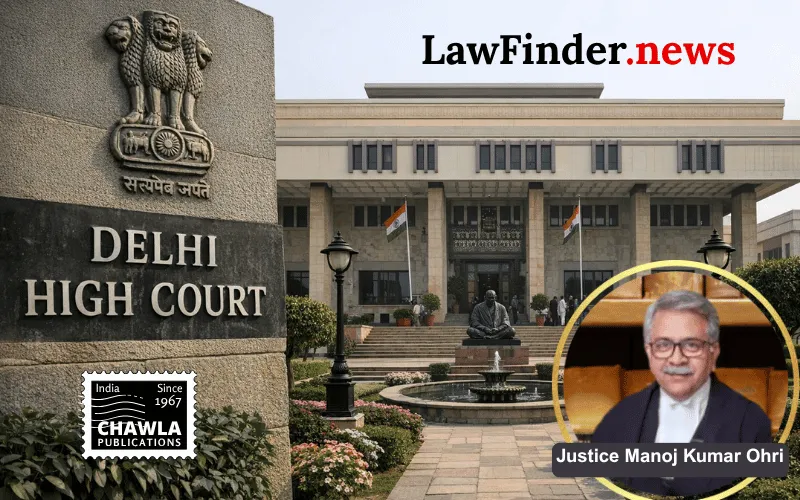
In a significant judgment delivered on August 24, 2026, the Delhi High Court, presided by Justice Manoj Kumar Ohri, allowed an appeal challenging the dismissal of an application to set aside an ex-parte decree. The case, Nirmaljeet Singh v. Guljeet Singh and Ors., revolved around the issue of service of summons through electronic means—specifically via WhatsApp—and whether such service could be deemed valid without proof of actual notice to the defendant.
The original suit filed by respondent Guljeet Singh sought damages and injunctions concerning unauthorized construction and encroachment issues at a property located in West Patel Nagar, New Delhi. The appellant, Nirmaljeet Singh, arrayed as defendant No.1, did not appear before the trial court, allegedly due to non-receipt of summons which were sent electronically during the COVID-19 pandemic.
The trial court had proceeded ex-parte against the appellant based on service of summons reported through WhatsApp on a mobile number linked to him. However, the process server’s report noted that the call was answered by a third person, Amarjeet Singh, who claimed to be a relative and accepted to pass on the summons. The appellant denied ever receiving the summons or having knowledge of the suit until 2025, when he came across documents circulated on WhatsApp by respondent No.2.
The appellant filed an application under Order IX Rule 13 of the Code of Civil Procedure, 1908 (CPC) seeking to set aside the ex-parte decree. The trial court dismissed the application as barred by limitation and found the WhatsApp service sufficient. On appeal, the Delhi High Court scrutinized the issue of service, underscoring that mere transmission of summons to a mobile number, especially when answered by a third person, does not conclusively establish service. The Court emphasized that actual notice to the defendant is crucial, particularly in cases of disputed service.
Relying on precedents from the Supreme Court including G.P. Srivastava v. R.K. Raizada (2000) and Parimal v. Veena @ Bharti (2011), the Court reiterated that "sufficient cause" under Order IX Rule 13 must be interpreted to advance substantial justice. The Court noted that depriving the defendant of the opportunity to contest the suit on questionable service would be unjust.
Consequently, the Court set aside the trial court’s order dismissing the application, allowed the application to set aside the ex-parte decree, and restored the appellant’s right to contest the suit. It also imposed costs of Rs. 20,000 on the appellant to be paid to respondent No.1. The Court further directed that the amount released in favor of respondent No.1 shall remain deposited with the trial court pending further orders.
This judgment underscores the judiciary’s cautious approach towards accepting electronic modes of service without proper proof of actual receipt, reinforcing procedural fairness and the right to be heard, especially during the pandemic-induced adaptations in court procedures.
Bottom Line:
Order IX Rule 13 CPC - Application to set aside an ex-parte decree - Mere service of summons via electronic mode (WhatsApp) without proof of actual notice to the defendant is insufficient to establish due service.
Statutory provision(s):
Order IX Rule 13 CPC, Civil Procedure Code, 1908
Nirmaljeet Singh v. Guljeet Singh, (Delhi) : Law Finder Doc Id # 2970163