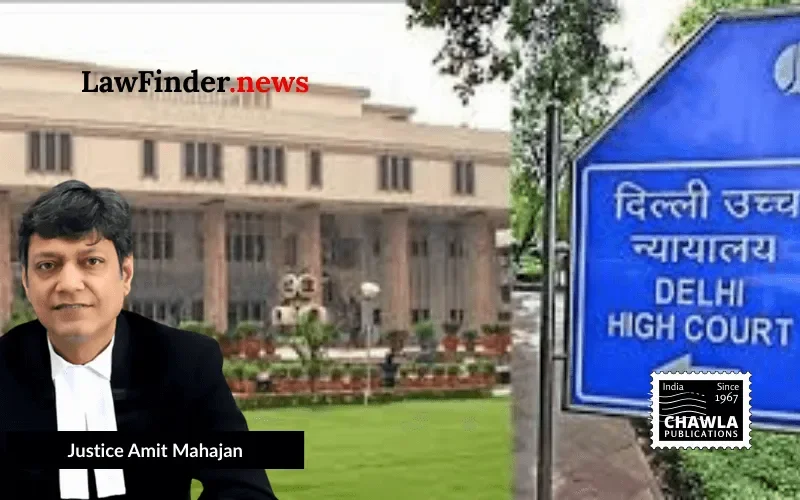
Court holds that formulation of regulations for airline staff misconduct lies within policy domain of competent authorities; civil and criminal remedies remain available for aggrieved passengers
In a recent judgment dated November 3, 2026, the Delhi High Court, presided over by Justice Amit Mahajan, dismissed a writ petition filed by Mrs. Shalini Tiwari seeking directions to the Ministry of Civil Aviation and Directorate General of Civil Aviation (DGCA) to frame rules and establish a complaint redressal mechanism specifically addressing misconduct and harassment by airline personnel against passengers.
The petitioner alleged that while contacting IndiGo Airlines’ customer care, she was subjected to vulgar and abusive language from an airline executive. Despite repeated representations to the airline and regulatory authorities, she contended that no meaningful disciplinary action was taken against the errant employee. She further highlighted a regulatory gap wherein Civil Aviation Requirements (CARs) provide robust mechanisms to deal with passenger misconduct but lack corresponding provisions for airline personnel misconduct.
Mrs. Tiwari sought directions for the government to formulate and incorporate detailed rules, regulations, and guidelines into existing CARs to cover such misconduct by airline staff. She also prayed for the establishment of a transparent, time-bound complaint redressal mechanism and disciplinary framework for airline personnel, along with an inquiry and action against the respondent airline for the incident in question.
The Court noted that the petitioner had earlier filed a petition which was disposed of with a direction to the DGCA to treat the representation and dispose of it within 30 days. Upon review, the DGCA communicated that the grievance had already been addressed by the airline with corrective and preventive measures.
Justice Mahajan emphasized that the framing of rules and regulatory guidelines is a policy matter entrusted to the competent authorities and not subject to judicial direction under Article 226 of the Constitution. The absence of a specific mechanism for airline personnel misconduct in CARs does not justify judicial interference. The existing mechanism for passenger misconduct primarily aims to safeguard airport and flight safety, whereas misconduct by airline personnel can be addressed through civil and criminal remedies available under law.
The Court further clarified that it cannot compel the government to enact regulations simply because a petitioner deems it necessary. Exercising extraordinary jurisdiction under Article 226, the Court found no exceptional circumstances warranting intervention in the present case.
Consequently, the petition was dismissed, with the Court leaving open the option for the petitioner to pursue appropriate legal remedies if dissatisfied with the airline’s internal actions.
This judgment reaffirms the principle that regulatory rule-making is a policy domain prerogative, while courts provide a forum for adjudication of grievances through existing legal mechanisms rather than direct rule formulation.
Bottom Line:
Article 226 - High Court cannot direct Government or regulatory authorities to frame rules, regulations or specific complaint-redressal mechanisms in policy domain merely because petitioner considers it necessary - Misconduct by airline personnel can be pursued through appropriate civil/criminal remedies - Where earlier representation was considered and authority noted grievance had been addressed by airline, no further direction for action against airline was warranted.
Statutory provision(s): Article 226, Constitution of India; Civil Aviation Requirements (CARs)
Shalini Tiwari v. Union of India, (Delhi) : Law Finder Doc Id # 3011714