Court affirms penalty related to 446 fake LPG connections based on investigation but strikes down penalty relating to 380 unverified connections due to lack of evidence, applying doctrine of severability.
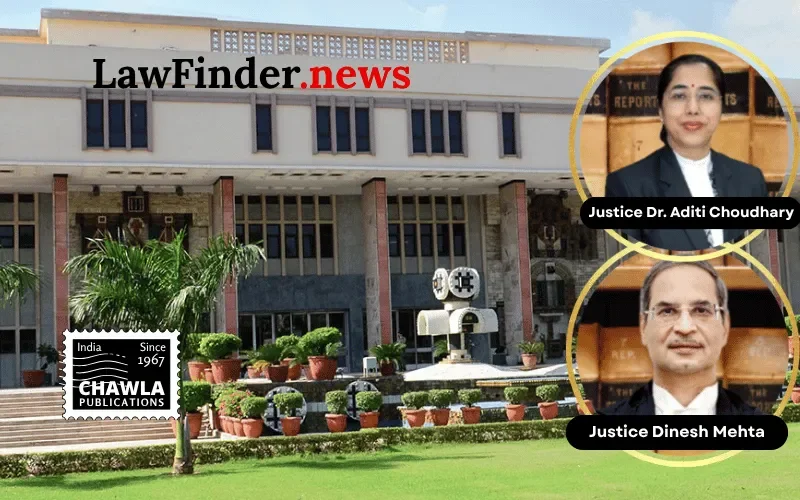
In a significant judgment delivered on July 1, 2026, the Delhi High Court (Division Bench comprising Justices C. Hari Shankar and Om Prakash Shukla) partially upheld an arbitral award imposing penalties on an LPG distributor, D V Anand, for alleged fake LPG connections but struck down a portion of the penalty related to unverified connections. The dispute arose between D V Anand (Appellant), an LPG distributor operating under Hindustan Petroleum Corporation Ltd. (Respondent), under a dealership agreement dated October 31, 2013.
Background:
The controversy centered around allegations of 826 fake LPG connections in the distributor’s records, triggered by a complaint in January 2014. The Respondent conducted investigations including sending verification letters to 387 addresses from the alleged fake connections; all letters were returned undelivered. A physical verification by officials also failed to locate many consumers. Consequently, a Show Cause Notice (SCN) was issued followed by imposition of a penalty amounting to Rs. 2.24 crore under the Marketing Disciplinary Guidelines (MDG), 2014.
The Appellant challenged the penalty through arbitration initiated in 2014, with the Sole Arbitrator appointed prior to the Arbitration and Conciliation (Amendment) Act, 2015. The arbitrator upheld the penalty and counter-claim of over Rs. 2 crore, rejecting the Appellant's claims for damages and costs. The Appellant’s subsequent petition under Section 34 of the Arbitration and Conciliation Act, 1996, was dismissed by a Single Judge of the Delhi High Court in 2018.
Key Legal Issues and Court Findings:
1. Eligibility of Arbitrator: The Appellant argued the arbitrator was ineligible post-2015 Amendment Act because he was an employee of the Respondent. The Court disagreed, holding that since arbitration proceedings commenced before the amendment’s commencement (October 23, 2015), the unamended Act applied, referencing Supreme Court precedents including Board of Control for Cricket in India v. Kochi Cricket Pvt. Ltd. and Rajasthan Small Industries Corpn. Ltd. v. Ganesh Containers Movers Syndicate.
2. Scope of Interference in Arbitration Appeals: The Court reiterated that under Section 37 of the Arbitration Act, appellate interference is limited to grounds under Section 34, and courts cannot re-appreciate evidence or substitute their view for that of the arbitrator unless there is a jurisdictional error or patent illegality.
3. Findings on Fake Connections: The Court divided the 826 alleged fake connections into two sets:
- Set I: 446 connections subjected to investigation, with particulars disclosed to the Appellant.
- Set II: 380 connections neither investigated nor disclosed to the Appellant.
The Court upheld the arbitrator’s findings regarding Set I connections, noting that the Appellant admitted data manipulation by ex-employees and failed to prove the genuineness of these connections despite the investigation evidence (letters returned undelivered, physical verification). The burden of proof shifted to the distributor under the Dealership Agreement to maintain accurate consumer records.
However, the Court found the arbitrator’s findings on Set II connections to be patently illegal and perverse because no evidence or particulars were provided to the Appellant, and no investigation was conducted. The arbitrator impermissibly shifted the burden of proof to the Appellant without disclosing these connections’ identities, violating principles of natural justice.
4. Doctrine of Severability and Modification of Award: Referring to the Supreme Court’s decision in Gayatri Balasamy v. ISG Novasoft Technologies Ltd. and subsequent cases, the Court applied the doctrine of severability. It allowed partial enforcement of the penalty related to the 446 verified connections while setting aside the portion of the award related to the 380 unverified connections.
The penalty components were analyzed as follows:
- The first component (Rs. 3,15,472) for the first instance of critical irregularity was upheld.
- The second component (Rs. 41,30,000) at Rs. 5,000 per fake connection was proportionally reduced to Rs. 22,30,000 corresponding to 446 connections.
- The third component (Rs. 1,64,81,665) related to unaccounted sales/refills, based on all 826 connections collectively, was set aside as it was inseparable and unsupported by evidence for the 380 connections.
5. Patent Illegality and Natural Justice: The Court underscored that arbitral awards can be set aside on grounds of patent illegality where decisions are perverse or without any evidentiary basis. The arbitrator’s failure to consider vital evidence (letters from the Appellant requesting particulars of all 826 connections) rendered the findings on the 380 connections unsustainable.
Conclusion:
The Delhi High Court partly allowed the intra-court appeal by modifying the arbitral award and the Single Judge’s judgment. The penalty is sustained only to the extent of Rs. 25,45,472 (comprising the first component and proportionate amount for 446 connections). The balance penalty relating to unverified 380 connections and unaccounted sales/refills is set aside.
The judgment reinforces the limited scope of judicial interference in arbitration, the necessity of evidence-based findings, and the importance of procedural fairness, especially in shifting burdens of proof. It also clarifies the applicability of the 2015 Amendment Act in arbitration proceedings commenced prior thereto.
Bottom line:-
Arbitration and Conciliation Act, 1996 Section 37 appeal against dismissal of Section 34 petition challenging arbitral award - Scope of interference limited to grounds under Section 34 - Court cannot re-appreciate evidence - Award upheld if based on plausible view of material on record.
Statutory provision(s): Arbitration and Conciliation Act, 1996 Sections 12(5), 21, 26, 34, 37; Arbitration and Conciliation (Amendment) Act, 2015 Section 12(5); Commercial Courts Act, 2015 Section 13; Code of Civil Procedure, 1908 Section 151.
D V Anand v. Hindustan Petroleum Corporation Ltd., (Delhi)(DB) : Law Finder Doc id # 2933699