Court says mercy powers under Article 72 can validly impose life imprisonment for remainder of natural life without remission; rejects challenge based on delay and Article 21.
The Delhi High Court has dismissed a writ petition filed by death-row convict Jitendra alias Jitu Nainsingh Gehlot, challenging the President of India’s decision to commute his death sentence to life imprisonment with a condition that he remain in prison for the rest of his natural life without any remission.
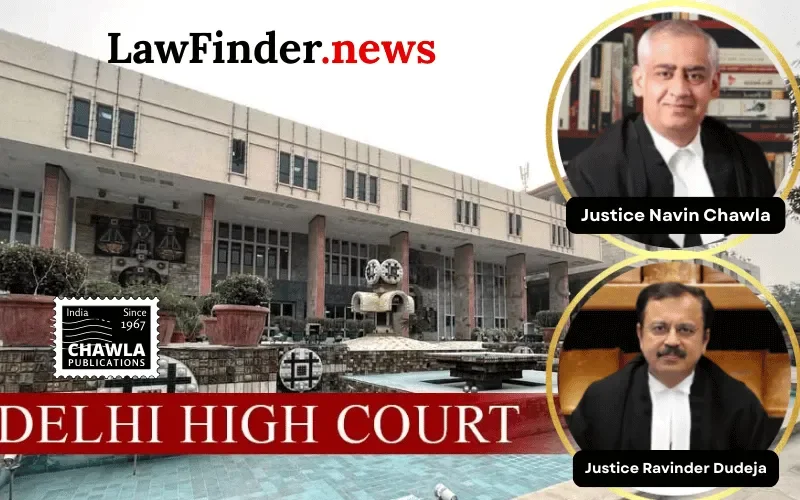
A Division Bench of Justice Navin Chawla and Justice Ravinder Dudeja held that the President’s clemency power under Article 72 of the Constitution is constitutionally valid and distinct from statutory remission powers. The Court said the President can commute a death sentence to life imprisonment while also directing that the convict shall not be released for the remainder of his natural life.
The petitioner had argued that the condition barring remission was unconstitutional and that the long delay of more than 15 years in deciding his mercy petition violated Article 21. He also claimed that the President failed to consider relevant materials and that the condition amounted to a form of slow death with no hope of rehabilitation.
Rejecting these submissions, the Court reiterated that judicial review over a clemency order is extremely limited. It is not the decision itself, but only the manner in which the power was exercised, that can be examined. The Court said interference is possible only if the order is shown to be mala fide, arbitrary, based on irrelevant considerations, or passed without application of mind.
The Bench noted that the President was aware of the delay in disposal of the mercy petition and had specifically sought the opinion of the Attorney General on the applicability of the Supreme Court’s ruling in Shatrughan Chauhan. The Attorney General had advised commutation on the ground of delay, but the Home Ministry recommended rejection. The President ultimately chose to commute the sentence while imposing the “remainder of natural life” condition.
The Court held that this course was within constitutional bounds, especially in view of Supreme Court precedent recognising that life imprisonment means imprisonment for the rest of the convict’s natural life unless remitted by competent authority. It further observed that the President had considered all relevant inputs before making the decision, and therefore the High Court could not substitute its own view.
The case arose from one of Pune’s most brutal crimes, involving the murder of seven persons, including five women and two children, during a robbery in 1994. The petitioner was convicted under multiple provisions of the Indian Penal Code, and both the Bombay High Court and the Supreme Court had upheld the death sentence before the mercy petition was eventually commuted.
Dismissing the petition, the High Court said there was no merit in the challenge and upheld the President’s conditional commutation order.
Bottom Line:
Judicial review of the President's decision under Article 72 of the Constitution of India is limited to examining the manner of exercise of power, not the decision itself. President's power extends to imposing life imprisonment for the remainder of natural life without remission.
Statutory provision(s): Article 21 of the Constitution of India, Article 72 of the Constitution of India, Article 161 of the Constitution of India, Article 226 of the Constitution of India, Article 32 of the Constitution of India, Section 432 of the Code of Criminal Procedure, 1973, Section 433A of the Code of Criminal Procedure, 1973, Section 482 of the Code of Criminal Procedure, 1973, Sections 302, 120B, 397, 449, 342, 34 of the Indian Penal Code, 1860
Jitendra @ Jitu Nainsingh Gehlot v. Union of India, (Delhi)(DB) : Law Finder Doc id # 3129627